
12 chapters · 1 interactive timeline · 16 images · 49 sources
- What this is about
- Brutus at the Technik Museum Sinsheim: a chassis from 1907, an aero engine from around 1930 and a body from 2006
- Engine
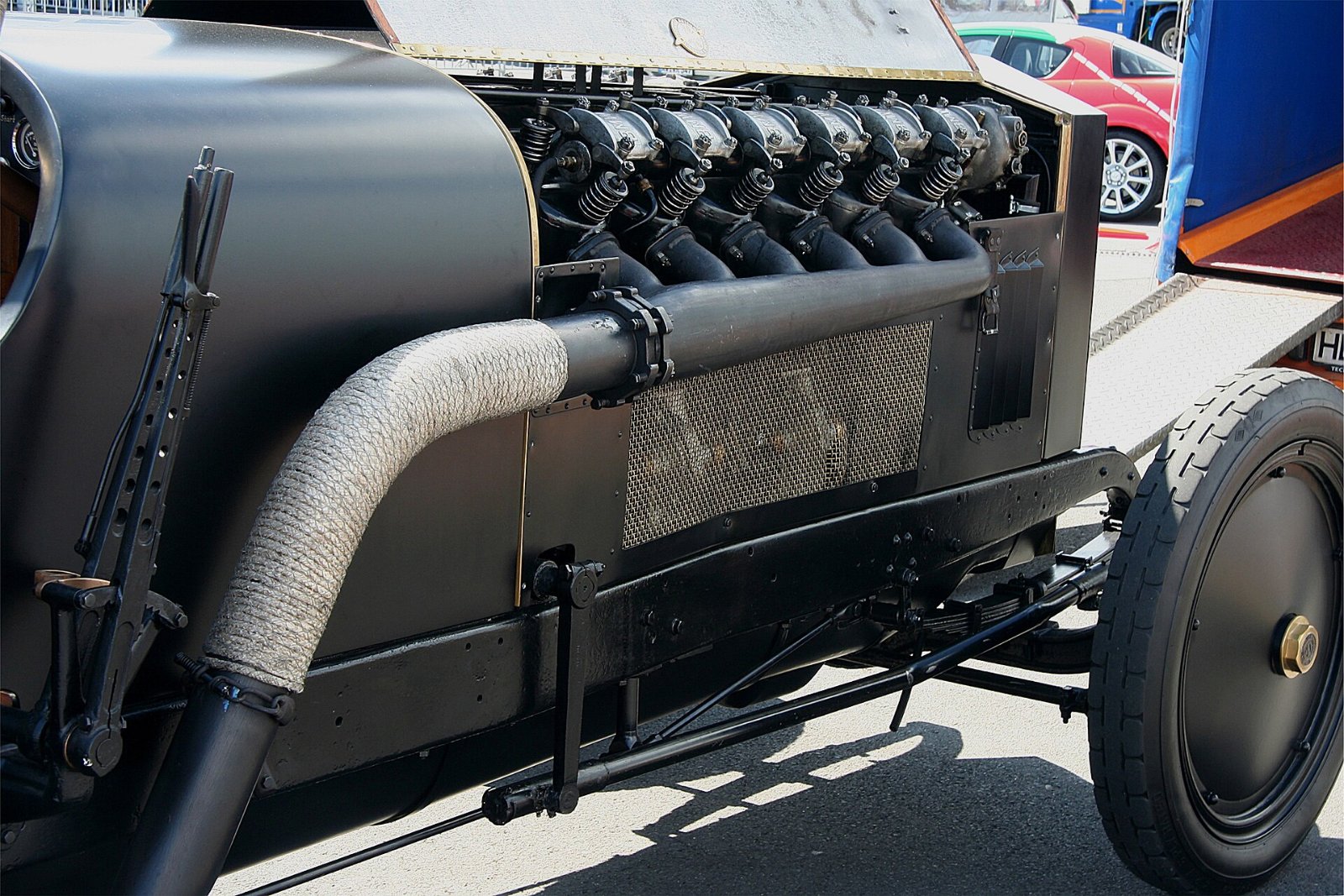
- BMW VI, series 8. Water-cooled V12 with a 60-degree bank angle, 46,930 cc, 510 kilograms dry
- Power
- The museum says 500 to 750 hp, which makes it the most honest source here. Individual figures run from 490 to 750 — chapter 3 explains why
- Brakes
- Rear axle only. Nothing at the front. And next to no engine braking
- Fastest documented run
- About 200 km/h, Roger Collings, Bosch proving ground at Boxberg, 2007 and 2008
- The hardest finding
- The museum dates its own engine wrongly — and the error has travelled from there into the international press (chapter 4)
- As things stand
- Anyone visiting Sinsheim in autumn 2026 will see Brutus without its engine. It is away being overhauled
Brutus exists only because somebody was twenty-two litres out. The twelve-cylinder that a club member had turned up in a Spanish scrapyard was meant to sit on a stand at Sinsheim and be looked at. Only when the museum’s mechanics took it apart during a four-year overhaul and did the arithmetic did it turn out that the estimated twenty-five litres were in truth almost forty-seven. At which point Hermann Layher, who runs the place, decided that you do not build a plinth around an engine like that. You build a car. Twenty-two litres of error.

I laid seventy-seven sources side by side for this article, and the result is remarkable. Brutus is a superbly photographed and miserably documented vehicle. There are pictures from every angle, videos of the cold start and reports in four languages — and seven different capacities. Seven. Ten different power figures and three different weights. If you want to know how many numbers a single car can have, you have come to the right place. So this article is not only about a vehicle. It is about what happens to numbers when they get copied often enough.
A note on units. Power is given in the German fashion, in PS, written here as hp. One PS is 0.986 British horsepower, so the difference hardly matters at these outputs.
A car built out of a miscalculation
The most interesting sentence in the whole origin story sits in a subordinate clause. A member of the museum’s club found the engine in a Spanish scrapyard, where it had lain for decades. The museum traded it from a collector for another aero engine, one that had come out of a Messerschmitt Bf 109. Not a purchase, then, but a swap — and at first the only plan was to tidy the thing up and put it on show. The surprise came during the general overhaul, which took four years, and the exhibit turned into a vehicle project.
„At first the engine was only to be displayed as a museum piece. During the four-year technical overhaul it emerged that the original estimate of about 25 litres was considerably below the actual figure.“
That passage comes from the German Wikipedia, which cites the Motor Klassik article by Hans-Jörg Götzl of 12 July 2009 and the museum’s own text. Since the museum PDF is by the same author, that is two sources with one writer. The story is therefore not independently confirmed. It remains an account from close to the museum, and I say so here because it is too good to pass on unchecked.
Everything else about where the engine came from rests on spoken recollection too. Who found it depends on which source you read: a club member in one, Layher himself in another. The museum’s mechanic Manfred Fink told Classic Driver the engine had lain in a scrapyard for more than fifty years and came from an aircraft of the Spanish Civil War. A place, a year, the collector’s name, an engine number, a receipt, a customs document: none of it did I find. I looked specifically.
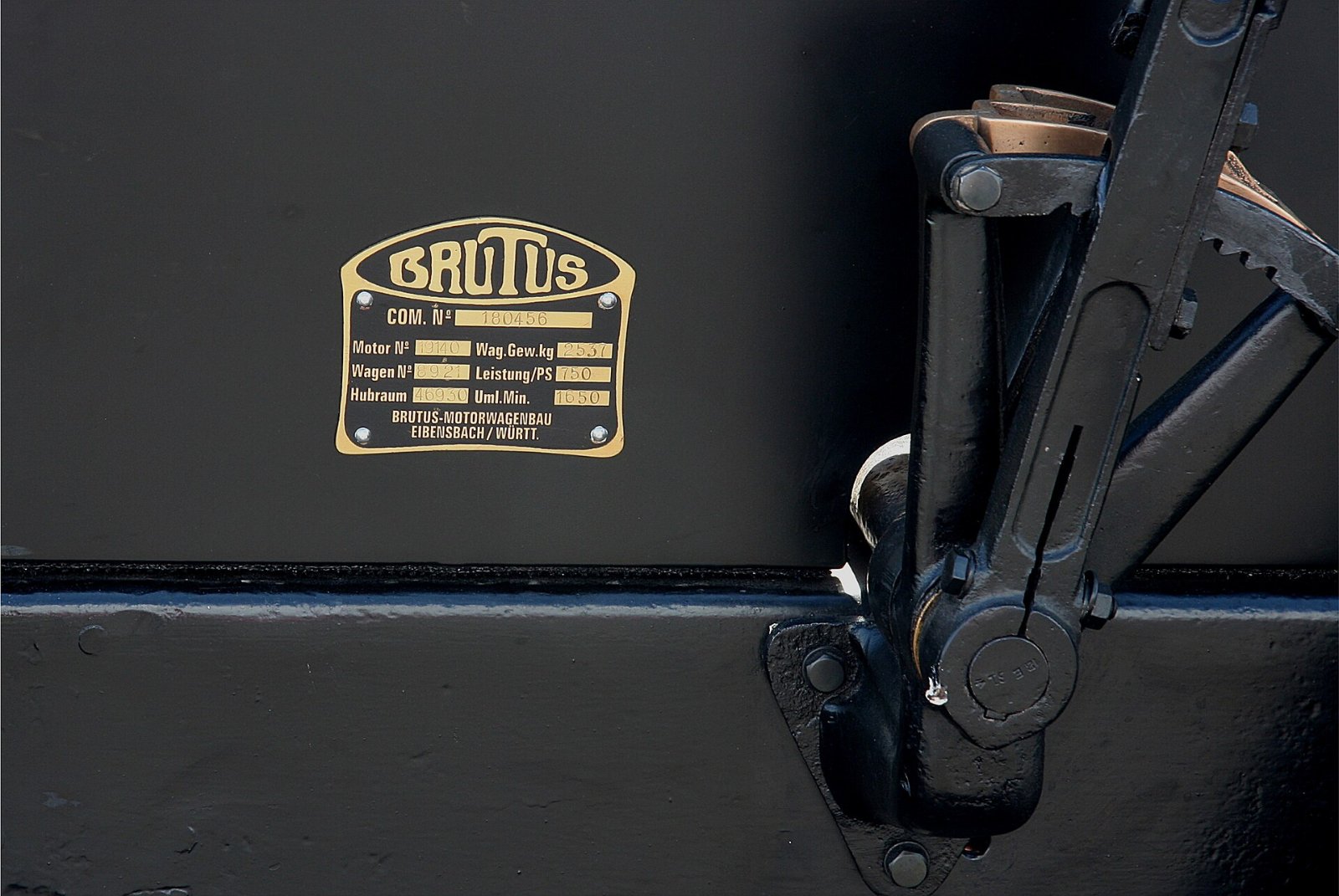
Layher did not choose the name to play the thing down. It points at Caesar’s assassin, and he uses the allusion openly: Brutus is „certainly the most dangerous vehicle in the world, and always out to kill its driver, meaning its boss“. After the first test run he said something that appears in the museum’s own publication, and I think it is the most honest line in all the material.
The car frightens me. It is dangerous — whatever you do with it.
Hermann Layher, director of the Technik Museum Sinsheim
A second reading comes from the specialist blog dermotor.de: the Latin brutus also means heavy, dull, unreasoning. Whether that played any part at the christening, no source says. It sounds like a reading that came along later. It is a fine one all the same.
46,930 cubic centimetres, and the cylinders are not the same size

Seven capacities are in circulation: 46 litres, 46.9, 46.92, 46.93, 46,899.9 cc, 46,920 and a round 47,000. They all describe the same engine, and the reason for the awkward number is a layout you rarely meet now. The twelve cylinders do not share the same stroke.
The BMW VI uses master and articulated connecting rods. Each crankpin carries a master rod, and the rod from the opposite bank is hinged to its side rather than running on the same pin. That saves length and weight, and it has a consequence. The articulated rod traces a different circle from the master rod, so its piston travels a different distance. The right bank works with a 199-millimetre stroke, the left with only 190.
The check, cylinder by cylinder. A cylinder’s swept volume is piston area times stroke. The area follows from the bore: at 160 millimetres that is 201.06 square centimetres.
201.06 cm² × 19.0 cm = 3,820 cm³ (left bank)
201.06 cm² × 19.9 cm = 4,001 cm³ (right bank)
6 × 3,820 + 6 × 4,001 = 46,926 cm³
The museum says 46,930 cc. The sum lands four out, which on an engine this size is nothing. What it means in practice: the explanation with the unequal strokes holds. Write 46 litres and you are rounding down, write 47 and you are rounding up. The exact figure is 46.9.
That settles the first of the three big contradictions. The other two stay standing. That is the more honest part of this article.
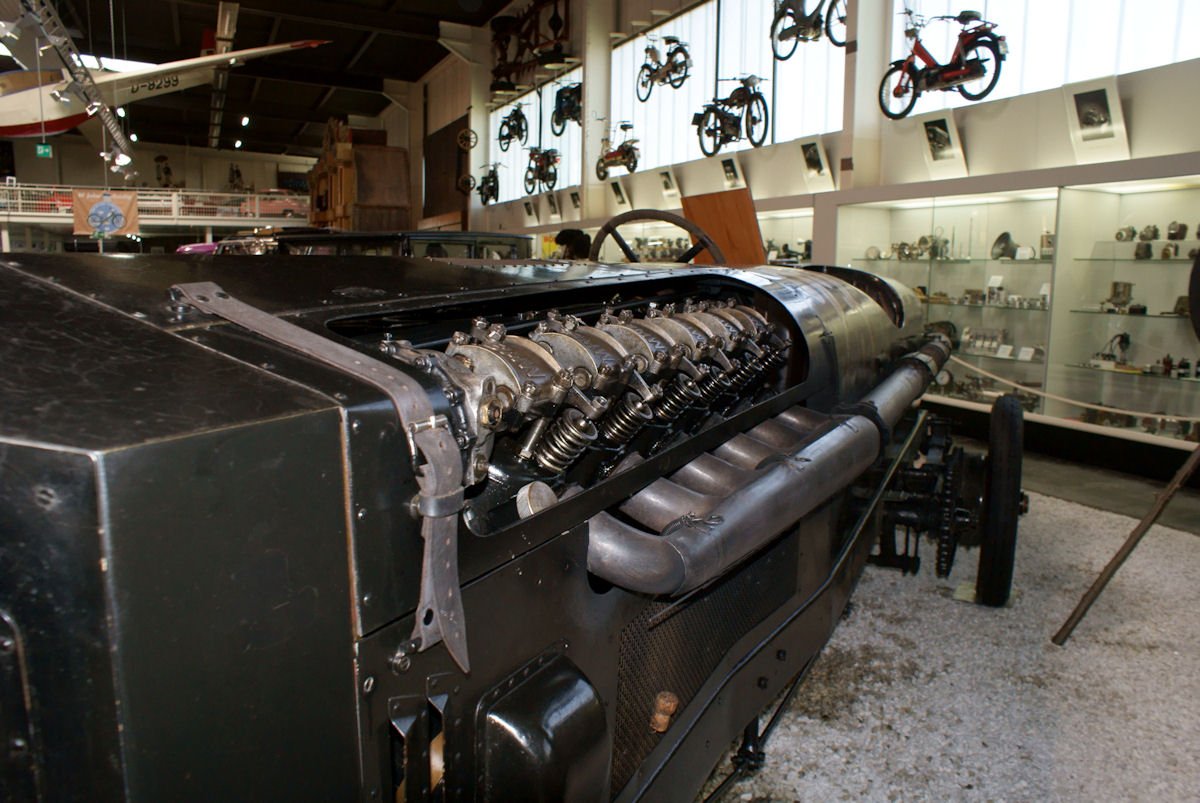
Ten power figures, and all of them are right
Power is where it gets tangled, so I have set the figures side by side without averaging them. An average here would fake a precision the material simply does not hold.
| Power | Speed | Kind of rating | Source |
|---|---|---|---|
| 750 hp | 1,650 rpm | Peak | Wikipedia (de) |
| 750 hp | 1,700 rpm | Short-term | Museum text, aviation literature |
| 750 hp | 1,750 rpm | Maximum | evocars |
| 750 hp | below 1,500 rpm | Given in an interview | Classic Driver |
| 680 hp | — | Exhibit label | Deutsches Museum |
| 585 hp | — | Continuous | dermotor.de |
| 550 hp | 1,530 rpm | Continuous | six sources |
| 500 hp | 1,485 rpm | Continuous | dewiki |
| 490–550 hp | 1,530 rpm | Standard conditions | Wikipedia (en) |
| 500–750 hp | — | Range | Technik Museum Sinsheim |
The key is the sub-type, because the BMW VI was built with three compression ratios: 5.5 giving 600 to 650 hp, 6.0 giving 630 to 660, and 7.3 giving 680 to 750. Add the difference between short-term and continuous ratings, and finally the altitude at which the measurement was taken — one source states its 680 hp expressly for 4,000 metres. Every one of these numbers can be right in itself. It only becomes wrong the moment somebody writes it down without the condition that goes with it.
What leaves the matter finally open: the Brutus engine is an example of series 8. Which compression ratio that series used I found in no source — not in the aviation literature, and not in the register of surviving handbooks, which lists series 3/4, 6/7 and 8/9. While that stays open, there is no saying which power figure can apply to this one engine at all. The museum’s range is therefore the soundest answer, and that is unusual. Usually the museum figure is the prettiest one. Here it is the most careful.
Torque is worse, though it looks orderly at first. Three sources give 3,200, 3,728 and 3,730 newton metres, which agree with each other and fit the power. Two others give 10,000 newton metres, and working back from 750 hp at 1,700 rpm lands you at about 3,100. The ten thousand is therefore not a variant but a mistake that has wandered from one blog to the next. I list it only so that somebody notices it the next time it gets copied.
It idles at 400 revolutions a minute. A modern car engine sits at 700 to 800. With twelve cylinders on a four-stroke cycle, 400 rpm is about forty firings a second — close enough together that the ear still separates them. You do not hear a note. You hear blows.
Two more numbers I did not expect to find. The first: the engine carries twenty-four spark plugs, two a cylinder, which is standard on piston aero engines, because one whole ignition system may fail without stopping the engine. The second: BMW built around 9,200 of these engines, the Soviet Union over 27,000 under licence. By the numbers, Germany’s best-known aero engine of the interwar years is a Soviet one.
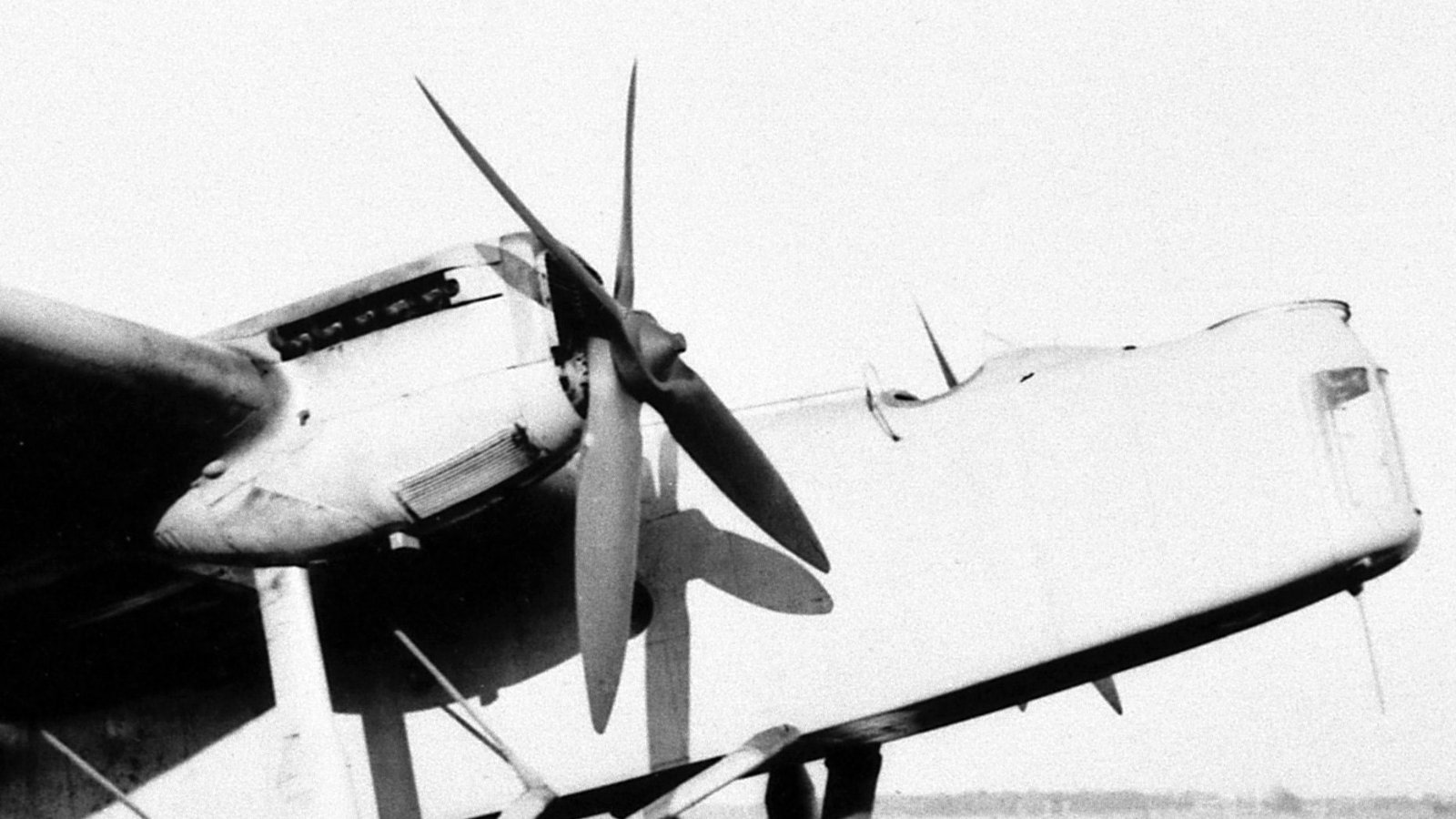
The museum dates its own engine wrongly
The exhibit page of the Technik Museum Sinsheim says Brutus has a „12-cylinder BMW aero engine from the First World War“, designed „for heavy bombers in the First World War“. The English page says the same, and neither will hold.
The BMW VI first ran in 1926. Type approval came in February of that year and production started in the same year. Max Friz had begun the work in 1924 — eight years after the First World War ended. BMW’s war engine was the six-cylinder BMW IIIa, also drawn by Friz. It was an entirely different engine: in line rather than a vee, six cylinders rather than twelve, about 19 litres rather than forty-seven.
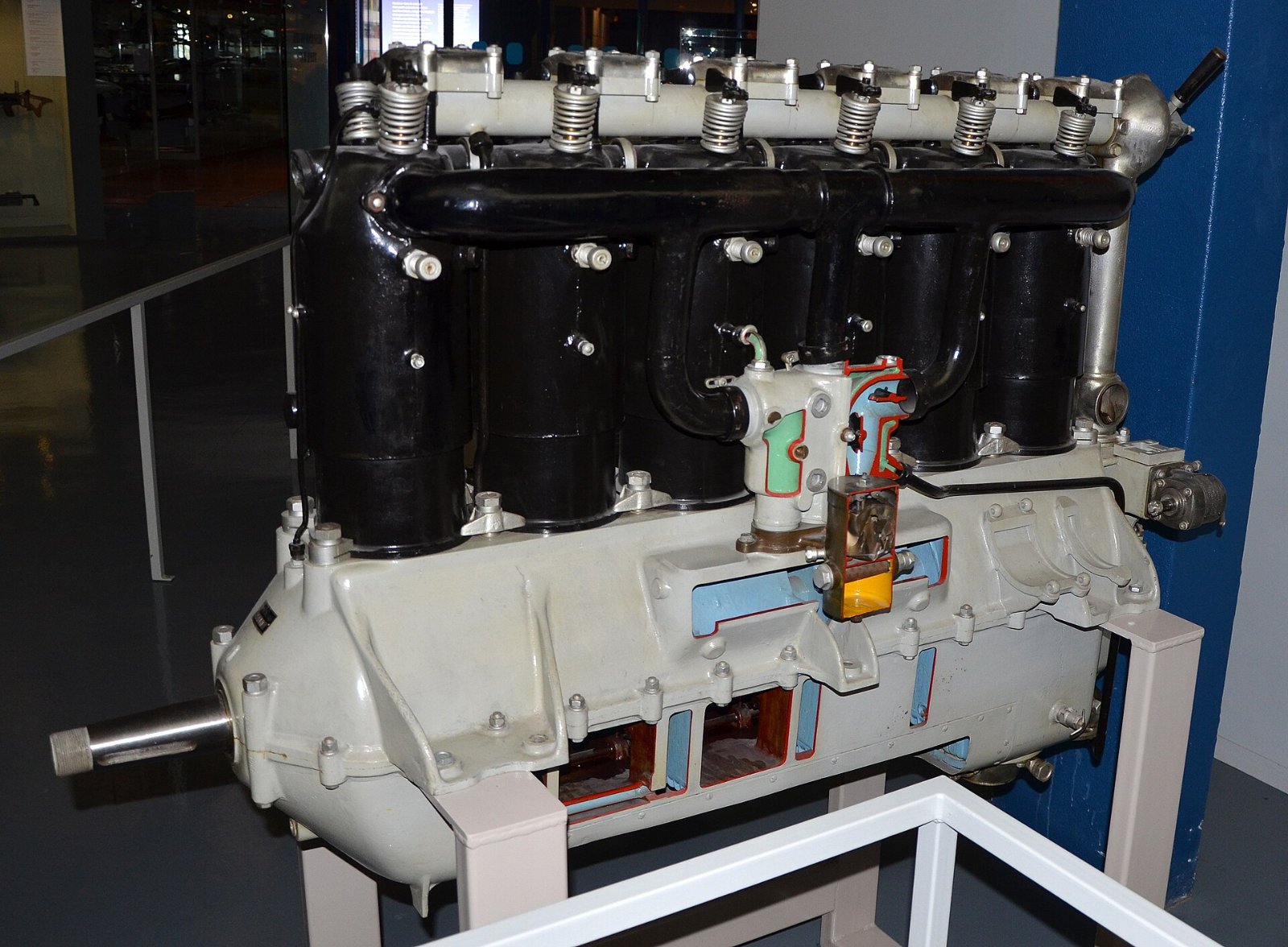
The error has not stayed harmless. It has travelled from the museum’s page into the press and been repeated there word for word. The most recent case was Italy in 2022, for the appearance at Padua: the engine had been used on Germany’s heavy bombers of the First World War. The 360-degree panorama shot inside the museum in 2016 speaks of a BMW aero engine from the First World War too. That is how a false statement works. It needs no malice, only a source people trust.
The heart of it is right all the same. Just one war later. The Treaty of Versailles of 1919 forbade Germany an air force, and surplus aero engines ended up in racing cars. That is exactly where the breed Brutus belongs to came from. Only the BMW VI is not an engine from that surplus. It is an engine of rearmament, built from 1926, in a period when Germany was officially building aero engines again for civil aviation. That is the finer story. It is also the more interesting one.
A fire engine chassis from the very first year
Under the engine lies a chassis that was never meant for speed. It came from American LaFrance of Elmira, New York, a maker of fire apparatus whose roots reach back to 1832 and which became the American LaFrance Fire Engine Company in 1903. One sentence from the company history settles where this chassis stands: the first motorised fire engine left the works in 1907. A chassis from 1907 or 1908 therefore belongs to the very first series. There is no earlier.
Whether it was 1907 or 1908 cannot be decided. The museum page and the museum text say 1907, the German Wikipedia and the Traumautoarchiv say 1908, and the English sources mostly write „1907/1908“. There is no chassis number, no photograph of a plate, no registration. Nor does anyone know which fire brigade owned it, how it reached Germany, or whether it was complete when acquired.
There is, however, a comparison piece, and it stands in the same building. The museum owns a second early American LaFrance, the Funkenblitz, built 1907, 9.5 litres, 95 hp. Its description lists what this chassis generation came with: drive by two chains to a live rear axle, no front brakes, an external contracting handbrake and an internal expanding footbrake at the rear. Whether Brutus carries the same brakes, no source says. It is likely, but not documented. The Funkenblitz, incidentally, ran the 1997 Peking to Paris rally and at ninety years old was the oldest vehicle in the field.
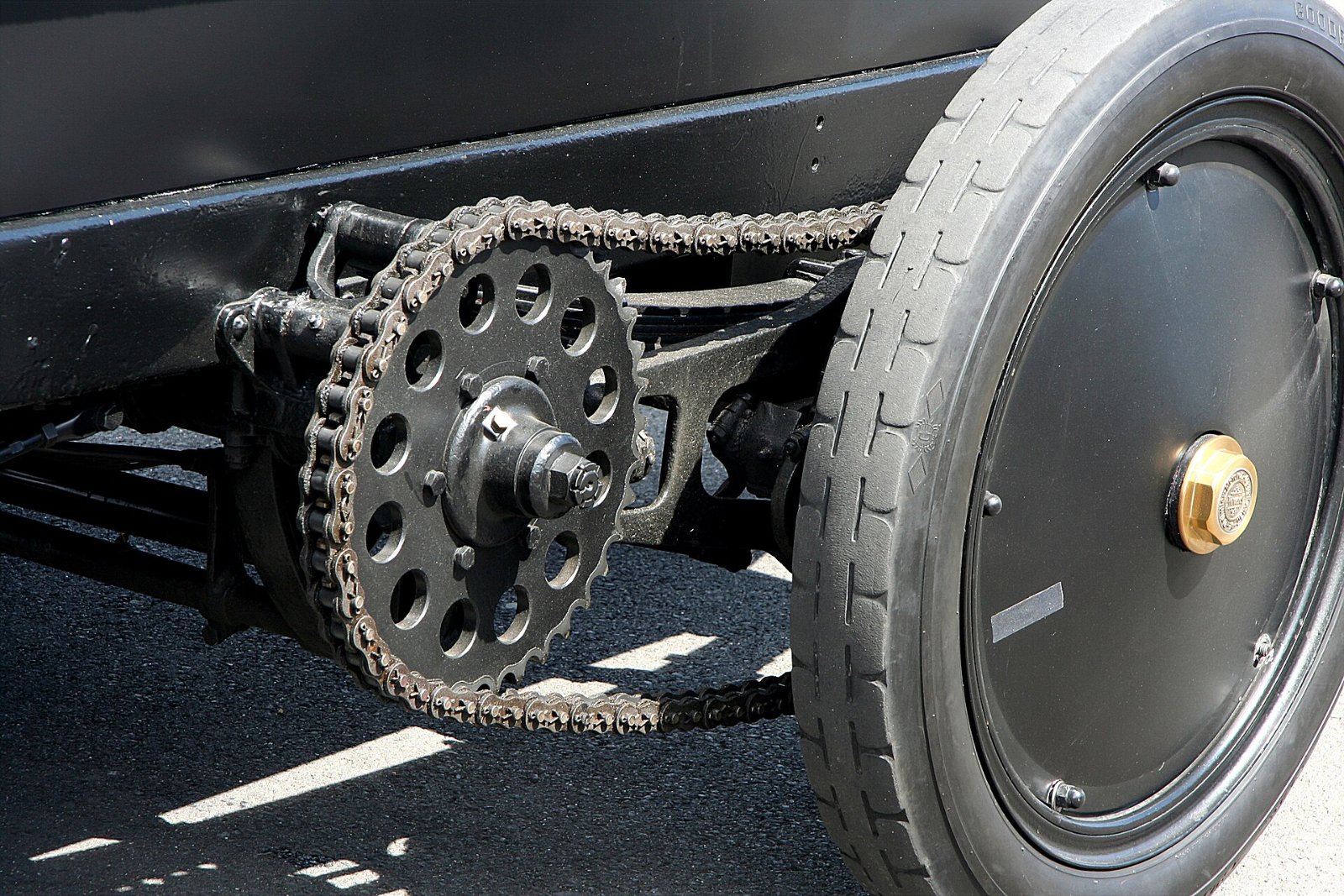
On the brakes, for once, every source agrees, and the answer is uncomfortable. Braking happens at the rear only. At the front there is nothing. The museum’s own text calls the braking effect „negligible“, while a specialist blog speaks of minimal retardation in relation to the power. No figure for a stopping distance exists in any of the seventy-seven sources. I looked. There is none.
Brutus has the drivetrain of an aircraft and the brakes of a 1907 fire engine. Between the two lie almost twenty years of development and roughly a factor of eight in power.
The route from piston to wheel
An aero engine is built for continuous full load at a steady speed. It has no gears, no torque converter for pulling away, and no useful engine braking, because in flight a propeller is turning with it anyway. Everything a car needs between engine and wheel therefore had to come from somewhere else. It came from the chassis.
- The BMW VI crankshaft, sitting low in the frame.
- An intermediate gearbox to match that low position — and expressly „usable in both directions of rotation“.
- Clutch, foot operated. Type and maker: not found.
- The original three-speed gearbox of the American LaFrance chassis, worked by an outside lever.
- Chain drive to the live rear axle.
Point two is easy to read past. It gives away more about the build than anything else. You need an intermediate gearbox that works either way round for one reason only: aero engines turn left or right depending on the type. Anyone building a driveline that does not care which way the engine turns has kept the option of fitting a different engine later. Which way the Brutus engine actually turns, no source says. That one is missing too.
What is missing altogether is engine braking, because this engine produces no useful drag. After filming with Deutsche Welle in October 2020, Layher decided Brutus needed a kill switch on the wheel to cut the ignition. The Blitzen-Benz two halls away already has one. Whether the switch has since been fitted I could not find out. My source stops on 9 December 2020.
Why 46.9 litres can be started by muscle
The starting procedure appears complete in one place only, the museum text, and it has five steps: pull the decompression lever, work the starter, bring compression back in, press the clutch, engage first. That sounds laborious. It is the only way to turn over an engine this size without a starter battery.
Brutus has an inertia starter, and it does not supply the energy so much as store it. A heavy disc is spun slowly up to high speed and then coupled to the crankshaft. A person working through a crank handle with the right reduction can put a surprising amount of energy into such a mass. Very large engines can be turned this way — the Daimler-Benz DB 605 was started in exactly the same fashion.
What the decompression lever is for. At 46.9 litres and a compression ratio of about 7:1, the starter would have to work against twelve compression strokes. The work that takes is the work released again at ignition — but it has to be put in first. The decompression lever holds the valves open so no pressure builds, and the engine turns almost without resistance. Only when the flywheel has its speed does compression come back in all at once.
In practice that means the starter never has to produce the torque twelve cylinders demand. It only has to have gathered enough energy to survive two or three turns under compression. This connection is my own, drawn from the museum text and the general description of an inertia starter — no source explains it this way for Brutus.
Whether the starter is wound by hand or spun up electrically, how long it takes, and whether starting fuel helps: none of that is written down either. From video at least the order can be heard — first a rising whine, which is the flywheel, then single explosions. The museum’s own story from 2020 notes drily that the start alarmed the whole neighbourhood.
What happens when you drive it

There is a report from the first day of testing. It reads like a snagging list. The acceleration is extreme. In corners the car pushes on at the front, and the chain-driven rear axle steps out on a stab of throttle. Engine heat reaches the cockpit unhindered, there being no bulkhead, and hot oil comes out of the open valve gear. After a change of driver the clutch burned out, which the report mentions so casually that it reads like the expected outcome.
The single most dangerous aspect sits almost in passing in one specialist blog: the pedals are the wrong way round. Clutch on the left, throttle in the middle, brake on the right — the historic arrangement, as it was before standardisation. Get out of any modern car, sit in Brutus, and in the moment of fright your braking foot is on the throttle. In a vehicle with no front brakes, that is not a detail.
| Speed | Circumstances |
|---|---|
| 100 km/h at 800 rpm | The design point of the gearing |
| 120–140 km/h | Normal running at demonstrations |
| 140 km/h | Third gear, wheels spinning, Speyer airfield |
| about 200 km/h | Roger Collings, Boxberg proving ground, 2007 and 2008 |
The 200 km/h run is the best documented single event in the car’s history, and it has a twist that two sources give independently. It was not the car that reached its limit, but the driver. Classic Driver puts it as Collings reaching his physical limit; Wikipedia records that test drivers credited the car with „considerable reserves“.
That Roger Collings of all people was at the wheel is no accident. The Englishman was president of the Vintage Sports Car Club from 1986 to 1990 and chairs the Aero-Engined Car Club. He won the VSCC Edwardian Trophy ten years running with a 1903 Mercedes 60 hp. In 1993 he built himself an aero-engined car: a Mercedes-Maybach with a 1916 airship engine, about 350 hp, good for 120 miles an hour. The man who drove Brutus to its limit had built one of his own first.

Why flames come out of the exhaust
On almost every video, flames shoot from the pipes at full load. The observation appears in four sources. The pipes are unshielded and the flames come out sideways. An explanation of why it happens I found in no source on Brutus. So here is the derivation from documented parts — expressly as a derivation, not a quotation.
The engine has two Zenith carburettors and no lambda control, and aero engines are run through a hand mixture control, with the full-load setting on rich. That has a purpose. The surplus fuel evaporates in the cylinder and cools the parts from inside. But rich also means more petrol in the cylinder than the available oxygen can burn — the right ratio would be about one to fifteen by mass.
The unburnt remainder leaves the cylinder when the exhaust valve opens. It is hot, and in the pipe it meets fresh air, at the open end at the latest. There it burns on, and that is what you see as flame. The pipes make it worse: on Brutus they are short and fat, so the exhaust has hardly any time to cool below ignition temperature on its way out. And lifting off after a full-load pull keeps mixture coming without clean ignition — the classic setting for backfires in the exhaust.

The breed: what happens when revs cannot rise
Brutus does not stand alone. It stands at the end of a line that exists for a purely technical reason. Car engines around 1910 managed at most some 3,000 revolutions, and power is torque times revolutions. Only one route was left: if the revs cannot rise, the capacity must. Large-capacity engines, though, existed only in aviation — first as a pre-war product, then in bulk as war surplus. Anyone who wanted to go fast bought an aero engine and built a car around it. There was no other way.

| Vehicle | Year | Capacity | Cylinders | Power | Engine from |
|---|---|---|---|---|---|
| Brutus | 1998–2006 | 46.9 l | V12 | 500–750 hp | BMW VI aero engine |
| Fiat S76 | 1910 | 28.4 l | Straight 4 | 290 hp | Fiat aero/airship engine |
| Chitty Bang Bang 4 / Babs | 1924 | 27.0 l | V12 | 450 hp | Liberty L-12 aero engine |
| Chitty Bang Bang 1 | 1921 | 23.0 l | Straight 6 | 245 hp | Maybach Mb.IVa aero engine |
| Fiat Mefistofele | 1923 | 21.7 l | Straight 6 | 320 hp | Fiat A.12 aero engine |
| Blitzen-Benz | 1909 | 21.5 l | Straight 4 | 200 hp | Benz car engine |
| Doktor Maybach (Sinsheim) | 1929 | 19.5 l | Straight 6 | 300 hp | Maybach aero engine of 1917 |
On capacity Brutus beats them all, and comfortably: the next largest, the Fiat S76, has a good sixty per cent of its volume. On speed actually achieved the ranking turns round. Babs ran 275.23 km/h at Pendine Sands in 1926 and took the land speed record. The Fiat Mefistofele reached 234.98 km/h at Arpajon in 1924 — the last land speed record set on a public road. The Blitzen-Benz managed 228.1 km/h at Daytona in 1911. Brutus stands at about 200, driven on a closed proving ground, without timing. Without any claim.
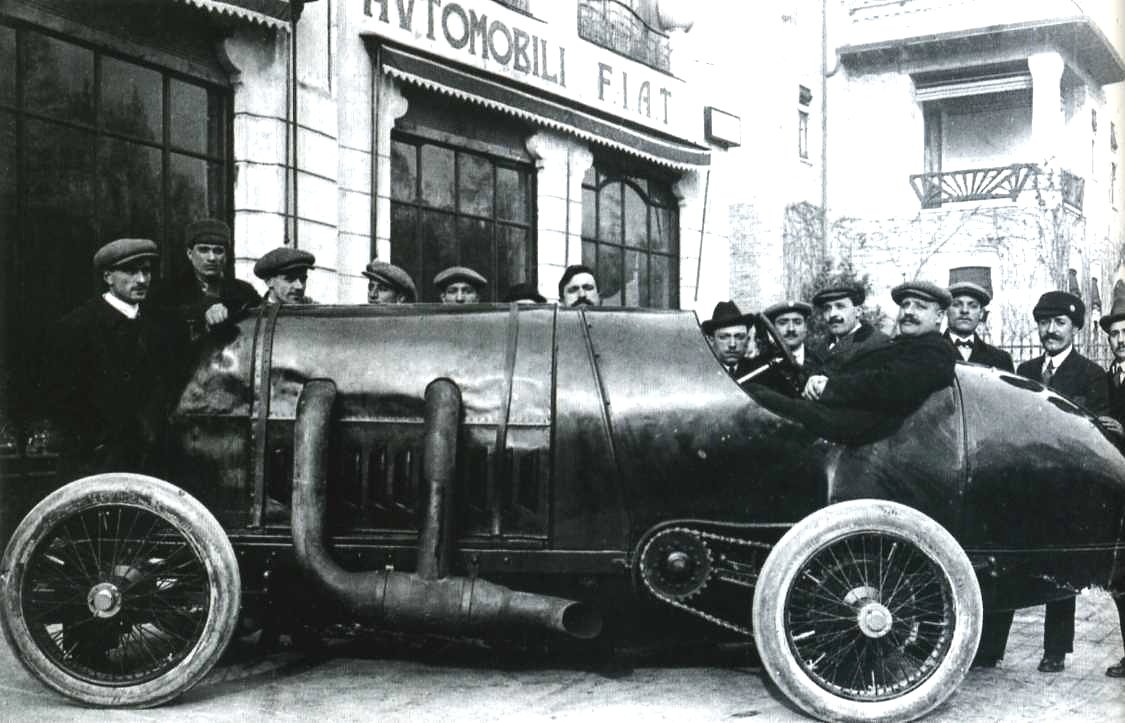


The closest relative is Pittaway’s Fiat S76: there too the engine is original and almost everything else is new. The difference still matters. With the S76 there was a historic car to reconstruct. With Brutus there was none. It is not a replica, not a restoration and not a kit — it copies no particular vehicle but a whole breed. The museum calls it an experimental car. You cannot put it more precisely than that.
What does not add up in the numbers
Last comes the part that occupied me most while researching. I collected every published figure for six quantities and sorted them by type of source. The result shows how a number comes into being once nobody checks any more. It simply gets passed on.
| Quantity | Figures in circulation | Where the outliers come from |
|---|---|---|
| Capacity | 46 l · 46.9 l · 46,899.9 cc · 46,920 cc · 46,930 cc · 47,000 cc | Roundings of the same number. Settled — see chapter 2 |
| Power | 490 to 750 hp in ten variants | Different sub-types, short-term against continuous, different measuring altitudes |
| Torque | 3,200 · 3,728 · 3,730 · 10,000 Nm | The 10,000 is arithmetically impossible. It appears in two popular sources, one of which took it from the other |
| Kerb weight | 2,300 kg (museum) · 2,537 kg (Wikipedia) · 3,000 kg | The 3,000 kg appears only in English-language blogs and one AI-generated wiki. There is no primary source for it |
| Chassis | 1907 · 1908 · „1907/1908“ | The museum says 1907, Wikipedia says 1908. Without a chassis number it cannot be decided |
| Engine period | First World War · from 1925 · from 1926 · early 1930s | „First World War“ is the museum’s figure and is wrong. 1926 is the sound one |
What stands out most is the pattern in which the wrong numbers appear. The outliers almost never come from the museum and never from the aviation literature. They come from a cascade that starts around 2011: English-language blogs, then forums, most recently AI-generated wikis, copying from one another and turning 2,537 kilograms into a round 3,000 on the way. Search for Brutus today and it is mainly that cascade you find. That is the problem. The sound figures sit in three places: the museum’s exhibit page, the Motor Klassik text by Hans-Jörg Götzl from 2009, and the aviation literature on the BMW VI. Everything else is echo.
If you go

One thing first, because it may change your plans. As of 10 September 2026 the museum notes on the exhibit page that the engine is being overhauled. Hall 2 therefore holds only the chassis and the body. When the work began and when it should end, the museum does not say. I could not find out.
The Technik Museum Sinsheim is open 365 days a year, Monday to Friday from 9 to 18, at weekends and on public holidays until 19. Admission is 25 euros for adults and 20 for children from five to fourteen; with the IMAX it is 30 and 25. Come on your own birthday with proof of it and you pay nothing. I took these prices from the museum’s site on 10 September 2026, and the ticketing gives no year, so check them before you set off.
Photography and filming for private purposes are expressly unrestricted — that is the wording on the visitor page. It does not extend to publishing, in a blog like this one for instance; that needs the press office. Every image in this article therefore comes from Wikimedia Commons.
If you want to hear Brutus run, the Brazzeltag at the sister museum in Speyer is the most reliable date. It falls on the second weekend in May — in 2026, the 9th and 10th. Whether Brutus appeared there this year is not clear from the programme release — with the engine out, it would be a surprise. Most people reach Sinsheim on the A6, and anyone driving in winter would do well to look at the age and tread of their own tyres first. On a vehicle with brakes on one axle, grip is the cheapest safety margin there is.
Which leaves the question I did not want to ask at the start and cannot avoid at the end: why does a museum build such a thing? Three reasons are on the record. The engine was too big to simply stand somewhere. It lets you show how enthusiasts in the twenties and thirties put such cars together. And a museum that drives works differently from one that only displays. The historic cars of this breed ran for records and prize money. Brutus runs for attention, on behalf of a house that lives on admissions, donations and memberships. That is not an accusation, only a different purpose — and perhaps the most honest reason why this car was built in 1998 and not in 1928.
Sources
All online sources retrieved on 10 September 2026. Source titles are left in their original language; translating them would misstate the reference. Where the text says „not found“, I looked and found nothing.
- Technik Museum Sinsheim: Experimentalfahrzeug BRUTUS
- Technik Museum Sinsheim: Brutus Experimental Vehicle (englische Fassung)
- Hans-Joerg Goetzl: Das Experiment Brutus — Hoellenmaschine mit Flugmotor. In: Museumsgeschichten (PDF)
- Technik Museum Sinsheim: American La France Funkenblitz
- Technik Museum Sinsheim: Blitzen-Benz
- Technik Museum Sinsheim: Der geoelte Blitz — Mythos Blitzen-Benz
- Technik Museum Sinsheim: Doktor Maybach Spezialrennwagen
- Technik Museen Sinsheim Speyer: Eine Reise in die Vergangenheit (9. Dezember 2020)
- Technik Museen Sinsheim Speyer: Besuch planen (Oeffnungszeiten, Eintritt, Fotografieren)
- Technik Museen Sinsheim Speyer: Gespraech mit Museumsleiter Hermann Layher (PDF)
- Technik Museum Speyer: BRAZZELTAG 2026, erste Programmpunkte (PDF)
- 45 Jahre Technikbegeisterung. Pressemitteilung ueber lifePR
- Eberhard Layher waere 100 Jahre alt geworden. Speyer-Kurier
- Brutus (Experimentalfahrzeug). Wikipedia (deutsch)
- Brutus (car). Wikipedia (englisch)
- BMW VI. Wikipedia (englisch)
- BMW VI. dewiki.de
- Deutsches Museum, Digitaler Katalog: Flugmotor BMW VI, geschnitten, Inv. 70708
- Online Aviation Library: BMW VI Betriebsanleitungen, Reihen 3/4, 6/7, 8/9 und VIu
- BMW VI. kfz-tech.de
- BMW VI — Erster V12-Flugmotor von BMW. flugzeug-lexikon.de
- Mikulin M-17. Wikipedia (englisch)
- Warbirds Resource Group: Heinkel He 51
- Warbirds Resource Group: Heinkel He 111 Variants
- AOPA-Germany: Safety Letter Nr. 58, Motorprobleme (Dezember 2021, PDF)
- Motoranlasser, Abschnitt Schwungmassenanlasser. Wikipedia (deutsch)
- American LaFrance. Wikipedia (englisch)
- Projekt Brutus. Classic Driver Magazine (mit Zitaten von Manfred Fink)
- Jan Kriebel: Experimentalfahrzeug Brutus. evocars-magazin.de, 11. Maerz 2011
- Brutus. dermotor.de
- BRUTUS — Hoellenauto mit Flugzeugmotor. oldtimertrecker.de
- American La France Brutus 1908. Traumautoarchiv.de
- Remembering Brutus. autoevolution.com
- Brutus — BMW VI Aero Engine Car to Feature at Brazzeltag. vintageaviationnews.com
- Daniel Kuehn: Neues Multimedia-Diorama mit dem Hubraum-Monster BRUTUS. sinsheim-lokal.de, 2. April 2016
- Auto e moto d’epoca a Padova. bellunopress.it, 22. September 2022
- 1908 American LaFrance BMW Flugmotor VI Baureihe 8 in Top Gear. IMCDb.org
- Top Gear series 18. Wikipedia (englisch)
- Motoring sportsmen — Roger Collings. Motor Sport Magazine, November 1997
- Fiat S76 Record. Wikipedia (englisch)
- Babs (car). Wikipedia (englisch)
- Chitty Bang Bang. Wikipedia (englisch)
- Fiat Mephistopheles. Wikipedia (englisch)
- Aero-engined car. Wikipedia (englisch)
- Technik Museum Sinsheim. Wikipedia (englisch)
- Technik-Museum Sinsheim. dewiki.de
- 47 Liter Hubraum! Der Brutus. automobile-news.de
- Heiner Straesser: 360-Grad-Panorama der Brutus-Ausstellung, 6. Juni 2016 (nur Beobachtung, Bilder nicht verwendbar)
- Zuschauer-Rekord beim BRAZZELTAG 2023 in Speyer. mrn-news.de, 16. Mai 2023
Not used as evidence, only to document the figures in circulation: an AI-generated wiki, a forum post and two popular blogs, the origin of the 3,000 kilograms and the 10,000 newton metres. Museum and press photographs and the 360-degree panorama could not be used either.
Bernd Mischke writes in Bernies Garage about car engineering, design and the people behind it. Tips, corrections and contradictions go to bernd [at] bernies-garage [dot] com.
Were you at the Brazzeltag?
Wanted: your own footage of Brutus running, with a date if possible. And if anyone knows whether the kill switch has been fitted by now — I could not find out.
Werkstattpost
A letter from the garage once a month: new articles, finds from the research, and now and then a question for you.