
- What this is about
- How a traction battery is repaired in the workshop — and what the owner needs to know about it
- The normal case
- Not a pack swap, a module swap. On cars built from 2022 onwards, 0.3 per cent of batteries were replaced, large recalls excluded
- Qualification
- De-energising from DGUV level 2S upwards. Opening the housing only from level 3S — an opened pack is never dead
- What a module costs
- BMW i3 around 1,200 euros as a part. VW ID.3 around 2,000 euros including labour, as of 2021 (chapter 7)
- What a whole pack costs
- 6,537.92 euros on the Smart, 28,516.68 euros on the Mercedes EQC — and both figures come from the same survey with no cut-off date
- Ageing
- 2.3 per cent capacity loss a year across the fleet. The ADAC endurance-test car stood at 89 per cent after 220,158 kilometres
- New since June 2026
- Delegated Regulation (EU) 2026/699 counts battery diagnosis and battery repair explicitly among the information manufacturers have to release
- What is not here
- No instructions. No working step in this text is meant or suitable for anyone unqualified

The most expensive repair on an electric car is the one that was never necessary. A battery pack is not a component but an assembly of several dozen modules. When one of them weakens, the battery management limits the usable range of the entire store. The owner notices nothing beyond shrinking range. The invoice he is handed in response is in many cases still written for the complete pack — although the rest of the cells are sound. That is the heart of the matter.
I went through a hundred sources for this piece: the safety rules of the German statutory accident insurance, the ADR dangerous-goods agreement, Tesla service procedures, the EU Battery Regulation, fleet analyses covering 22,700 vehicles and the price tables that appear in every second buyer’s guide. The article walks through the workshop first and through the owner’s position afterwards. Where the sources contradict each other, the contradiction stands in the text and not in a footnote.
One sentence first, so the direction is clear: this article describes how a qualified workshop works. It is not a set of instructions. Anyone who opens a battery housing without the qualification of DGUV level 3S is not risking a warranty claim but his life.
1. Cell, module, pack — and why the middle level decides everything
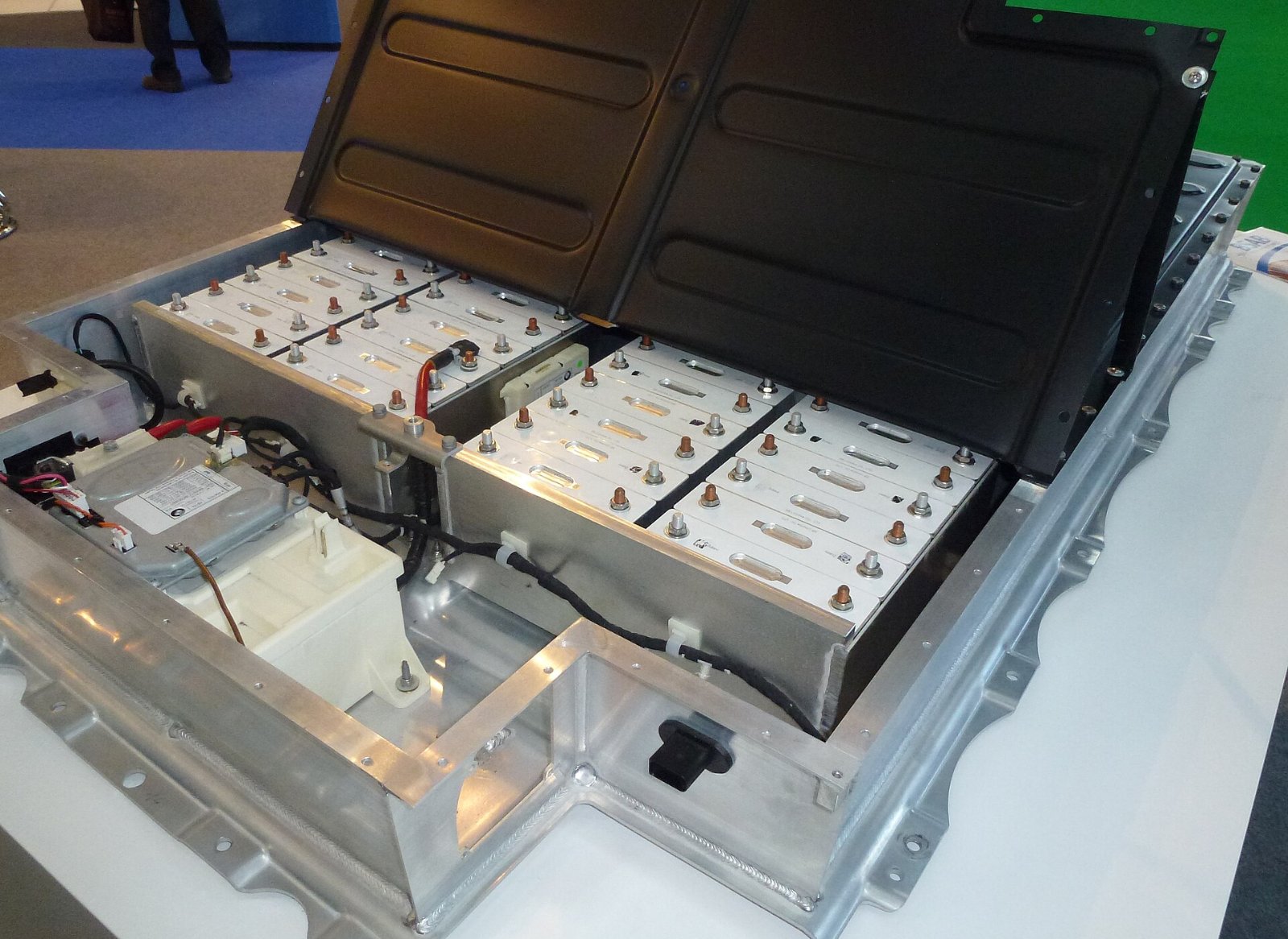
The hierarchy is the same at every manufacturer, the execution at none. At the bottom sits the cell, which stores the energy. Several cells make up a module, held together by cell connectors, a cooling plate and a small monitoring board. The modules in turn sit in the pack. With them sit contactors, fuses, the battery management and a housing that has to keep out water, stone chips and fire.
The middle level is the interesting one, because it is the repair unit. A module in the VW ID.3 on the MEB platform holds 24 cells. If one of them shows too much self-discharge, the workshop replaces neither the cell nor the pack but the module in between. Whether that is possible at all is decided by the design — and there the manufacturers are currently running in two opposite directions.
Three cell formats, three design philosophies
The cylindrical cell is the oldest shape and the one Tesla grew up with: first 18650, then 2170, today 4680. Its advantage lies in manufacturing, because a cylindrical cell can be wound quickly and cheaply. Its drawback is the space between the cylinders, which cannot be used, and the sheer number of them. Dismantling the structural 4680 pack of the Model Y, Munro & Associates counted roughly 204 cells per section across four sections, so about 816 cells.
The prismatic cell is the rectangular box the German manufacturers prefer. The Audi Q8 55 e-tron carries 432 prismatic cells in 36 modules and reaches 114 kilowatt-hours that way. Porsche Macan Electric and Audi Q6 e-tron go the other way. They put only 180 large cells into twelve modules — fewer parts, fewer joints, fewer places where something can fail.
The pouch cell, finally, is a bag of coated foil. It uses the available space best and needs a frame to hold it in shape. The VW e-Golf of 2014 had 264 pouch cells in 27 modules; the Porsche Cayenne Electric of 2026 manages with 192 large pouch cells in only six modules. I looked for market shares of the three formats and found nothing reliable. The overviews that can be found date from 2017 or come from suppliers without a data basis.

What else sits in the box besides the cells
Contactors separate the cells from the rest of the vehicle as soon as the system shuts down. They are wearing parts, and their typical failure is called sticking: the contacts weld together, and the car can no longer be cleanly isolated. Pyrotechnic disconnects interrupt the high voltage in a crash, fuses do it on overcurrent.
The pre-charge circuit is the component hardly anyone knows about, and it is what keeps the contactors alive. Without it the inrush current into the DC-link capacitors would destroy the contacts the very first time. A component manufacturer works through what the circuit has to deliver in an 800-volt system:
| Quantity | Value |
|---|---|
| System voltage | 800 V |
| DC-link capacitance | 1,000 µF |
| Pre-charge time | 1 s |
| Pre-charge resistor | 120 to 200 Ω |
| Maximum pre-charge current | 6 A |
| Pulse energy per charge cycle | 320 J |
The arithmetic behind it is as simple as it gets: R = t / (5 · C) for the resistance, Imax = U / R for the peak current, E = 0.5 · C · U² for the energy. The resistance therefore follows from the time you want to give the capacitor and from its capacitance. In practice that means the circuit charges the capacitors to system voltage in about a second, with six amps at most instead of several hundred. Only then does the main contactor close, and by that point there is no meaningful voltage difference left across its contacts.
Two more components deserve a mention, because they govern how the car behaves during any repair. The insulation monitor measures the resistance between the high-voltage network and the body continuously and reports when it drops below the set value. And the interlock loop, a thin wire, runs through every high-voltage plug and housing cover. Open one connection and the loop breaks, so the system shuts down. That is why an opened battery lid on an installed pack forces every vehicle into a fault state. What looks like a defect is, at this point, exactly the intended behaviour.
The battery management measures what the owner never gets to see
The BMS monitors cell voltages, temperatures, current and insulation, and it controls the thermal management and cell balancing. In passive balancing, cells at a higher voltage are pulled down through load resistors until they match the rest. In active balancing the energy is redistributed instead of burned off. One training provider gives a trigger threshold of more than 30 to 50 millivolts of deviation per cell. That is not a manufacturer figure. But it is the order of magnitude at stake, and it matters again in the chapter on module replacement.
The surprise from this chapter: Tesla fills the structural 4680 pack of the Model Y with pink polyurethane foam. To take it apart, Munro & Associates needed a dry-ice blaster to remove the foam step by step. Sandy Munro on the job: „Taking this apart is a miserable deal.“
2. Why nobody simply takes the lid off
In vehicle engineering, high voltage begins at 60 volts DC, and that threshold is set low on purpose. In classical electrical engineering „high voltage“ starts only at 1,000 volts AC or 1,500 volts DC. The 400 to 800 volts of an electric car would count as low voltage there. A word, in other words, that plays down precisely the hazard at issue. So vehicle engineering gave itself its own term with its own threshold: more than 60 volts DC, up to and including 1,500 volts.
The sentence I cannot write
Almost every text on high-voltage technology states that direct current cramps the muscles and makes letting go impossible. I tried to source that claim and failed. The relevant standard IEC 60479-1 in its 2018 edition defines the let-go threshold expressly for alternating current only. For direct current, section 6.2 knows only a perception threshold and a reaction threshold. The standard relates the two through an equivalence factor of 3.75: 300 milliamps DC correspond, in terms of the probability of ventricular fibrillation, to roughly 80 milliamps AC.
Workshop lore carries the rule of thumb „from 30 milliamps you get fibrillation and death“. It appears that way in a manufacturer briefing from the IDIS consortium, with no distinction between alternating and direct current. A German technical site gives 200 milliamps at more than 0.4 seconds of exposure — and refers, once again, to a time-current diagram for alternating current. Only the plain version is therefore defensible. Direct voltage at this level is lethal, the standards draw the hazard line at 60 volts, and a DC arc does not extinguish itself.
That last clause is the real difference from domestic wiring. An AC arc goes out a hundred times a second as the voltage passes through zero. A DC arc has no zero crossing. It keeps burning until someone takes the current away or it tears itself apart mechanically. On its own it does not stop.
The five safety rules — and the one that does not apply here
The five safety rules come from DIN VDE 0105-100 and read: isolate, secure against re-energising, verify the absence of voltage, earth and short-circuit, cover adjacent live parts. Undoing them follows the reverse order, releasing the short-circuit connections first and the earth connections afterwards.
At an energy store, rule four does not apply. DGUV Information 209-093, the German accident-insurance guidance for work on high-voltage vehicles, puts it bluntly: „Energy stores must not be short-circuited!“ This is where installation engineering and vehicle engineering part company, and the reason is obvious. An overhead line becomes dead the moment you switch it off; a battery never does. It is the source, and anyone who short-circuits it builds exactly the arc the rule was meant to prevent.
Three levels, and only one of them may open the housing
A statement of law. Reference: DGUV Information 209-093, „Qualification for work on vehicles with high-voltage systems“, August 2021 edition. I am not a lawyer and this is not legal advice; what follows reproduces the text of the guidance and the associated DGUV FAQ.
Level 1S, the instructed person, may do nothing at all on the high-voltage system on their own responsibility. They work under direction and supervision, on intrinsically safe vehicles, on tyres, body and interior. Two teaching units are enough for that. Anyone who wants to recover or tow an electric car needs at least this level — the recovery driver standing on the hard shoulder at night included.
Level 2S, the qualified person for high-voltage systems, may work independently on isolated systems and supervise level 1. Sixteen to eighty teaching units, depending on prior knowledge. German vehicle mechatronics technicians trained under the 2013 syllabus bring this competence out of their apprenticeship. Isolating a vehicle and verifying the absence of voltage are reserved for levels 2S and 3S.
Level 3S, the qualified person for live working, is the one this article turns on. Twenty-four teaching units, sixteen of them practical, at least a year of professional experience, first-aid training, and a second person present during the work. The decisive sentence stands in the DGUV FAQ: servicing high-voltage batteries requires level 3S. An opened battery housing is by definition not dead. The cells are live as long as they hold charge, and an empty pack effectively does not exist.
In practice the technician who isolates your car, does the brakes and works on the drivetrain still may not take the lid off the pack. That needs a further qualification and, on top of it, the manufacturer’s release for this particular vehicle.
What that costs can be put in figures. The German motor trade association ZDK gives 3,500 euros of training per employee. Tools and equipment come to 3,000 to over 4,000 euros per work bay. A trade-magazine calculation from June 2026 works through a whole workshop:
| Item | Amount |
|---|---|
| Level 1S training, three people | 1,050 € net |
| Level 2S training, one person | 2,595 € net |
| VDE tools and protective equipment, two bays | 4,000 € |
| Quarantine container with fire protection | 7,000 € |
| Special lift with battery lowering table | 14,000 € |
| Manufacturer diagnostic licences, five brands a year | 5,500 € |
| Total one-off investment | around 45,700 € |
| Annual running costs | around 10,300 € |
That is the sum a workshop has to raise before it opens its first pack. Germany has around 40,000 motor trade businesses, roughly two thirds of them independent. This figure explains more about the state of that market than any regulation does.
3. Diagnosis — and why the figure on the screen is not a measurement
The percentage the car itself displays as battery health is a manufacturer definition, not a measurement. Aviloo, one of the independent providers, stresses that it calculates state of health independently of the manufacturer tools. Read the other way round, that means what stands in the on-board menu is smoothed, rounded and calculated by rules the manufacturer does not publish. For the owner it is an indication. For a repair decision it is not enough.
What is actually measured in the workshop
Cell voltages are the basis of any fault-finding at module level. Aviloo now presents them as a heat map, a cell-by-cell picture with severity shading. That format is readable by someone who does not enjoy a table with 432 rows.
Insulation resistance is the value that shows whether a housing is sealed and a cable intact. And here there is a contradiction that deserves to be written out:
| Source | Limit | Applies to |
|---|---|---|
| Overview of ECE R100 (source Audi, HTWG Konstanz) | at least 100 Ω/V | direct voltage |
| Teaching material kfz-aufgaben.de | at least 500 Ω/V | no distinction |
| PicoAuto, guided test | typically 500 Ω/V | no standard cited |
The resolution: the regulation itself holds two values, 100 ohms per volt for DC buses and 500 ohms per volt for AC buses. Only the DC value could be sourced from the freely available summary. The 500-ohm figures in the teaching and supplier sources are therefore either the AC value or a conservatively chosen workshop limit. Both workshop sources note anyway that the manufacturer-specific target value governs. A 350-volt battery at 500 ohms per volt gives 175 kilohms; 200 volts at 100 ohms per volt gives 20 kilohms. The difference is considerable, and anyone without the manufacturer’s figure is measuring blind.
Measurement runs between every live conductor and the vehicle body, so both cables between battery and inverter as well as all three phases to the motor. The test voltage must at least match the nominal voltage of the battery, and the displayed resistance should climb steadily during the measurement. The system has to be isolated while this happens.
An example of how specific manufacturer requirements get
Tesla publishes the procedure for checking the high-voltage contactors on the Model Y openly, and it shows nicely what matters. An insulation tester for at least 500 volts DC is prescribed. The voltage between the contactor terminals has to lie between minus 0.1 and plus 0.1 volts. The cables may have no more than 0.2 ohms. And the resistance between the contactor terminals must be greater than one megohm.
The surprise from this chapter: the limit at which Tesla declares a contactor stuck is not a voltage but an insulation value. Below one megohm means abort the procedure and replace the contactor. A component whose whole job is switching is judged by its resistance in the open state.
The failure patterns that actually occur
A single weak cell is the most common case and the most instructive. It shows raised self-discharge, drops away in open-circuit voltage, and the battery management then limits the usable range of the entire pack. The weakest cell governs the whole, and what reaches the owner is less range and a car that no longer charges to full.
The best-known German case is the VW recall of 2021. It covered around 10,130 ID.3 and ID.4 worldwide, some 3,000 of them in Germany, all built in 2020. The cause was individual cells with excessive self-discharge, spotted through diagnostic data from routine workshop visits. What was replaced was the affected module with its 24 cells, not the pack. The repair took one to two days and cost around 2,000 euros including labour. Of more than 300,000 ID vehicles sold, fewer than four per cent were affected.
A defective module announces itself, according to one specialist firm, through 20 to 40 per cent range loss. Added to that are high-voltage system warnings, falling charge power and charging that stops at 80 per cent. That is a supplier statement, not a manufacturer specification.
A pre-charge fault shows up at system start, and the diagnosis runs through the voltage at the DC-link capacitor during the start attempt:
| Reading at the DC link | Interpretation | Likely cause |
|---|---|---|
| 0 V, no rise | pre-charge circuit interrupted | blown fuse, failed resistor, faulty relay |
| rise breaks off at about 50 % | current draw interrupts the charging | active high-voltage load, sticking relay contacts |
| 90 to 95 %, fault persists | capacitors charged, system will not start | main contactor does not close |
To these come insulation faults from moisture and corrosion, coolant leaks in liquid-cooled systems and connector corrosion on the module monitoring boards. And then there is the category that is not one: software faults. In the ADAC endurance test the charge power of the ID.3 rose from about 125 to over 160 kilowatts after an update. Not one component had been replaced.
And a note that sounds banal and is not: not every battery fault is a high-voltage battery fault. In the same endurance test, at around 158,000 kilometres, an aged 12-volt battery caused diffuse electronic faults and starting problems. Replacing it cost 456 euros.
What a battery certificate delivers — and what it does not
The Aviloo Premium test measures across a complete discharge cycle. The owner has seven days to drive the car from full to under ten per cent without charging in between, while a box at the OBD socket records. The certificate arrives two days after the test ends. The ADAC gives the tolerance as plus/minus three per cent. The same company’s Flash test needs three minutes at a standstill. By the supplier’s own account it lands about three per cent away from the Premium test — which is a different thing from landing three per cent away from the truth. Dekra offers a dynamic test that captures battery data during a short acceleration and returns a result in fifteen minutes.
What such a certificate says: the remaining capacity as a percentage of new, and at Aviloo the spread between the cells as well. What it does not say: anything about housing damage, corrosion at connectors or a coolant leak. For that you still need someone who opens the pack and looks.
And then there is a sentence at the ADAC that is easy to read past. The certificate helps in assessing warranty claims but does not decide whether a claim succeeds; the manufacturers do that with their own assessment procedures. The owner can have measured whatever he likes. Who defines the threshold and who measures again is, in both cases, the manufacturer.
4. What happens in the workshop
This chapter describes what goes on in a qualified workshop. It is not a set of instructions. Every step assumes DGUV level 2S at least, opening the housing assumes level 3S, plus the manufacturer’s release for the vehicle in question.
Preparation
The work area is cordoned off and signed. Where live work takes place a second person has to stand alongside, at least instructed and trained in first aid. A rescue hook for electrical accidents lies within reach; Tesla lists it explicitly in the tool list of its shutdown procedure. Jewellery and metal objects come off, pockets are emptied. Insulating gloves of class 0 at least, so rated for 1,000 volts, with leather overgloves on top and safety glasses. And the gloves are checked for damage before every use, not once a month.
Isolating and verifying the absence of voltage
Tesla’s shutdown procedure for the Model 3 shows how precisely a manufacturer prescribes this. It is publicly accessible and carries a flat rate of 0.30 hours. First the 12-volt supply is disconnected, then the lower seat cushion of the second row comes out. Then the technician checks the auxiliary battery: 13 to 16 volts for a lithium-ion battery, 10 to 14 volts for lead-acid. Only then does the protective equipment go on, the cover of the high-voltage test point comes off, and measurement follows in a prescribed order:
| No. | Measurement | Limit |
|---|---|---|
| 1 | positive terminal of the high-voltage battery against ground | below 10 V |
| 2 | negative terminal of the high-voltage battery against ground | below 10 V |
| 3 | high-voltage battery overall, positive against negative | below 10 V |
The surprise from this chapter: the same service literature carries the sentence „HV LED indicators are not reliable; always measure with a multimeter.“ So the manufacturer distrusts its own safety indicator — and writes that into the workshop manual.
A cross-manufacturer briefing from the IDIS consortium takes a different route: ignition off, key placed at least three metres from the car, starter battery disconnected, service plug pulled, then confirmed with a voltage tester. It also states a waiting time: ten minutes after deactivation, so the high-voltage system outside the battery can discharge. The German transport trade association BG Verkehr puts it more cautiously and only writes that residual voltage may persist for several minutes after switch-off. Tesla gives no waiting time at all and demands the measurement instead.
Taken together, there is only one sensible reading: the measurement does not replace the waiting time, and the waiting time does not replace the measurement.
The pack comes out
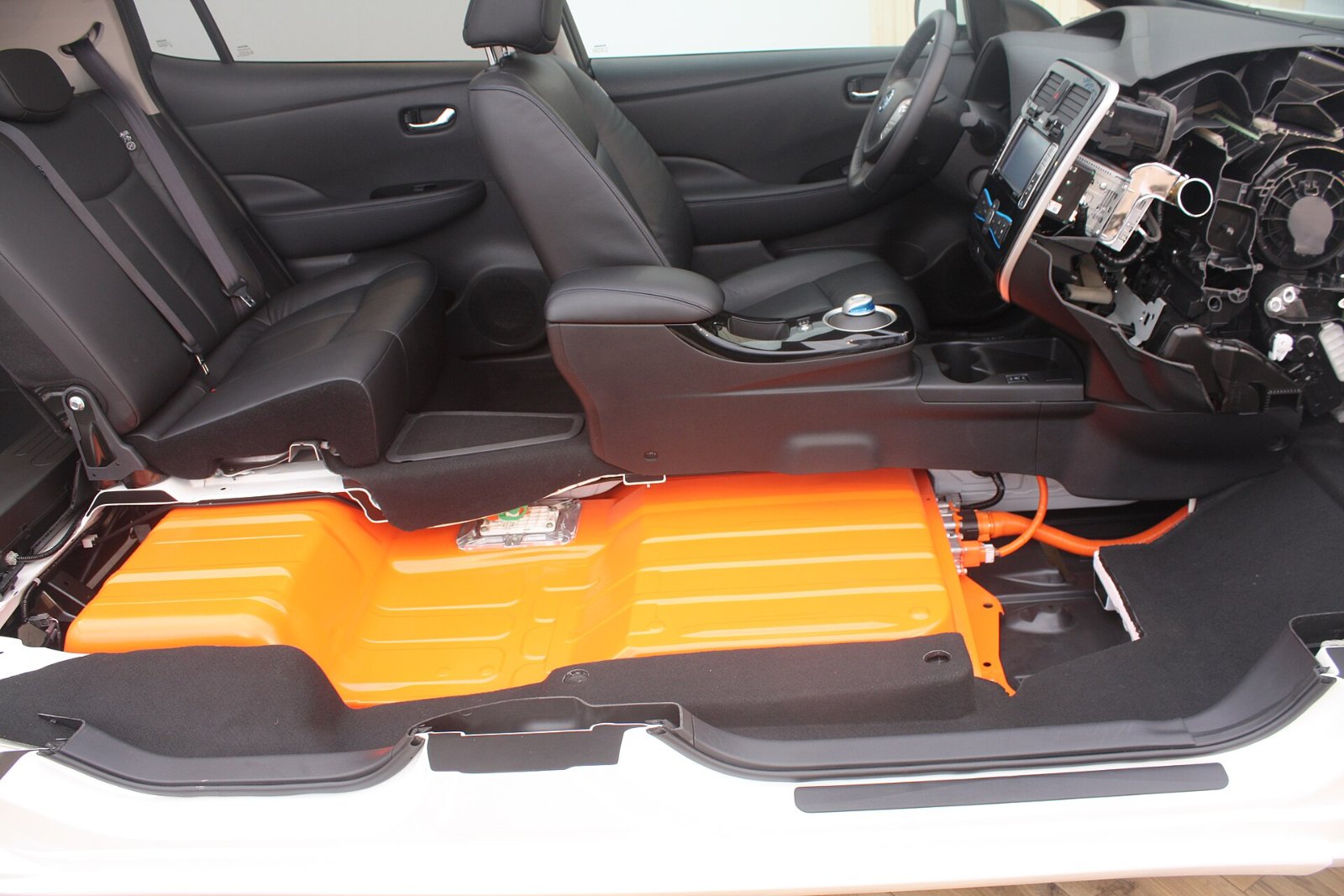
Before removal on the Model 3, Tesla requires a discharge procedure down to below 25 per cent state of charge. Shipping carries stricter limits: below 50 per cent for road transport, below 30 per cent by air. Then come interior trim panels, disconnecting the external connections, scuttle and shield plates, draining the coolant, releasing the mountings and finally lifting the pack out with the crane. The flat rate for removal and refitting on a rear-wheel-drive Model 3 is 5.40 hours.
The tool list reads accordingly: battery lift table with top plate, vehicle lift with H-frame, adjustable aluminium crane, regionally differing lift-pad adapters, alignment rods, plus a dedicated communication tool for the high-voltage battery. Two sentences from the instructions are worth quoting verbatim: „Never stand under a suspended load“ and „Never attempt to move a crane while it is carrying a suspended load.“
The weight of the pack, incidentally, is not stated by Tesla in the documents examined. I found no reliable source elsewhere giving weights for specific production packs. The fact that the manufacturer prescribes a crane and a lift table says enough. A figure in kilograms I cannot source is a figure I would rather not write down.
As long as the pack lies in the workshop, its own rules apply: stored dry, protected from high temperatures, in its original orientation, never directly on the floor but on an insulating rubber mat rated for high voltage. The storage place has to carry warning signs.
The housing comes open — and here the sources thin out
For the Model 3, Tesla runs a separate service procedure titled „Seal – perimeter seal – HV battery“, flat rate 3.60 hours. So the seal of the battery lid is replaced rather than reused. One nut is also treated expressly as a single-use part, namely the one securing the 12-volt positive cable at the cable gland.
The torque figures do not appear in the publicly accessible service pages. The documents refer to a torque calculator behind the workshop login. Nor do they say which sealant is used. That is not a gap in my research but the actual news: anyone without the tightening torques cannot close the pack again to specification. A sealed housing is not a matter of feel. It is a matter of numbers.
Finding and replacing the defective module
A German specialist firm describes the sequence for the VW ID.3 in six steps: diagnosis with the VW tools, safety protocols, module identification and removal, fitting the replacement components, BMS recalibration, function test. One to two hours for the diagnosis, one to two working days for the whole repair. That is a supplier statement. The independent cross-check comes from the ADAC, which allows about a day for a module repair and compares it, in effort and cost, to repairing a blown engine.
Where the replacement module comes from is the next question. From the manufacturer as a new part, for one. A study by the German automotive technology institute KTI found that Volkswagen, Skoda, BMW, Audi, Cupra, Hyundai, Kia, Mini and MG supply documentation, spare parts and repair instructions including module replacement. Or from the trade in used modules, which does exist: one German firm runs its own shop for modules from VW MEB, LG Chem and CALB. On the origin of such modules and their quality assurance I found nothing reliable, and that is worth knowing before comparing quotations.
Bosch has taken its own route: since autumn 2023 it offers a repair kit for aged nickel-metal-hydride modules in Toyota and Lexus hybrids. On the Prius III, 14 Bosch units of 14.4 volts each replace the 28 original flat modules, while the housing, cooling fan and electronics stay. Three to four hours of labour, no special tools, fitting only by staff with high-voltage level 3. The recommended price is 1,779 euros excluding VAT and labour, with five years of warranty on the cylindrical cells. An approval sticker from the German federal motor transport authority comes with it, so that no re-inspection is needed. That covers hybrid batteries, though, not the lithium packs of electric cars.
The step laymen underestimate: matching the voltage
Modules in a pack are wired in series, and that has a consequence which the first round of thinking misses. A replacement module at a different cell voltage from the rest produces an equalising current the moment it is connected. The battery management cannot absorb that current, because its balancing is built for differences of millivolts. The trigger threshold lies at 30 to 50 millivolts per cell. A module half a volt out is playing in an entirely different order of magnitude. Out by a factor of ten.
So the replacement module is matched manually before assembly, with a diagnostic unit and a meter rated for high voltage. The person doing it holds level 3S. External cell balancing has become a working step of its own that can be taught; one training-equipment maker runs a dedicated exercise for it. The voltage difference actually permitted for connection is manufacturer-specific and lives in the workshop documents, not on the open web.
Closing up, testing, teaching in
After assembly come the checks: leak tightness, insulation, teaching the module into the battery management, a test run under load. That a leak test takes place is evidenced by the existence of the perimeter seal as a spare part and its own service procedure. The actual method — test pressure, permissible leak rate, holding time — could not be found in public sources. The teach-in procedures of the individual manufacturers are nowhere in the open either.
And that answers the question of what actually makes such a repair expensive. Not the module but the flat rates. 5.40 hours for removing and refitting the pack alone, 3.60 hours for the perimeter seal, plus diagnosis, balancing and testing. At shop rates of up to 200 euros an hour, the lion’s share of the invoice comes from labour, not from material.
5. Whether the pack can be opened at all
The most important decision about a battery’s repairability is taken years before the damage, at the design desk. And the manufacturers are currently moving apart there.
The classic layout: modules, bolted and replaceable

Audi Q8 55 e-tron: 36 modules. Porsche Macan Electric and Audi Q6 e-tron: twelve each. VW ID.3 and ID.4: modules of 24 cells, replaced individually in the 2021 recall. On the BMW i3 the manufacturer planned for module replacement from the start, as the trade press reports. Audi confirmed to the same source that it offers „100 per cent repair depth“. In this construction, replacing a module is not improvisation but an intended operation.
Cell-to-pack: the modules disappear
In the BYD Blade, long prismatic cells go straight into the pack structure, with no conventional modules. CATL’s Qilin reaches 72 per cent volume utilisation of the pack that way, because cooling, structure and thermal protection are integrated at pack level. That saves weight, space and parts — but it removes precisely the repair unit that used to sit between cell and pack.
Cell-to-body: the battery is the car

In the BYD Seal, battery and floor form a common structure. In the Tesla Model Y with the 4680 pack it goes further still, and that is the case the debate caught fire over. Munro & Associates dismantled the pack and describe it: sheet-steel upper part, aluminium lower part, four sections with bulkheads, busbar plates on top, cell vents underneath, a thin layer of mica below the cells. And the whole thing potted in polyurethane foam. Munro’s verdict was „zero repairability“.
The consequences were assembled by a Reuters investigation in 2023, and they are the real reason this subject is more than workshop housekeeping. At the British dismantler Synetiq, up to twenty electric vehicles a day stood in the isolation area at times. Roughly 95 per cent of their battery cells were undamaged. Matthew Avery of Thatcham Research puts it plainly: an electric car is not especially sustainable if the battery has to be thrown away after a minor accident. Christoph Lauterwasser of the Allianz Center for Technology carries the sum further: scrap a pack early and practically the whole CO&sub2; advantage is gone.
The counter-movement, which also exists
The picture would be incomplete without two developments in the other direction. A CATL subsidiary has developed a repair service for structural battery packs. It quotes 1,375 to 2,750 US dollars against an average of 13,750 dollars for complete replacement. The target vehicles are the Model Y and Cybertruck with 4680 cells. That is an announcement in a Chinese trade publication, not a verified service offering, and it should be read that way.
And on the research side, the ModuRep project is working on modules in which individual cells can be replaced instead of whole modules. RWTH Aachen, the Fraunhofer battery cell research facility and four industrial partners are involved. The economics ministry of North Rhine-Westphalia funds the work over three years. The subject is joining techniques that come apart more easily without giving up structural strength.
6. Who is allowed to do it, and how many actually do
The surprise from this chapter: on cars built from 2022 onwards, 0.3 per cent of batteries have been replaced so far, large recalls excluded. The whole argument about repair concepts, approvals and regulations turns on a case that occurs in three vehicles out of a thousand.
The figure comes from an analysis by the US provider Recurrent, which observes a fleet by telemetry, and it has a trend that speaks for itself:
| Model years | Share of batteries replaced | Note |
|---|---|---|
| 2011 to 2016 | 8.5 % | early cars, some without active battery cooling |
| 2017 to 2021 | 2.0 % | second generation |
| from 2022 | 0.3 % | large recalls excluded |
How large the sample was exactly, the source does not say, only „thousands of participating electric cars“. The publication date was missing as well. The German comparison case confirms the direction. In the largest ID recall, fewer than four per cent of vehicles were affected, and there too the module was replaced, not the pack.
The manufacturers
The automotive technology institute KTI in Lohfelden has studied accident repair for years and counted again in spring 2025. For more than two thirds of the electric cars newly registered in April 2025 there are manufacturer repair concepts for the high-voltage battery. Volkswagen, Skoda, BMW, Audi, Cupra, Hyundai, Kia, Mini and MG are named, each including the replacement of individual modules. Which manufacturers make up the remaining third the study does not say — so neither do I.
The independent workshops
Here it gets unsatisfying, and that belongs in the picture. The German auto parts trade association GVA writes in May 2026 that a number of independent workshops have specialised in repairing high-voltage batteries. It names not a single one. As an obstacle the association points to limited access to technical information and spare parts. I found three firms that work at module level and describe it publicly: ESDI EV Technologies in Herford, e-mobilwerkstatt, and the ERTL group in Saxony. The last has been a certified battery competence centre for Renault, Dacia and Alpine since 2024 and for Skoda since 2026.
Those are three examples and expressly not a market overview. A verified list of the firms working at module level in Germany does not exist publicly. There are referral portals, but no independent overview, and all the statements above come from the providers’ own pages.
What is moving in the law right now
Statements of law. I am not a lawyer. What follows reproduces regulatory texts and trade reporting and is no substitute for legal advice.
In September 2025 a report went through the trade press that alarmed independent workshops. The European Commission was said to be working on a delegated regulation under articles 55 and 56 of framework regulation (EU) 2018/858. It would tie the replacement of traction batteries to a separate authorisation, and thereby reserve it for manufacturer-authorised workshops. Around 40,000 German motor trade businesses with over 100,000 employees would be affected. The matter was scheduled before the responsible EU committee on 2 October 2025. The ZDK filed formal objections.
What became of it I could not establish. As this research stands in September 2026, no outcome of that session is publicly documented. If you have a reference, please write to me and I will add it.
Something else can be evidenced, though, and it points the other way. On 23 March 2026 the Commission adopted Delegated Regulation (EU) 2026/699, in force since 23 June 2026. It amends annex X of regulation (EU) 2018/858 and governs for the first time EU-wide which cybersecurity measures manufacturers may take around access to vehicle data. The trigger was a judgment of the European Court of Justice in case C-296/22, holding that cybersecurity may not restrict free competition. The point that decides this article stands in annex X under 2.5.12 and 2.5.13: the information manufacturers have to release now expressly includes battery diagnosis, battery repair and the safe handling of battery components. Manufacturers have to implement this in stages between 23 September 2026 and 23 June 2028.
Access to this data has run for independent workshops since 1 April 2024 through the SERMI scheme. In Germany SERMA GmbH is the conformity assessment body. A workshop pays 249 euros net a year for it, plus 49 euros per employee and year.
So two developments stand side by side, and they should not be confused. The feared one would narrow battery repair through type-approval law; its outcome is open. The decided one opens access to data and names battery repair explicitly. Without data no permission helps, and without permission no data helps.
7. What it costs, and why the price tables online all look alike
Anyone searching for battery prices finds two large German tables, and both contain the same amounts down to the cent. Honda e 7,283 euros, Dacia Spring 6,769.65 euros, Smart 6,537.92 euros, Nissan Leaf 40 kWh 10,306 euros, Mercedes EQA 15,209.22 euros. One source is from March 2024, the other was updated in July 2026. These are not two independent pieces of evidence but two renderings of the same survey. In both cases the cut-off date of the underlying price list is missing.
That is no small thing. Anyone updating a text in 2026 and leaving the 2024 figures exactly as they were has either collected no new prices, or nothing has in fact changed. Which of the two applies is stated nowhere. With that reservation, the figures are usable — as an order of magnitude, not as a quotation.
| Vehicle | Replacement battery, part only |
|---|---|
| Renault Twizy | approx. 4,000 € |
| Smart EQ fortwo / forfour | 6,537.92 € |
| Dacia Spring | 6,769.65 € |
| Honda e | 7,283.00 € |
| Renault Zoe / Kangoo Z.E. / Twingo Electric | approx. 9,000 € |
| Nissan Leaf 40 kWh | 10,306.00 € |
| VW ID.3 / ID.4 | 10,000–15,000 € (source’s estimate) |
| BMW i3 | max. 12,000 € |
| Mercedes EQA | 15,209.22 € |
| Nissan Leaf 62 kWh | 15,516.00 € |
| Mercedes EQB | 18,739.50 € |
| Mercedes EQS | 19,603.12 € |
| Mercedes EQV | 27,230.31 € |
| Mercedes EQC | 28,516.68 € |
On top of that comes the labour, four to five hours for fitting, on the Kia EV6 more than nine. At shop rates up to 200 euros an hour, that is up to 1,900 euros added. Tesla publishes no official battery prices. The Reuters investigation of 2023 speaks of up to 20,000 dollars for the Model 3 in the US market, against a new price around 43,000 dollars.
Module replacement by comparison
| Case | Price | As of |
|---|---|---|
| BMW i3, single module (part) | approx. 1,200 € | not stated |
| VW ID.3 / ID.4, module of 24 cells, labour included | approx. 2,000 € | 2021 |
| VW ID.3, module replacement (supplier estimate) | 2,500–4,500 € | September 2026 |
| Toyota Prius III, Bosch repair kit (excl. VAT and labour) | 1,779 € | autumn 2023 |
| CATL repair service for structural packs, China | 1,375–2,750 USD | August 2025 |
The same specialist firm that quotes 2,500 to 4,500 euros for a module swap puts complete replacement at the VW dealer at 8,000 to 15,000 euros. That is a supplier statement with a visible interest. The cross-check against the manufacturer price tables does, however, support the order of magnitude of the second figure.
What a kilowatt-hour actually costs
BloombergNEF surveys pack prices annually. The figures for 2025, published in December 2025, read 108 US dollars per kilowatt-hour as a global average, down eight per cent on the year before. China stands at 84 dollars, North America at 121, Europe at 131 — so 56 per cent above China. Split by chemistry: 81 dollars for lithium iron phosphate, 128 for nickel manganese cobalt.
These figures are the price a manufacturer buys at, not the price at which an owner gets a spare part. A 77-kilowatt-hour pack would come to roughly 10,000 dollars of pure cell cost at European BNEF prices. The spare-part price for the ID family is 10,000 to 15,000 euros. The difference follows from margin, logistics, dangerous-goods handling and labour — but that split cannot be evidenced. So I set the two figures side by side and name the gap instead of filling it.
The economic limit
The ADAC endurance-test car, a VW ID.3, was still worth 23,861 euros after 160,000 kilometres according to DAT residual-value data, against a list price of 48,550 euros including VAT. A pack swap in this class costs 10,000 to 15,000 euros for the part plus labour. A module swap costs 2,500 to 4,500 euros by the supplier’s account. So for a car like this the pack swap sits on the boundary and the module swap clearly below it. From around 12,000 to 15,000 euros of residual value, the pack-swap arithmetic tips for good. That is my calculation from sourced individual figures, not a source.
The Allianz Center for Technology gives a range of under 1,000 to 29,000 euros for battery damage after an accident, depending on design and repair options. And its expert Carsten Reinkemeyer criticises the practice of treating every accident vehicle as a fire risk as a matter of course, calling it wildly overdone. It drags expensive special transport and long quarantine in its wake.
8. The point at which a car part becomes dangerous goods
A defective pack is legally no longer a spare part but a cargo. Lithium-ion batteries travel as UN 3480, packed in equipment as UN 3481, installed in a vehicle as UN 3171 for a battery-powered vehicle. The hazard label carries pattern 9A.
It gets interesting at special provision 376, which applies to batteries no longer in the condition originally tested — leaking, vented, mechanically damaged. Only someone technically qualified may classify them, and there are two steps. Damaged or defective leads to packing instruction P908 or LP904. Critically defective means thermal runaway is to be expected under normal conditions of carriage, and leads to P911 or LP906.
The surprise from this chapter: in Germany, transporting critically defective lithium batteries requires a determination by the Federal Institute for Materials Research and Testing. In dangerous-goods law, a broken car battery is thus in the same league as substances needing individual clearance from a federal authority.
On top of that comes transport category 0 for critically defective batteries. That means no exempt quantities, full dangerous-goods rules from the first gram. Every battery in its own inner packaging, a venting device on sealed containers, absorbent material, non-conductive lining in metal containers, marking with „DAMAGED/DEFECTIVE LITHIUM-ION BATTERIES“.
Reliable prices for such a transport I did not find. Neither hauliers nor associations publish comparable tariffs for it. That is a real gap for anyone trying to cost a repair. It is one of the reasons the question „who collects the pack“ weighs more in the choice of workshop than it seems to deserve at first glance.
And if it does catch fire
The DGUV paper on fighting lithium-ion battery fires in vehicles is a refreshingly sober document. Water is suitable and recommended as an extinguishing agent, it says, and additives are not needed. Experience shows a low flow of about 60 litres a minute is enough to cool the battery. Two lines are recommended, one for the vehicle and one for the battery. Submerging whole vehicles in a water container as a precaution is expressly advised against.
What is remarkable is what is not in it. Hydrogen fluoride, the standard argument against electric cars in public debate, is not mentioned in this paper at all. What is mentioned is nickel, cobalt and their compounds as carcinogenic hazardous substances in escaped battery material. Fires and gases, it adds, are heavier than air, toxic and flammable.
A workshop that accepts damaged packs needs a quarantine area, and its requirements are specific: at least five metres of clearance from combustible objects and other vehicles, a bay of 5.0 by 2.5 metres, outdoors, on non-combustible sealed ground with a drainage connection, a firefighting water supply of at least 800 litres a minute within a hundred metres, retention for contaminated water, secured against unauthorised access. How long a vehicle stands there is disputed. The industry associations VDA and VDIK speak of several days, BG Verkehr gives typically five or more for accident vehicles. The Berlin fire brigade leaves the decision to a qualified person at DGUV level 2S.
9. How fast such a battery actually ages
With this the article changes perspective. Up to here it was about the workshop. From now on it is the question that really occupies the owner: how likely is it that I need any of this at all?
The most solid answer comes from Geotab, a telematics provider. It analysed data from more than 22,700 electric vehicles across 21 model ranges in Canada, the USA and Europe in 2025, and published the results in April 2026. The average is 2.3 per cent capacity loss a year, which arithmetically leaves 81.6 per cent of the original capacity after eight years.
More interesting than the average is the breakdown, because it shows what the owner influences:
| Usage profile | Annual degradation |
|---|---|
| rapid charging under 12 % of all charges | 1.5 % |
| rapid charging over 12 %, under 40 % of those above 100 kW | 2.2 % |
| rapid charging over 12 %, over 40 % of those above 100 kW | 3.0 % |
| hot climate (over 35 % of days warmer than 25 °C) | +0.4 percentage points |
| over 80 % of the time at an extreme state of charge | 2.0 % |
| low utilisation (under 15 % cycles) | 1.5 % |
| high utilisation (over 35 % cycles) | 2.3 % |
Extreme rapid charging therefore doubles the ageing rate outright. That is the single largest lever in the whole analysis. And it lies in the hands of whoever drives.
Work through your own car
From these figures I built a small calculator, and you can try it right here. The first view projects the curve across the years, according to charging and climate profile, and shows when the warranty threshold of seventy per cent would arithmetically be reached. The second view goes by mileage. It sets three things side by side: the six measurements of the ADAC endurance-test car, the guide values for buying used, and the e-Golf that falls out of the pattern. Enter your own mileage and your measured percentage below — then you will see at once where your car stands in that field.
A contradiction in the data that deserves explaining
The same company measured 1.8 per cent in 2023, and that number still circulates as the number. It is outdated, and the reason is methodological, not technical. Charlotte Argue of Geotab explains it this way. The new survey contains more young electric vehicles, and faster wear is typical in the first one to two years. The established models from the 2023 data set now sit at 1.4 per cent a year. The curve flattens once the initial fast ageing is over.
The endurance-test car that supplies the argument
The ADAC has run a VW ID.3 with 77 kilowatt-hours since 2020. It has the remaining capacity measured regularly with the Aviloo Premium test, tolerance plus/minus three per cent:
| Mileage | Remaining capacity |
|---|---|
| 21,749 km | 96 % |
| 59,166 km | 96 % |
| 87,020 km | 94 % |
| 128,500 km | 92 % |
| 169,651 km | 91 % |
| 220,158 km | 89 % |
Two hundred and twenty thousand kilometres, 89 per cent remaining capacity, no battery defect. The repairs during the test were a driveshaft and a GPS aerial for 525 euros. Then a parking sensor for 207 euros, the 12-volt battery for 456 euros and the charge-flap mechanism for 227 euros. None of that was the high-voltage battery, and at 217,000 kilometres the car passed its statutory technical inspection without a single defect.
The surprise from this chapter: the same car stood at 91 per cent in June 2025 — and dropped out of warranty anyway, because the mileage limit of 160,000 had been reached. The warranty ends long before the battery has a problem.
The honest other side
It would be too easy to stop here. The replacement rate for model years 2011 to 2016 was 8.5 per cent, and the early air-cooled cars age visibly differently. A VW e-Golf from 2016 with more than 200,000 kilometres and over 1,000 charge cycles came to 69 per cent remaining capacity. That is about 14 of an original 24 kilowatt-hours, good for around 65 kilometres. It was a single measurement by a YouTuber using a method he himself described as rough, not a test-bench figure. And the car had no liquid cooling. As an extreme example it serves; as a statement about the model it does not.
10. Warranty: eight years, 160,000 kilometres, seventy per cent
Statements of law. I am not a lawyer and give no legal advice. What follows reproduces manufacturer terms, regulatory texts and trade reporting, each with its reference. The legal framework described here is that of Germany and the EU.
First the distinction that governs everything. Statutory rights exist by law, run against the seller and cover defects already present at handover. A warranty is voluntary, runs against whoever grants it, and on their terms. The manufacturers’ battery warranties are warranties, and that means simply: the terms are set by the party granting them.
The market standard reads eight years or 160,000 kilometres, with a guaranteed remaining capacity of 70 per cent. Some go beyond that:
| Manufacturer | Models | Warranty | Remaining capacity |
|---|---|---|---|
| BYD | all with Blade battery | 250,000 km / 8 years | 70 % |
| Toyota / Lexus | all fully electric models | 250,000 km / 10 years | 70 % |
| Mercedes | EQS, EQS SUV, EQE, EQE SUV | 250,000 km / 10 years | 70 % |
| Porsche Taycan | if the standing-time rules are observed | 160,000 km / 8 years | 70 % |
| Porsche Taycan | if they are not | 60,000 km / 3 years | – |
On the Lexus the sources contradict each other. In 2022 the ADAC gave ten years and a million kilometres for the UX 300e; Auto Bild gives 250,000 kilometres in ten years in February 2026. The newer figure probably reflects the current market position; that could not be verified.
What can cost you the warranty: deep discharge voids it at BMW, Fiat, Nissan and Opel. Skipped service updates do so at Tesla. Chip tuning and unapproved tow bars likewise. And the Taycan shrinks from eight years to three if the standing-time rules in the handbook are not observed. VW recommends a state of charge between 30 and 80 per cent for standing times over twelve hours.
Whether a repair at an independent workshop affects the battery warranty I could not establish. None of the sources examined makes a reliable statement on it. That is the question owners care about most, and the only large one this research has no answer to. If you hold a written manufacturer statement on the point, I would be glad to see it.
A judgment that strengthens buyers
The regional court of Wuppertal granted a buyer rescission of the contract in case 10 O 282/23. He had bought an electric car for 39,000 euros with a WLTP range of 332 to 341 kilometres and achieved around 160 in practice. An expert measured 281 kilometres on the test bench, about 18 per cent below the WLTP figure, together with unusually heavy battery degradation. The court found a substantial defect and confirmed the rescission; 5,250 euros were deducted from the purchase price for 40,000 kilometres driven. Anyone who falls more than ten per cent short of the WLTP range may rescind, on this reasoning. It is exactly what the courts have long held for combustion cars with badly excessive consumption. This is a single decision of a regional court, not settled supreme-court law.
What the EU Battery Regulation really requires
The surprise from this chapter: the much-quoted repairability duty of the EU Battery Regulation — batteries must be „readily removable and replaceable by the end user or by independent operators“ — stands in article 11 and applies to appliances and light means of transport. It covers the cordless drill. It does not cover the car.
What covers the car is article 14. Under it, traction batteries have to contain a battery management system that stores the data needed to determine state of health. The lawful purchaser, or a third party acting on their behalf, shall have read access to it at any time. That is the lever by which independent workshops and owners are meant to reach the cell data. Without that data, diagnosis at module level is guesswork.
From 18 February 2027 the digital battery passport arrives under article 77: around 80 mandatory data points for vehicle batteries, grouped in seven clusters, retrievable through a QR code, with three access levels — public, authorities, authorised persons. Sensitive details such as the exact cell chemistry stay with the last group. Anyone reading older sources will, incidentally, find 1 January 2026 and article 65: that is the Commission proposal of 2020, not the version in force.
11. What the owner can do
Have it measured before someone else does
The simplest route in Germany runs through the ADAC, which supplies the Aviloo box. Ten test centres fit it free of charge: Delmenhorst, Dortmund, Frankfurt, Hamburg, Kiel, Cologne, Munich, Nuremberg-Fürth, Oberhausen and Stuttgart. Self-fit kits go out by post across the country. Then drive seven days from full to under ten per cent without charging in between; the certificate follows two days later.
What such a test costs, by the way, is stated nowhere. For the most important pre-purchase check on a used electric car, no public price was to be found anywhere in the German-language web that was examined. Not at Aviloo, not at Dekra, not at TÜV or GTÜ. What was to be found is the amount a dealer earns extra through the certificate: 550 to 1,100 euros per car, according to a 2024 study.
When buying used
The ADAC gives minimum values for state of health: 92 per cent at 50,000 kilometres, 88 at 100,000, 84 at 150,000 and 80 at 200,000. Those values appear in the calculator above as the dashed line. They come, however, from an analysis of some 28,500 measurements on plug-in hybrids. Those batteries are loaded quite differently from a battery-electric car’s: smaller capacity, deeper cycles, more frequent full cycles. The ADAC recommends them for electric cars all the same, without explaining the transfer. Take the values as a rule of thumb. A measurement series for electric cars they are not.
Ask for these documents as well, and ask in writing:
- A battery certificate from a manufacturer-independent provider, with date and mileage.
- The service book, complete. On an electric car it matters no less than elsewhere.
- Evidence of software updates carried out. At Tesla, missing them is grounds for excluding warranty.
- The remaining warranty in writing: years, kilometres, guaranteed remaining capacity, transferability.
- Documentation of any battery repairs: which modules, when, by whom, with what qualification.
- From 18 February 2027 the digital battery passport via QR code as well.
Whether the battery warranty passes to a new owner I could nowhere source in citable form. The ADAC advises clarifying the applicable warranty rules before purchase, and documenting all information on battery damage and repairs in the contract of sale. It offers a model contract for electric cars.
Finding a workshop that works at module level
Four questions settle this faster than any review platform. First: what DGUV qualification level do the people who are to open the pack hold? Without level 3S the lid does not come off at all. Second: does the workshop have SERMI access to the manufacturer data? Third: is there a quarantine area to the VDA/VDIK standard? Without it, a damaged pack cannot be stored to specification. Fourth: how does the pack get there and back, and who carries the dangerous-goods risk?
With the brands that have a documented repair concept — Volkswagen, Skoda, BMW, Audi, Cupra, Hyundai, Kia, Mini, MG — the franchised workshop is the first port of call. That is simply where the documents, parts and approvals are.
And what you had better leave alone
- Do not open it yourself. High-voltage systems carry 300 to 800 volts DC, the hazard threshold lies at 60 volts, and a DC arc does not extinguish itself.
- Do not short-circuit it. That sentence stands exactly so in the DGUV paper, exclamation mark included.
- Do not rely on LED indicators. Even the manufacturer writes as much.
- Do not touch orange cables. The colour exists for precisely that reason.
- Do not put a damaged car in the garage. Crashed electric vehicles can catch fire with a delay; five metres of clearance in the open is the minimum.
- Do not tow a crashed electric car on a suspended axle. The requirement is a flatbed.
- Do not simply ship a defective pack. UN 3480, special provision 376, and for critically defective batteries a determination from the German federal materials institute.
- Do not leave the battery empty or full for weeks. For longer standing times the ADAC recommends 30 to 70 per cent, VW 30 to 80.
- Do not skip software updates. At Tesla that is a warranty matter.
- Do not try to put out a burning electric car yourself. Extinguishing here means cooling, over a long time, with breathing apparatus.
And what actually helps
The ADAC recommendations line up with what the Geotab figures show quantitatively, and that is rare enough: charge to 80 per cent day to day and to full only before long trips; hold between 30 and 70 per cent during longer standing times; top up by 10 to 20 per cent at the latest; park in the shade in summer and in a garage in winter; and charge on alternating current day to day rather than direct current. Frequent rapid charging at 50 to 350 kilowatts has a negative effect. Here the fleet data prove the recommendation right, at 1.5 against 3.0 per cent a year.
In practice, anyone who can charge at home or at work halves the ageing rate of their battery against someone who mostly hangs on a rapid charger. Not because of the charging technology itself, but because slowly charged cells see less heat and reach the extreme states of charge less often.
The link marked „Partner“ is an affiliate link. If you buy through it, Bernies Garage receives a commission; the price stays the same for you. Only what fits the subject of the article is recommended.
If you need charging equipment for that: our AWIN partner EVdance carries wallboxes, charging cables and adapters for charging at home. What connected load you are allowed depends on your grid operator; in Germany, wallboxes above 11 kW need approval.
12. What comes afterwards
Since 18 August 2025 manufacturers have had to take back waste electric-vehicle batteries free of charge. That holds regardless of type, composition, condition, brand or origin, and without obliging the end user to buy a new battery. So says article 61 of the EU Battery Regulation; the cost of the collection system falls on the manufacturer.
Alongside it stands a market observation that does not fit. One blog post puts the disposal of an HV battery at 200 to 800 euros and that of a complete electric car at 500 to 1,200 euros. The obvious explanation would be that the take-back is free but the dangerous-goods transport to get there is not. That explanation is not evidenced, so both statements stand here side by side.
Little is recycled in Germany so far, and the one plant that exists is not yet an industry. Mercedes-Benz opened Europe’s first integrated battery recycling factory at Kuppenheim in October 2024. It uses a mechanical-hydrometallurgical process at temperatures up to 80 degrees, with an expected recovery rate above 96 per cent. Lithium, nickel, cobalt, copper, aluminium, iron and plastics are recovered. It processes 2,500 tonnes a year.
The surprise from this chapter: on 1 January 2026 the German vehicle register held exactly 2,034,260 battery-electric passenger cars. Against that, 2,500 tonnes of recycling capacity a year. What stands at Kuppenheim is a pilot plant, not yet a disposal infrastructure for two million cars.
Second life looks much the same. Audi and EnBW commissioned a storage installation on the Heilbronn power station site in December 2022. Twelve high-voltage battery systems from former development vehicles give one megawatt of output, enough for about an hour of electricity for 3,000 households. The packs are meant to last at least five to ten years there and are then recycled. Twelve packs are not a market, though, and I found no reliable figures on the scale of second life in Germany.
13. What the whole thing turns on
At the end stands a picture that will not quite fit together. The batteries last longer than almost anyone expected. They are replaced on three in a thousand newer cars. Manufacturers have repair concepts down to module level for two thirds of new registrations. And since June 2026 an EU regulation counts battery repair explicitly among the things an independent workshop is entitled to learn.
And at the same time one manufacturer pots its cells in foam. A British dismantler has twenty vehicles a day standing in the isolation area with 95 per cent of their cells intact. And for the most important check when buying used there is no public price.
The technical question is settled. A module can be replaced, it can be taught, it takes a day and costs roughly what an engine repair costs. The open questions are all of another kind. Whether the workshop can reach the data, whether it can get the part, whether the insurer pays for the repair instead of writing the car off — and whether the designer built the pack so that anyone can open it at all.
That is decided not by physics but by a person at a drawing board. And it is decided years before the damage, in an office where nobody sits who later pays the bill.
Sources
All sources retrieved on 10 September 2026 unless noted otherwise. The titles are left in their original language, because a translated title would misstate the reference. Supplier and advertising pages are marked as such; their statements on services, prices and qualifications are supplier claims, not verified facts.
- DGUV Information 209-093, „Qualifizierung für Arbeiten an Fahrzeugen mit Hochvoltsystemen“, Ausgabe August 2021 (Volltext über die BGHM)
- DGUV Publikationen, Datenblatt zu DGUV Information 209-093
- DGUV, FAQ-Liste Elektromobilität, Stand 12/2023
- DGUV, Fachbereich Holz und Metall, FAQ Hochvolttechnik
- IEC 60479-1:2018, „Effects of current on human beings and livestock“, Normvorschau
- ECE R 100 — Hochvoltvorschriften bei Elektrofahrzeugen (Quelle Audi, Wiki der HTWG Konstanz)
- Krafthand Wissen, Eintrag „ECE R100“
- kfz-aufgaben.de, Lehrmaterial Isolationsmessung
- Pico Technology, Guided Test Isolationswiderstand (Anbieterseite)
- ASI Akademie für Sicherheit, Die fünf Sicherheitsregeln nach DIN VDE 0105 (Schulungsanbieter)
- Krafthand, „Große Haftungsrisiken bei Arbeiten an Hochvoltanlagen“, 23.07.2012
- BG Verkehr, Flyer „Pannen- und Unfallhilfe an Fahrzeugen mit Hochvoltsystemen“, 2019
- BG Verkehr, Lithium-Metall- und Lithium-Ionen-Batterien (Gefahrgut)
- safetytrainingplus, Sondervorschrift 376: Transport defekter Lithium-Ionen-Batterien nach ADR (Schulungsanbieter)
- RETRON, ADR-Sondervorschriften und Verpackungsanweisungen (Anbieterseite)
- gefahrgut.de, „SV 376: Anträge online“ (BAM-Antragsvordruck)
- VDA/VDIK, „Technische Quarantäneflächen für beschädigte Fahrzeuge mit Lithium-Ionen-Batterien“, August 2022
- Berliner Feuerwehr, FAQ Quarantäneflächen Unfallfahrzeuge, 03.09.2025
- DGUV, Fachbereich AKTUELL FBFHB-024, Brandbekämpfung von Lithium-Ionen-Batterien bei Fahrzeugbränden, 29.11.2023
- ADAC, „E-Auto brennt: Wie die Feuerwehr löscht und wie sicher die Autos sind“, 10.05.2024
- Projekt ALBERO, Arbeitspaket 1.4 „Charakteristiken des Thermal Runaway“
- EV FireSafe, HV cable & components
- EVKX.net, Battery Pack & Configuration
- InsideEVs, Tesla 4680 Structural Battery Pack Teardown: What Is Under The Foam?
- InsideEVs, Tesla’s 4680 Structural Battery Pack Teardown: Pack Fully Disassembled
- Reuters-Recherche „Scratched EV battery? Your insurer may have to junk the whole car“, 20.03.2023
- CleanTechnica, „Tesla’s New Structural Battery Pack — It’s Not Cell-to-Pack, It’s Cell-to-Body“, 10.10.2020
- Notebookcheck, „CATL is cutting EV battery replacement price 10x with new structural pack repair service“, 12.08.2025
- InsideEVs, „The Facts Are In: You Shouldn’t Worry About EV Battery Replacements“ (Daten von Recurrent Auto)
- Geotab, „EV Battery Health: Key Findings from 22,700 Vehicle Data Analysis“, 28.04.2026
- Electric Autonomy Canada, „Latest Geotab study finds EV batteries lose just 2.3% life per year“, 13.01.2026
- ADAC, „VW ID.3 nach 220.000 Kilometern im Dauertest“, Stand Juli 2026
- ADAC, „Elektroauto-Batterie: Lebensdauer, Garantie, Reparatur“, 25.10.2022
- ADAC, „Batteriecheck Elektroauto: So kann man den Akku testen“, 24.06.2026
- ADAC, „E-Auto-Akku richtig laden und schonend fahren“, 09.03.2026
- ADAC, Ratgeber zum Gebrauchtkauf von Elektroautos, 08.04.2026
- ecomento, „ADAC-Studie: Plug-in-Hybrid-Batterien altern sehr unterschiedlich“, 03.11.2025
- Aviloo, Produktseite FLASH Test (Anbieterseite)
- electrive.net, „Aviloo führt neues Batteriezertifikat ein“, 12.06.2025
- Dekra, Batterietest an Elektrofahrzeugen (Anbieterseite)
- elektroauto-news.net, „E-Auto Akku Tausch Kosten“, 25.03.2024
- t-online, „Der wahre Preis: So viel kostet ein neuer Akku fürs Elektroauto“, aktualisiert 20.07.2026
- auto motor und sport, „E-Auto-Akku — Birgt der Batterie-Austausch ein Kostenrisiko?“
- BloombergNEF, „Lithium-Ion Battery Pack Prices Fall to $108 Per Kilowatt-Hour“, 09.12.2025
- kfz-betrieb (Vogel), „Batteriereparatur und -austausch für freie Kfz-Betriebe gefährdet“, 19.09.2025
- Gesamtverband Autoteile-Handel (GVA), „Nachhaltig und wirtschaftlich: Reparatur von Hochvoltakkus“, 28.05.2026
- schaden.news, KTI-Untersuchung zu Hersteller-Reparaturkonzepten für HV-Batterien
- Krafthand, „HV-Batteriereparatur bis auf Zellebene ermöglichen“ (Projekt ModuRep), 07.03.2026
- autoservicepraxis, „Austauschlösung: Bosch bietet Reparatursatz für HV-Batterien“
- ESDI EV Technologies, VW ID.3 Batteriereparatur (Anbieterseite)
- e-mobilwerkstatt, „Tesla Batterie reparieren statt tauschen“, 08.10.2025 (Anbieterseite)
- ERTL-Gruppe, Batteriereparatur — Werkstatt & Service (Anbieterseite)
- Trainmobil GmbH, „Cell-Balancing bei HV-Batterien“ (Schulungsanbieter)
- Tesla Service, Model 3 Servicehandbuch, HV-Batterie (Allradantrieb), Ausbauen und Ersetzen
- Tesla Service, Model 3 Servicehandbuch, HV-Batterie (Hinterradantrieb), Ausbauen und Ersetzen
- Tesla Service, Model 3 Body Repair Procedures, HV-Abschaltverfahren des Fahrzeugs
- Tesla Service, Model Y Servicehandbuch, HV-Batterieschütz, Prüfung auf Klemmen
- IDIS-Konsortium, „Sicherer Umgang mit elektrischen Hochvoltkomponenten in Elektro-Altfahrzeugen“, Version 2.8
- Miba AG, „Vorladewiderstand berechnen: Formeln & Praxis-Check“ (Bauteilhersteller)
- Bonnen Batteries, Fehler beim Vorladen von Elektrofahrzeug-Akkus (Batteriehersteller, technischer Blog)
- amz.de, „Thermomanagement im Batteriepack“, 27.03.2023
- ingenieur.de, „Ölkühlung gegen Leistungsverlust: Neue AMG-Batterie geht in Serie“, 03.08.2026
- Verordnung (EU) 2023/1542 über Batterien und Altbatterien, EUR-Lex
- IHK Bodensee-Oberschwaben, Die neue EU-Batterieverordnung: Pflichten und Fristen
- VDE, Infopapier zur Batterieverordnung (EU) 2023/1542
- Deutscher Bundestag, Wissenschaftliche Dienste, WD 5 – 3000 – 077/24, 04.06.2024
- UMCO, Neue EU-Batterieverordnung: Auswirkungen auf Hersteller und Recyclingindustrie (Beratungsunternehmen)
- Haufe Sustainability, „Batteriepass ab 2027: Neue Testumgebung ist online“, 24.06.2026
- schaden.news, „SERMI: Die wichtigsten Antworten rund um die Zertifizierung“, 13.03.2024
- AUTO BILD, „Elektroauto: Diese Akku-Garantien geben die Hersteller“, 04.02.2026
- t-online / dpa-tmn, „Akkus von E-Autos: Bei der Garantie lauern Fallstricke“, 31.01.2023
- electrive.net, „Urteil: Zu geringe E-Auto-Reichweite berechtigt zum Rücktritt vom Kaufvertrag“, 19.06.2026 (LG Wuppertal, Az. 10 O 282/23)
- Allianz, E-Auto-Akku-Versicherung (Versichereraussage)
- Bund der Versicherten, „Akku: Elektroauto-Herzstück gut absichern!“, 14.09.2023
- GDV, „E-Autos und Verbrenner gleichen sich in Schadenhöhe und -häufigkeit an“, aktualisiert 13.08.2025
- t-online, „Maßlos überzogen: Experte kritisiert diesen Kostenfaktor nach E-Auto-Unfällen“, 20.08.2026
- automobil-produktion, „Mercedes eröffnet Batterierecycling-Fabrik in Kuppenheim“, 21.10.2024
- solarbranche.de, „Audi und EnBW nehmen Energiespeicher mit Second-Life-Batterien in Betrieb“
- wirkaufendeinethg.de, „Das E-Auto entsorgen: diese Kosten kommen auf Dich zu“, 01.06.2025 (Anbieterblog)
- Dr. Web, „E-Auto-Werkstatt einrichten: Was kostet das 2026?“, 02.06.2026
- auto motor und sport, Akku-Probleme: VW ruft ID.3 und ID.4 in die Werkstatt (Rückruf 2021)
- Fraunhofer ISI, Gesamt-Roadmap Lithium-Ionen-Batterien 2030 (2015)
- Kraftfahrt-Bundesamt, Infografik „Mehr als 2 Millionen Elektro-Pkw in Deutschland“
- ecomento, „Fahrzeugbestand in Deutschland am 1. Januar 2026: 4,1 Prozent Elektroautos“, 03.03.2026
- ESDI Shop, Batteriemodule VW MEB, LG Chem, CALB (Anbieterseite)
- Krafthand, „Die Isolationsüberwachung in Elektrofahrzeugen“, 02.01.2021 (Volltext hinter Abo-Schranke)
- Martin Frei, „Grundlagen Kfz-Hochvolttechnik“, 3. Auflage, Krafthand Medien, Januar 2018 (Leseprobe)
- WE Mobility Academy, „Was ist Hochvolt? Definition im Fahrzeug“ (Schulungsanbieter)
- roe-gmbh.com, Grenzwerte für elektrische Körperdurchströmung (Dienstleisterseite)
- BAM, Gefahrgutregel BAM-GGR 024, Revision 2 vom 23.05.2025 (beim Abruf nicht erreichbar)
- Notebookcheck, „VW e-Golf: YouTuber testet 8 Jahre alten Elektro-Volkswagen“, 27.12.2023
- Delegierte Verordnung (EU) 2026/699 der Kommission vom 23. März 2026 zur Änderung des Anhangs X der Verordnung (EU) 2018/858, EUR-Lex
- Noerr, „Nach EuGH-Carglass: Delegierte Verordnung (EU) 2026/699 gibt neue Leitplanken für Secure Gateway, OBD-Zugang und RMI“
- autoservicepraxis, „Neue EU-Regelung: Erweiterter Zugang zu Fahrzeugdaten stärkt freie Werkstätten“, 07.04.2026
- autohaus.de, „Neue EU-Regelung: Erweiterter Zugang zu Fahrzeugdaten stärkt freie Werkstätten“, 06.04.2026
- ZKF, „Neue EU-Regelung: Erweiterter Zugang zu Fahrzeugdaten stärkt freie Werkstätten“
No manufacturer press images are used in this article. Every photograph comes from Wikimedia Commons and was checked individually for author and licence. Not found and therefore not claimed: pack weights of specific production vehicles, torque figures and sealant for closing the housing again, prices for battery certificates, dangerous-goods transport costs, the outcome of the EU committee session of 2 October 2025, and a verified list of the firms working at module level in Germany.
Bernd Mischke writes in Bernies Garage about car engineering, design and the people behind them. Tips, corrections and disagreement go to bernd [at] bernies-garage [dot] com.
Two questions I have no answer to
First: does a module swap at an independent workshop affect the battery warranty? If you hold a written manufacturer statement on it, I would be grateful. Second: what became of the EU committee session of 2 October 2025? I will add both, with the reference.
Workshop Post
Once a month a letter from the garage: new articles, finds from the research, occasionally a question for you.