
16 chapters · 2 interactive tools · 45 engine codes · 59 checkpoints · 83 sources
- Golf II
- Type 19E, type 1G1 from model year 1990. August 1983 to December 1992, over 6.3 million built. No cabriolet, no estate.
- Golf III
- Type 1H, Vento as 1H5. Autumn 1991 to the end of 1997 as a hatchback, 4,805,900 cars. Estate until 1999, cabriolet until 2002.
- The big bumper
- arrived not in 1987 but in 1989/90 — how to read the year off the car
- Fully galvanised
- neither of them. VW dates the fully galvanised body to 1997 — why the question is the wrong one
- Which rusts more
- cannot be decided. The German TÜV report for 2026 and the ADAC breakdown statistics for 2026 carry no line on these cars — what follows from that
- Golf II prices
- 3,000–6,000 € for a standard car, 8,000–15,000 € for a GTI, 15,000–25,000 € for G60 and Rallye (early 2026, German market)
- Golf III prices
- 700–3,500 € for the mass of them, from 15,000 € for an original VR6 — one dealer asked 49,950 € in January 2025
- Historic plates
- 191.73 € of German road tax a year, flat rate. Golf II eligible since 2013, Golf III since 2021 — what destroys the claim
- Deal-breaker
- the windscreen. At VW Classic Parts it is an empty category for the Golf 3 and not listed at all for the Golf 2
- Tools
- Code finder: 45 engines, Inspection list: 59 checkpoints
Two sentences that turn up in every second forum post about these cars do not survive a check. The big bumper did not arrive in 1987, and neither car left the factory fully galvanised. Volkswagen itself dates the fully galvanised body to 1997, the year the Golf III hatchback went out of production. What follows is where to put your hands — and where the sources give you nothing.
Two cars, one platform
Anyone torn between a Golf II and a Golf III is not choosing between two designs but between two periods of the same one. Volkswagen states plainly that the Golf III sits on its predecessor’s platform. The dimensions confirm it at a point most people miss. The younger car grew in length, width and weight, from 845-1,165 to 960-1,380 kilograms, yet its wheelbase is shorter: 2,471 millimetres against 2,475. Suspension parts are therefore related in places and quite unrelated in others — the part number decides, not the similarity of shape.

On the end of Golf II production three sources contradict each other. Wikipedia says December 1992, Volkswagen dates the generation 1983 to 1991, and a British parts dealer ends it in February 1992. All three can be explained without anyone being at fault. The Golf III arrived in autumn 1991 and the II carried on alongside it. So counting to the change of generation, to the last German car or to the last built anywhere gives three different years. Over 6.3 million were made.
There was no cabriolet in this generation, because that stayed on Golf I underpinnings until August 1993, and no estate either. Anyone offering you a Golf II Variant has muddled something. The Golf III supplied both. The Variant came in autumn 1993 as the first Golf estate of any kind, and the cabriolet at the same time, both built by Karmann in Osnabrück. Around 4,085,300 hatchbacks were made up to December 1997.
On the cabriolet the numbers part company: 164,234 cars up to January 2002 by one source, 139,578 by the other. The likely reason is whether the facelift years from 1998 are counted. Both stand here side by side, because the conflict cannot be resolved. The sources give no more than that.
Golf II: how to read the year off the car
The Golf II had two facelifts, not one, and that is exactly where most attempts at dating one in the metal come apart. The first arrived in 1987/88 and changed the face. Five grille ribs instead of seven, no more quarter windows in the doors, larger side glass, repositioned mirrors, and clipped trim strips instead of glued-on ones. The tailgate was redesigned, though no checked source says in what way.
The second facelift came in 1989/90, and it is the one everybody means when they say big bumper. Only here did the car get the large bumper mouldings, partly in body colour, with fog lamps in the bumper to order and a second central electrics box. At the same time the type designation changed from 19E to 1G1. So 1989, not 1987.
Big bumper is scene and parts-trade jargon, not a factory term, and it is documented only as a product name in the aftermarket. No factory source with an introduction date exists in the material examined. What is documented is that Wikipedia and the parts dealer both date the large bumpers to 1989/90. Anyone looking for a big bumper is looking for a car from the last three years of production.
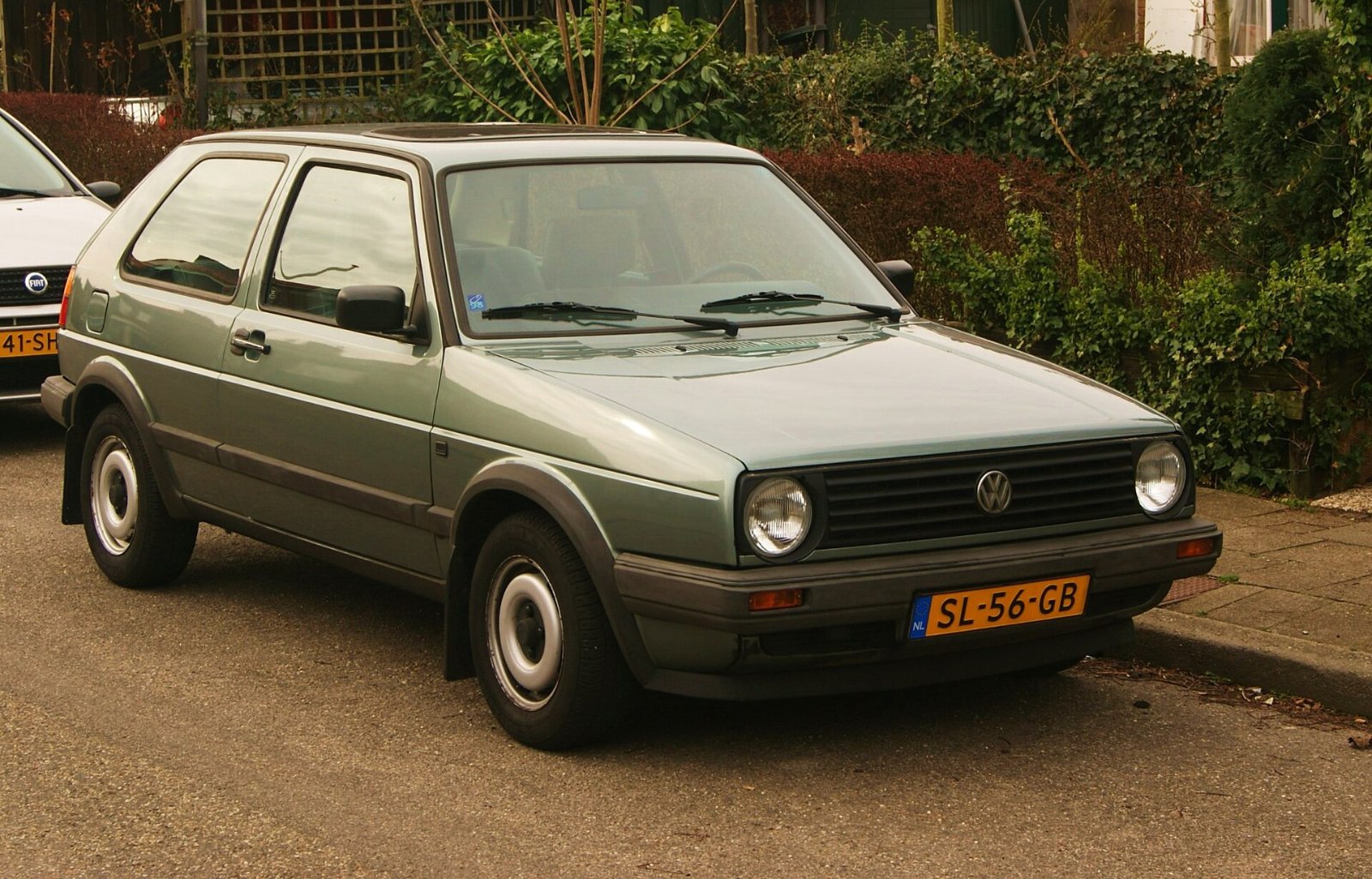
There is one dating clue no seller ever thinks of, and it sits under the dashboard on the driver’s side. Before August 1987 the fusebox has 22 positions, and number 3 feeds the cigarette lighter, radio, clock and interior light; after that number 21 takes over radio and lighter. A build year can be dressed up. A fusebox cannot.
| Golf II special edition | Built | Number |
|---|---|---|
| Rallye Golf (G60, syncro, three-door only) | 1989–1991 | 5,000 |
| Golf Limited (VW Motorsport, 210 hp, syncro) | 1989 | 71 |
| Golf Country (Steyr-Daimler-Puch, Graz) | 5/1990–12/1991 | 7,735 |
| — of which Chrome Edition, 52,200 deutschmarks | 558 | |
| — of which Allrounder | 160 | |
| Edition One | 1989–1991 | around 12,000 |
| Edition Blue | 1991 | 2,100, of which 1,749 for Germany |
| Fire and Ice, Pasadena, Function | 1991–1992 | not found |

The trim lines were C, CL and GL, with GLX and Carat above them until August 1986. Then came GT and GTD, which looked sporting and made less power than the GTI. A special edition called Harlekin appears in a single trade source among the Golf 2 variants; by every other account it is a Golf III model. With the Golf Country, which Steyr-Daimler-Puch in Graz converted 7,735 times, rarity comes with a drawback. Everything the wheels throw up collects under the arch extensions. The extension is the problem.

Golf III: the indicators give away the year
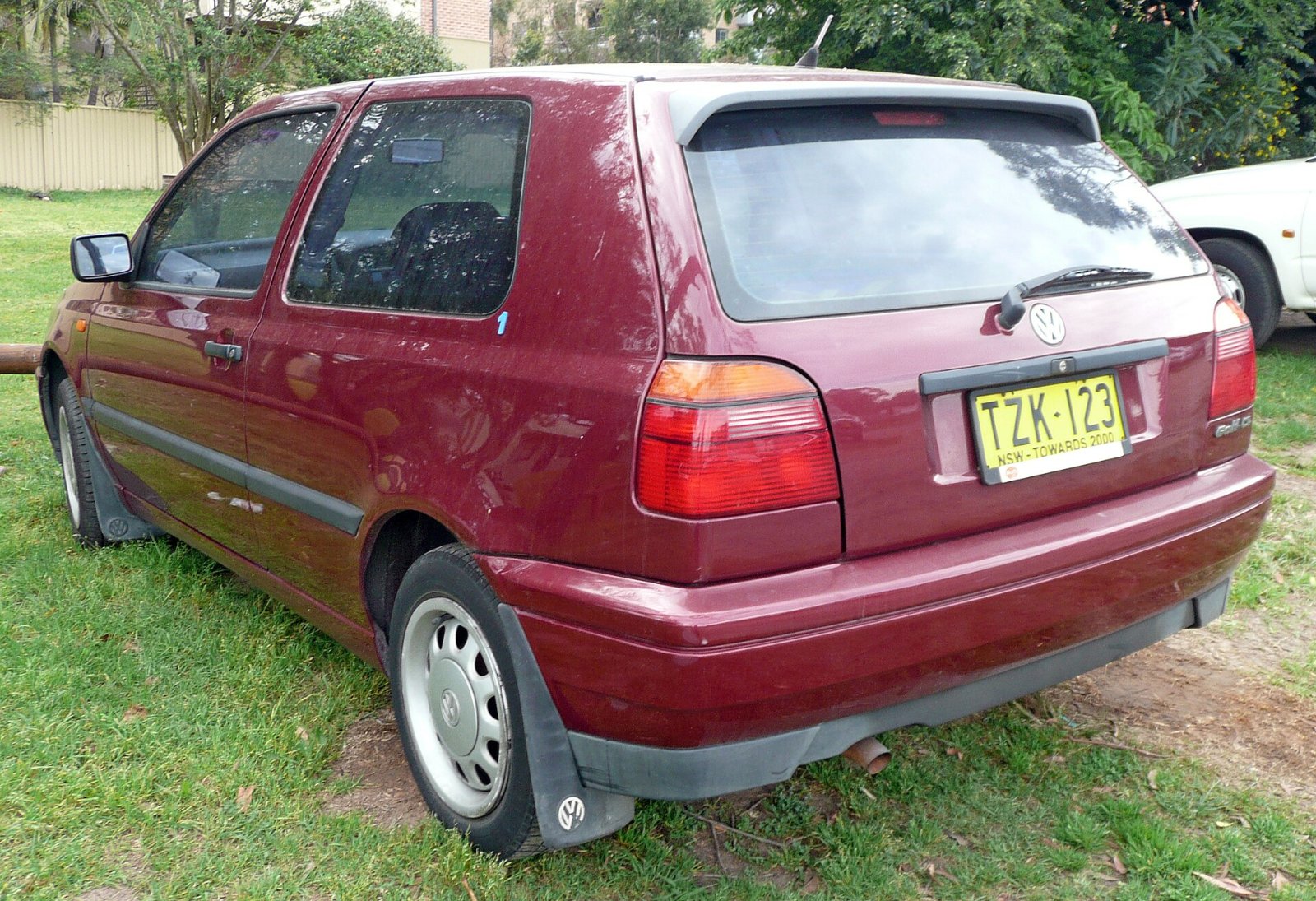
On the Golf III you need no paperwork to tell the early series from the late one. Square indicators in the bumper corner mean before autumn 1995; round indicators in the wing, with bumpers in body colour, mean after it. You can see that from twenty metres. The same facelift made twin airbags standard. From September 1996 every Golf III had ABS with individual wheel control, and from 1997 the trim lines were called Trendline and Comfortline.

One detail from the same model years costs money if you miss it. In 1996/97 Volkswagen changed the coolant from G11 to G12, from blue-green and silicate-bearing to red and silicate-free. The colour in the expansion tank tells you in two seconds which is in there. I found no factory source saying the two do not mix — only the change itself is documented. Red or blue-green: that is all you need.

The Golf III was built in Wolfsburg, in Zwickau in a former Trabant plant, and in Bratislava, Brussels, Sarajevo, South Africa and Mexico. Several trade sources connect the faults of the early years with the ramp-up of those new plants. That is documented as a trade-press hypothesis and nothing more; no comparison of data between the plants exists. Keep it in mind and do not pass it on as fact. Said, yes. Proven, no.
There was no Country, no Rallye and no G60 in this generation, because the scroll charger was not carried over — the VR6 took its place. The special editions turned musical instead. Alongside Europe, Savoy, New Orleans, Avenue and Wilder Süden came Pink Floyd, Rolling Stones, Bon Jovi and, in 1996, the 20 Years of GTI edition. A G60 in a Golf III does not exist.

Why the galvanising question is the wrong one
The commonest question in the Golf forums is whether the Golf II was galvanised and the Golf III was not, and the answer is awkward. Neither of them left the factory with a fully galvanised body. Volkswagen keeps its own chronology of corrosion protection, and it dates the instruction to 1997 — the year the Golf III hatchback went out of production. That is six years after the Golf III was launched.
| Year | What Volkswagen introduced |
|---|---|
| 1978 | the first wax flooding plant for cavities and seams |
| 1983 | Golf II launches with warm-applied wax, a flooded body in white, wheel arch liners, sealed seams |
| 1991 | Golf III launches; water-based paint shops, dynamic corrosion testing |
| 1997 | fully galvanised body ordered |
| 2000 | underbody panelling, PVC paste on cut edges and weld seams |
| 2013 | cathodic dip priming |
| from 2020 | 12 years of warranty against rust-through |
What the Golf II got in 1983 was something else. Warm wax ran through the cavities and folds of the entire body in white, joined by wheel arch liners and sealed seams. The effect was tangible enough that in summer the brown wax soup ran out of the doors and tailgate of freshly delivered cars. That was not a fault. That was the rust protection, flowing again in the heat.
Anyone looking at a Golf II today with spotlessly clean door bottoms should ask where the wax went. Forty years, one steam cleaner too many, a respray with thorough preparation — and the protection is gone without anything showing from outside. After that it rusts like any other car.
There is a dissenting voice, and it belongs here. The buyer’s guide at rad-ab writes that partial galvanising made the Golf II hold up markedly better than its predecessors. Volkswagen itself names no galvanised steel for 1983, and I found no factory source for partial galvanising. Both are possible: that the trade source uses the term loosely, or that individual panels were galvanised without VW mentioning it. Only the wax flooding is documented.
On a car of this age it is not the factory protection that decides anything, but what previous owners made of it. Cavity waxing is therefore not cosmetic; it is the difference between a car that runs another ten years and one that fails its next inspection. Wax, fluid and a spray probe are sold by the specialist car care trade. One dry autumn weekend is cheaper than any weld seam.
Which rusts more — and why nobody knows
The claim that the Golf III rusts worse than the Golf II can be neither confirmed nor refuted from the available sources. The reason is more remarkable than the question. A good deal speaks for the Golf III case. Wikipedia lists the Lopez effect and a local tendency to corrode in the first years among the criticisms. One guide finds that the Golf II, unlike the III, rarely shows severe sill rot. And t-online quotes the German motoring club ADAC on raised corrosion of body and brake lines. There is evidence on both sides.
What argues against the easy conclusion is the predecessor’s own list. A British parts dealer has defined twelve rust zones on the Golf Mk2, structural areas included. A commercial analysis service writes of the GTI 16V that hidden corrosion in sills, floor panels, bulkhead and jacking points threatens the structure. And in the meinGOLF forum the rust list for the Golf 2 is longer than the one for the Golf 3.
No statistic compares the two generations by the same method. The TÜV report for 2026 evaluates 9.5 million roadworthiness tests, in age brackets up to „15 years and older“. For a 1988 Golf II there is no line in it. The ADAC breakdown statistics for 2026 cover cars from two to nine years old. Both large German data sets are blind here. Anyone showing you a „TÜV statistic on the Golf 2“ is showing you something that does not exist.
More precisely, and less satisfyingly: the Golf III’s reputation rests on a cause documented three times over, namely the cost-cutting targets of purchasing chief José Ignacio López de Arriortúa. The Golf II’s rests on a judgment — „remarkable longevity and rust protection“ — that nobody has ever tested. A documented cause and a documented good name are not the same as a measurement. A reputation is not a measurement.
In practice something else beats both anyway. These cars are twenty-nine to forty-three years old. How much rust one carries is decided by its history — garage or street, winter use or summer car, coast or foothills — far more than by its generation. Auto Bild documented an example: a Golf II GTI from Barcelona, because southern Europe modified fewer cars and kept them away from salt. History beats generation. Which spots to work through one by one is what the inspection list below sets out — try it before you drive to the viewing.
Rust on the Golf II, zone by zone
There are no freely usable photographs of the spots that follow, so descriptions stand here instead of pictures. A substitute image showing something else would be worse than none. The severity rating is mine, not the sources’: high means it affects the structure, fails a roadworthiness test or costs more than the car is worth. No photograph, but described precisely.
| Zone | Cause, years | How to check | Severity, documented cost |
|---|---|---|---|
| Windscreen frame, scuttle | old screen rubber, stone chips, standing water; all years, four sources | blisters under the rubber and around the wiper spindle holes; damp carpets after rain are the early warning | high — screen out, frame repaired, new screen |
| Inner sill, behind the trim | water traps in the design, and the trim holds the damp in; 1990s cars in particular | trim off, car on a lift — without that you have seen nothing | high — sill panel 29.95–35.95 € |
| Jacking points | the jack damages the paint, then salt goes to work; all years | look from below, a screwdriver against the seam, and ask first | high — panel OE 191 803 098 F 96.49 € |
| Rail ends at the rear | water in the cavity, wax aged out; forum reports say early cars in particular | empty the boot, endoscope into the cavity, magnet on the seam | high — no individual price found |
| Strut turrets, upper A-pillar | damp in the upper wing area; all years | bonnet up, light up the turret; cars without arch liners are easier to judge | high — a load-bearing point |
| Chassis rails, rear axle mount | underseal lifting lets water in behind it; all years | from below; loose, blistered underseal is a worse sign than visible surface rust | high — not found |
| Rear arches, outer and inner | dirt between inner and outer panel, worse under extensions; all years | clear the dirt, look at the lower 20 to 30 centimetres inside, unbolt the extension | medium — panels 25.95–32.49 € |
| Battery tray | a leaking battery and its acid; all years | lift the battery and probe the panel underneath with something hard | medium — it sits on the chassis rail, and it spreads from there |
| Filler neck | damp behind the rubber sleeve; all years, three sources | pull at the neck or lift the boot carpet | medium — panel 32.95 € |
| Rear panel, back corners | old accident repairs, damp at the seam under the rear lamps | the lower corners under the bumper and the panel at the towing eye | medium — lower rear panel 32.95 € |
| Tailgate | water at the screen seal and behind the handle strip; all years | take the handle strip off, light up the cable grommet | medium — used tailgates in the right colour are getting scarce |
| Door bottoms, trim area | stone chips; behind clipped trim only from 1987/88, because before that it was glued | the bottom edge in daylight, and check the drain holes — if they are blocked, there is water in the door | medium — not found |
| Bulkhead, front rails | stone chips, water from the scuttle; all years | sound deadening off, light up the bulkhead behind the engine | high at the bulkhead, medium at the front panel |
| Sunroof | blocked drain tubes; forum reports say early cars | pour water into the roof channel and watch all four corners | medium — not found |
| Brake lines | age and road salt at the clips; all years | follow them from below, every clip in turn | high — a safety item, and German inspectors fail cars for it |
Documented individual prices exist for panels, not for labour. Workshop hours run between 50 and 75 euros at a specialist and between 130 and 180 at a franchised dealer. One analysis service puts structural welding on a GTI 16V at 1,000 to 5,000 euros. All figures as of 10 September 2026.
Rust on the Golf III, zone by zone
This list is shorter than the Golf II’s, and the reason has nothing to do with the car. For the predecessor there is a parts dealer’s systematic twelve-zone list. For the Golf III there are only scattered individual mentions — and the three relevant collected threads at Motor-Talk returned HTTP 403. That is a finding about the sources. Not about the car.
| Zone | Cause, years | How to check | Severity, documented cost |
|---|---|---|---|
| Sill at the jacking points | as on the Golf II, worse because of the plastic trim; a buyer’s guide reports it far more often than on the predecessor | trim off, test the mounting point with a screwdriver | high — not found |
| Strut top mount | damp in the turret; one documented case from 1993, rusted through over about five by five centimetres | take the top mount cover off and light up the turret | high — forum figures: just under 250 € for a turret, an estimated 200–300 € at a workshop |
| Brake lines | corrosion along the run; all years, three sources, and the classic of this generation | from below, every clip in turn | high — the most frequently named reason for failing a German test |
| Brake hoses | age; Auto Bild calls them particularly vulnerable and often faulted at the first test | a soft pedal with long travel; look at the hoses for cracks and swelling | high — not found |
| Behind the plastic trim strips | damp under the applied strips on doors and side panels | take the strip off — inspecting from outside is worthless, and the clips break as you do it | medium — not found |
| Tailgate | water at the bonded seam of the rear screen and around the handle | strip the tailgate inside, feel along the seal edge, look for blisters under the screen rubber | medium, high once it is through — see the parts situation |
| Fuel filler flap | damp behind the sleeve, as on the Golf II | flap open, lift the sleeve, take the side trim out | medium — not found |
| Wings and arches | dirt and salt under fitted arch extensions | take the extension off, or an endoscope from below | medium — not found |
| Underbody plugs beside the sills | missing or hardened rubber plugs let water into the cavity | car on the lift, check every plug in turn | medium as a cause, high as a consequence |
| Spare wheel well, boot floor | leaking seals, damp in the boot as a common complaint | spare wheel out, wipe the well dry, hose the car down, look again after twenty minutes | medium — not found |
For the Golf III there is no evidence on rail ends, battery tray, lower A- and C-pillar, windscreen frame, chassis rails and front panel. That does not mean those places do not rust on this car; it means I found no source for this generation. Look anyway. An unsupported suspicion costs five minutes; a hole you did not find costs the car.
On water in the footwell the evidence is thin. The forums pass around the scuttle drain, the door membranes and the pollen filter housing; I found no reliable source. Carpet up, press the insulation. What belongs in the bag for a viewing: a strong lamp, a magnet wrapped in cloth to find filler, an endoscope for everywhere you would otherwise have to cut to see. Then a screwdriver, a Torx set and a hosepipe.
The most expensive mistake when buying a Golf is not the rust you can see. It is the rust you did not look for, because looking would have meant unscrewing a trim panel.
The engines of the Golf II
The engine code stands in the German registration document in field P.5, and on the engine itself. On an EA827 it usually sits on the end face of the block at the gearbox flange — though I found no factory source for the exact position, so that comes from practice. That field decides whether the car is what the seller says it is. Everything else is narrative.
| Model | Code | Capacity | Power | Built |
|---|---|---|---|---|
| 1.0 | GN | 1,035 cm³ | 33 kW / 45 hp | 1983–1985 |
| 1.3 | HK / MH | 1,272 cm³ | 40 kW / 55 hp | 1983–1992 |
| 1.3 catalyst | NZ | 1,272 cm³ | 40 kW / 55 hp | 1985–1992 |
| 1.6 | RF | 1,595 cm³ | 53 kW / 72 hp | 1986–1991 |
| 1.6 catalyst | EZ | 1,595 cm³ | 55 kW / 75 hp | 1983–1991 |
| 1.8 | PN / GX / RP | 1,781 cm³ | 66 kW / 90 hp | 1983–1992 |
| GTI 1.8 | EV / PB | 1,781 cm³ | 82 kW / 112 hp | 1984–1992 |
| GTI 1.8 catalyst | RD | 1,781 cm³ | 79 kW / 107 hp | 1985–1988 |
| GTI 16V | RG | 1,781 cm³ | 102 kW / 139 hp | 1986–1987 |
| GTI 16V catalyst | PF | 1,781 cm³ | 95 kW / 129 hp | 1987–1991 |
| GTI G60 | PG | 1,763 cm³ | 118 kW / 160 hp | 1990–1991 |
| Golf Limited | 3G | 1,763 cm³ | 155 kW / 210 hp | 1989 |
| Rallye Golf | 1H | 1,763 cm³ | 118 kW / 160 hp | 1989–1991 |
| 1.6 D | JP | 1,588 cm³ | 40 kW / 54 hp | 1983–1991 |
| 1.6 TD | 1V / JR / MF | 1,588 cm³ | 44–51 kW / 60–70 hp as a range | 1983–1991 |
| 1.6 TD with intercooler | RA / SB | 1,588 cm³ | 59 kW / 80 hp | 1989–1991 |
The catalyst cost measurable power. The GTI 8V lost five horsepower, from 112 to 107, and the 16V lost ten, from 139 to 129. On the 1.6 it runs the other way. RF without a catalyst makes 72 hp and EZ with one makes 75, and since the production periods overlap these are not two stages of development. No source explains the contradiction. Perhaps an error, perhaps a different compression ratio.
On the 16V there are two things to know. The 139 hp engine without a catalyst was in the range for 1986 and 1987 only, which is why it is rare. And the codes KR and PL, which the scene firmly attaches to the 1.8 16V, appear in none of the Golf II sources retrieved. RG and PF are documented. That does not mean KR and PL are invented, only that I cannot source them here. The same goes for the question of which code runs Digifant and which K-Jetronic.
On the diesels a gap remains. For JR and MF no source gives an individual output, only the range of 60 to 70 hp across three codes. JP at 54 and SB at 80 hp are documented. Anyone quoting a single figure for JR has a source I do not.

Cracked cylinder heads dominate the anecdotal literature on the 1.6 diesel, but no reliable source with a crack pattern and a mileage was retrievable. On the 1.9 of the Golf III, cracked heads are documented. That the same swirl-chamber principle sits in the 1.6 makes the transfer plausible but not correct. So I do not make it. What holds for every diesel of these years: after a cambelt change the injection pump has to be retimed. If that is missing from the invoice you are shown, ask.
The engines of the Golf III
In November 1993 the Golf III brought the first TDI in Golf history, the 90 hp 1Z. It also brought the first six-cylinder in a Golf and, at the bottom of the range, a 1.4 that ranks among the least comfortable buying decisions in the series. More on that shortly.
| Model | Code | Capacity | Power | Built |
|---|---|---|---|---|
| 1.4 | ABD | 1,391 cm³ | 44 kW / 60 hp | 09/1991–12/1997 |
| 1.6 | AEX / APQ | 1,598 cm³ | 55 kW / 75 hp | 08/1992–09/1994 |
| 1.6 | ABU | 1,595 cm³ | 55 kW / 75 hp | 09/1994–07/1995 |
| 1.6 | AEA | 1,595 cm³ | 74 kW / 100 hp | 08/1994–10/1995 |
| 1.8 | AAM / ANN | 1,781 cm³ | 55 kW / 75 hp | 09/1991–12/1997 |
| 1.8 | ABS | 1,781 cm³ | 66 kW / 90 hp | 09/1991–09/1994 |
| 2.0 GTI 8V | 2E, plus ADY, AGG, ABA, AKR | 1,984 cm³ | 85 kW / 115 or 116 hp | 2E: 09/1991–09/1994 |
| 2.0 GTI 16V | ABF | 1,984 cm³ | 110 kW / 150 hp | 08/1995–12/1997 |
| 2.8 VR6 | AAA | 2,792 cm³ | 128 kW / 174 hp | 09/1991–12/1997 |
| 2.9 VR6 | ABV | 2,861 cm³ | 140 kW / 190 hp | 08/1994–12/1997 |
| 1.9 D swirl chamber | 1Y | 1,896 cm³ | 47 kW / 64 hp | 09/1991–12/1997 |
| 1.9 SDI direct injection | AEY | 1,896 cm³ | 47 kW / 64 hp | 08/1995–12/1997 |
| 1.9 TD swirl chamber | AAZ | 1,896 cm³ | 55 kW / 75 hp | 09/1991–12/1997 |
| 1.9 TDI | 1Z | 1,896 cm³ | 66 kW / 90 hp | 11/1993–06/1996 |
| 1.9 TDI | AHU | 1,896 cm³ | 66 kW / 90 hp | 07/1996–12/1997 |
| 1.9 TDI with VNT turbo | AFN | 1,896 cm³ | 81 kW / 110 hp | 01/1996–12/1997 |
The 2.0 litres come with a caveat. Wikipedia gives the group 2E, ADY, AGG, ABA and AKR together at 85 kW, while the detailed engine table carries a production period for 2E alone. The other four are documented as codes; their production periods are not. Four codes without a year. Anyone wanting to look a code up will find the code finder directly below, with all 45 engines from both generations.
The worst technical error in the Golf III literature concerns the diesels. One buyer’s guide writes that the turbodiesels suffer failures of the unit injector elements, which have to be replaced every 90,000 kilometres. The Golf III had no unit injectors. The table gives distributor injection pumps throughout, and unit injection arrived in 1999 with the Golf IV. What is probably meant is the injector nozzles, which makes the interval worthless.
What is documented costs more. On the swirl-chamber diesels 1Y and AAZ, cracked cylinder heads are documented, and failing prechambers damage pistons and block. On the TDIs, snapped cambelts around 90,000 kilometres are documented, plus a crankshaft sprocket working loose, from a single source. On a car worth between 700 and 3,500 euros, head damage exceeds the value several times over.
A cambelt interval is deliberately absent here. For the engines of the Golf II and III I could not source a factory figure. The only number in the sources is the observation of failures at 90,000 kilometres on the TDI, which is not an interval. On a belt that has lain in the engine for twenty-three years, its age counts for more anyway, though that too is trade convention rather than documented fact.
The 1.4 ABD is the trap of this range, because two sources independently report piston slap at high mileage. Sixty horsepower in a car of up to 1,380 kilograms is exactly the combination that kills an engine. It gets driven at the limit constantly, because nothing else moves it along. The sensible buy is the 1.8 or the 2.0, and the 150 hp ABF is rated by one guide among the most reliable engines in the range. Sixty horsepower is not enough.
G60 and VR6: the expensive dreams
The G60 is the only engine in these two generations where the risk is not the technology but the market. The scroll charger of the PG measures 1,763 cubic centimetres and makes 160 hp. It ran in 1990 and 1991 in the GTI G60, in the Rallye Golf under the code 1H and in the Golf Limited at 210 hp. There is no photograph of a dismantled charger here, because no freely usable one exists. The market is the risk here.
Inside the charger a displacer scroll works against a fixed housing, sealed by strips running in grooves and driven by a belt of its own. One rebuilder describes exactly what his work covers. A complete seal kit, all bearings in C3 quality including the layshaft bearing the scene calls the wobbly eye, shaft seals rated to 190 degrees, strips made to size rather than cut from stock, and an Optibelt toothed belt 12.0 millimetres wide. Price: 489.00 euros, as of 10 September 2026.
A second firm names the commonest failure as a broken strip guide, which is welded and its groove re-cut, along with wear of the displacer base. At the time of retrieval, both repair listings carried the same note: no new orders can be accepted at present. Anyone buying a G60 buys a dependency on a very small market. The 489 euros sound harmless. The sentence about orders is the expensive part.
Wearing parts for the G60 are unremarkable by comparison: the independent trade lists cambelt kits, water pumps, brakes and wheel bearings as mostly in stock. The charger is the exception, not the rule. Two sources report that modified G60s failed more often than standard ones, which will surprise nobody given an engine with that history.
On the VR6 the sources contradict each other head-on, and the argument is worth reading closely. The magazine Gute Fahrt reproduces the factory position that the timing chain is maintenance-free and needs no replacement. It confirms that it knows of no bad experience even at high mileage. Auto Bild, by contrast, lists a snapped timing chain as serious damage, while retromotion and t-online name something else: broken chain tensioners. Chain or tensioner, that is the question.
Two of the three problem sources are therefore not talking about the chain but about the tensioner. Technically that is a difference, because a maintenance-free chain can perfectly well be defeated by a tensioner that wears out. The contradiction cannot be resolved, so it stands here as it is. On the test drive only one thing helps: listen for rattle from the timing drive.
To this the VR6 adds the head gasket and heat cracks in the cylinder head, both rated serious. The real buying advice for this engine, though, appears in no failure list. Auto Bild Klassik writes that many VR6s suffered engine damage through tuning, which makes an unmodified low-mileage example rare and sought after.
Gearboxes, brakes, electrics
On gearboxes I have to disappoint you. The five-speed of the Golf II is the 020 and the stronger successor the 02A. On their weaknesses I found almost nothing reliable: on ratios, oil quantities and differential failures the accessible sources say nothing. Exactly one fault is documented: wear of the second-gear synchro, which crunches on a fast change and can be checked in thirty seconds. On the Golf III the automatics count as troublesome, from two sources, though neither says which failure is meant.
At the axles the findings of both generations repeat themselves. Wheel bearings wear noticeably and count as a fixed repair after purchase. Driveshaft gaiters split and let dirt into the joint, the suspension bushes harden, and on the Golf III the rear axle bushes work loose. All of that is wear, and none of it is chance.
The most important sentence in this chapter is not about rust. One trade source speaks of bodies hammered soft on modified cars with lowered suspension, because years on short springs without matched dampers work away at the mounting points. You cannot see it from outside. That is the best reason to walk away from a lowered example.
The front brakes of the Golf II are called VW II and are modestly sized, and the socket bolts in the calipers round out easily. The rear handbrake mechanism seizes when it is not used — which mostly catches cars advertised as having „stood in a garage for years“. The most useful diagnostic tip concerns the brake servo. mobile.de reports that leaks there occasionally cause an uneven idle, and anyone who then hunts in the engine is hunting at the wrong end of the engine bay. An air leak, not the mixture.
The clutch, one workshop source says, is happy to give up, and replacing it needs special tools. A trade site estimates 500 to 800 euros while flagging its own figures as estimates without guarantee. VW Classic Parts lists brake pads under 1H0 698 071 for 26.99 euros. That this number appears in both the Golf 2 and the Golf 3 catalogue shows how much the two cars share. Estimates remain estimates.
The central electrics of the Golf II sit in the cabin under the dashboard, and you need to know two things about them. There are two fusebox layouts, divided by August 1987, and two generations of the central electrics, the second arriving with the 1989/90 facelift. Anyone ordering wiring diagrams therefore has to know the year first. The wrong diagram costs an afternoon. On the central electrics of the Golf III, incidentally, I found no reliable source at all.
ABS was available on the Golf II from February 1987 at a steep extra cost, and in 1990 it was 1,800 marks. Auto Bild documents a car showing that even a 1989 GTI did not have to have it. A Golf II without ABS is the normal case. For the ATE MK20 hydraulic unit of the Golf III, a working repair market exists. One supplier quotes 189.00 euros without recoding; a second 199 euros for a repair, 299 plus a 200-euro deposit for an exchange unit and 499 euros for an on-site service.
On the part numbers of the ABS control units these two suppliers contradict each other. One gives the 1J0 number group for the Golf 3, which is the Golf IV group; the other gives 1H2, which is the Golf III group. One of the two is very probably misfiled. Do not order a number you have not read off the car yourself.
The pneumatic central locking with its vacuum pump is the dominant electrical topic in the Golf III forums. Even so I found no reliable trade source on its mounting position or repair costs, and no freely usable photograph of the pump exists either. What any buyer can check is banal and effective. Lock the car, put an ear to the boot, and if the pump runs on for more than a few seconds the system leaks. That is workshop logic, not a source, and it stands here as such. The sources give no more.
On Digifant and Mono-Motronic fault patterns this text offers nothing, and that is not carelessness. One forum’s Digifant glossary was retrievable only as a page index, and a settings-data page ran into a redirect loop. The threads on the idle actuator and air mass meter could be captured only as search hits. Writing about it needs workshop literature that is not freely available online. This gap stays open.
The test drive, step by step
Most test drives are too short to prove anything. The engine needs fifteen to twenty minutes to reach operating temperature, and only after that do gearbox and bearing faults become audible. The sources give thirty to forty-five minutes as a minimum. A ten-minute run at a dealer counts as a warning sign.
First, cold. The engine has to be cold before anyone touches anything, and the test for that is a hand held beside the manifold area, not on it. A pre-warmed engine in a thirty-five-year-old car is a reason to move the appointment.
Second, the dry body in daylight. First the walk round, looking at panel gaps and differences in paint. Then the screen frame, the door bottoms with their drain holes and the inner arches. Then the sills with the trim off, the jacking points, the filler neck, the tailgate and the battery tray with the battery lifted. Last the strut turrets and bulkhead, the emptied boot, the lifted footwell carpet and the ramp.
Third, the first sixty seconds. Warning lights must go out after about three seconds. Blue smoke means burning oil, white smoke when cold is condensation and normal, black means an over-rich mixture. The idle sits typically between 700 and 900 revolutions; stumbling points to the injection, knocking on start-up to worn hydraulic lifters. Blue smoke on a 16V means valve guides, typical from around 200,000 kilometres and put at 1,000 to 2,500 euros.
| What you hear or smell | What it probably is |
|---|---|
| clicking on lock, under load | a driveshaft joint, usually after a split gaiter |
| a hum that changes as you steer | a wheel bearing |
| a crunch changing quickly into second | the second-gear synchro ring |
| knocking at the rear over expansion joints | rear axle bushes (Golf III) |
| the rear brakes barely working | drum brakes lose effect with age (Golf III) |
| the handbrake pulling to one side | the rear mechanism has seized (Golf II) |
| rattle from the timing drive | VR6 chain tensioner — see the contradiction above |
| a whistle that rises with boost | G-charger: strips, bearings |
| a soft brake pedal with long travel | brake hoses (Golf III) |
| an uneven idle with nothing wrong in the engine | a leaking brake servo (Golf II) |
| burnt rubber pulling away | the clutch at its end, 500–800 € |
| a sweet smell with the heater running | coolant — matrix, hose, cracked expansion tank |
| fuel in the cabin or boot | the tank sender flange or the lines |
Fourth, the drive. Two minutes of town traffic for engine and steering, two minutes of bad surface for the suspension, two minutes at 80 on a country road for tracking and bearings. Then two minutes of acceleration for the gearbox and one minute of hard braking. That is the core, and the remaining half hour is there to get everything warm. Afterwards look under the car for drips, check the colour in the expansion tank and look for a mayonnaise-like emulsion on the oil cap.
Two preparatory steps pay off beforehand. Look at the last roadworthiness report. It tells you what an inspector saw on this exact car no more than two years ago — the single most valuable sheet of paper in the whole business. And compare the vehicle identification number in several places against the documents.
⚖ A legal question, and with it the sentence that holds for this whole text: I am not a lawyer, and nothing here is legal advice. On liability during a test drive, one trade site passes on a rule of thumb. At a dealer with fully comprehensive cover the driver is liable only for gross negligence, and in a private sale for ordinary negligence as well. It names no legal basis for that. The relevant German law is the loan provisions of sections 598 ff. of the Civil Code and the case law on implied exclusions of liability. In a private sale the agreement belongs on paper before the drive.
Anyone who does not trust themselves with this can hand it over. Professional used-car checks at DEKRA, TÜV or the ADAC cost between 49 and 150 euros. On a Golf II GTI in the 8,000 to 15,000-euro bracket that is one to two per cent of the purchase price. The cheapest part of the whole undertaking.
Paperwork, historic plates, road tax
⚖ This chapter deals with German law, because that is the market these cars mostly change hands in. I am not a lawyer, and none of it is legal advice; it is research. Where a legal basis is known it is named, and where the source names none, that is said too. The registration office, the tax office and, in case of doubt, a lawyer are what binds.
The German registration document carries over thirty fields, and five of them decide almost everything on these cars. Field B holds the first registration and with it age, tax and the claim to a historic plate. Field E holds the seventeen-digit vehicle identification number, field P.2 the output in kilowatts, field P.5 the engine code. Fields 2.1 and 2.2 hold the manufacturer and type key numbers. In documents from before October 2005 the two key numbers sit in fields 2 and 3. Five fields, no more.
Here lies a trap that costs half an afternoon. Volkswagen today carries manufacturer key number 0603, but the Golf II runs under 0600. Make an insurance or parts enquiry using 0603 and you find nothing, and nobody on the telephone will explain why.
One concrete insurance group is documented. A Golf II with 40 kW, key numbers 0600 and 610, sits in 2026 in third-party group 11, partial cover 11 and fully comprehensive 10. Since the comprehensive scale starts at 10 and runs to 34, that is the cheapest group there is. Something follows from that which contradicts the classic-car market: a classic policy need not be cheaper on this car than an ordinary tariff. Work out both.
On the chassis number: the first three characters are the manufacturer identifier, WVW for Volkswagen passenger cars. Positions four to nine carry the type identifier, where 1H denotes the Golf III. Position ten is the model year as a rolling code, position eleven the plant. Because the model year code repeats every thirty years, a J means 1988 or 2018. The number alone does not date the car.
⚖ The legal basis of the German historic plate is section 23 of the road traffic licensing regulations for classification as a classic, and section 9 of the motor vehicle tax act for the tax. Several sources name both in the same terms. One testing organisation says the assessment happens within a roadworthiness test under section 29, and that originality and condition are what is examined.
The conditions are manageable: at least thirty years since first registration, good condition or a proper restoration, a positive assessment and a valid test certificate. The Golf II has qualified since 2013 and late examples since 2022. The Golf III’s turn came in 2021, a 1994 car in 2024; the last 1997 hatchbacks follow in 2027 and the cabriolet only in 2032. The cabriolet takes longest.
What destroys the claim is, on these two cars, the real buying decision. Non-period modifications count against it, as do too many modifications at once, and lowering and widening are named expressly. One guide warns specifically for the Golf II that cheap suspension kits, cheap alloy wheels and tinted glass do not count as period. With a surviving population the modifying scene has shaped for thirty years, that is the hurdle most cars on offer fall at.
Anyone wanting to put a car back starts with the wheels, because they are the most visible. Period sizes on these cars run between 13 and 15 inches, and which size is entered stands in the documents; tyres and complete wheels can be found by key number. Remember 0600, not 0603.
| Cost of a historic plate | Source A | Source B |
|---|---|---|
| Classic assessment under section 23 | 80–200 € | 100–400 € |
| Roadworthiness test | 50–100 € | 80–150 € |
| Re-registration | 26–30 € | around 40 € |
| Plates | 25–40 € | 20–30 € |
| Total per source A | 180–370 € | not totalled |
The two ranges for the assessment contradict each other, and I do not average them. The difference probably comes down to region and testing organisation, though neither source says so. The tax, by contrast, is unambiguous and documented four times over: 191.73 euros a year, flat, whatever the capacity and engine type. Since October 2017 historic and seasonal plates can be combined; the source gives section 9(5) sentence 4 no. 2 of the tax act as the basis.
Whether it pays depends less on capacity than on emissions class. One source documents real figures from practice. Tax of 329 euros for a 1.3 litre and 276 euros for a GTI 16V, because the larger engine has a regulated catalyst. Neither figure carries a date and both serve only as an order of magnitude. Anyone wanting certainty works it out with the key number and the federal finance ministry’s tax calculator.
⚖ The most useful advantage in practice stands in the 35th federal emission control ordinance, whose annex 3 exempts cars with historic and red trade plates from the emissions sticker. The ADAC confirms that they may enter low-emission zones without one, whatever the fuel and emissions class. The reasoning is the low annual mileage of classics, which the ADAC puts at 1,000 to 3,000 kilometres a year. Diesel bans, by contrast, are set locally: Stuttgart, Munich and Darmstadt exempt historic plates, but not automatically.
The strongest reason to look for a historic-eligible Golf III is usually discovered after the purchase. A Golf III 1.9 TDI without a historic plate gets no green sticker, and is therefore barred from the low-emission zones of around forty German cities. The same car with a historic plate may go anywhere. It does not apply abroad — France requires a Crit’Air sticker, Italy has its ZTL zones.
⚖ Two points stand here with a caveat. A single source writes of new EU rules from 2026 under which emissions-relevant changes would have to meet Euro 7-like limits, and engine tuning would need a parts certificate or individual approval. It names neither regulation nor date — an unconfirmed single statement, not the law. And R12 is a CFC whose use is prohibited in the EU under the Montreal Protocol, though I did not find the specific implementing regulation. Converting to R134a needs a new drier, all the O-rings, new compressor oil and adapters, and costs 300 to 1,000 euros.
What it costs
A price without a date is worthless, so every figure here carries its date — and one warning belongs first. For the Golf II and III I have no price guide by condition grade. The VW pages of the youngtimer price guide were not in the retrievable extract, and the one valuation site found returned HTTP 403. The figures below come from the trade press and from watching the market.
| Golf II | Date | Figure |
|---|---|---|
| t-online | early 2026 | standard versions 3,000–6,000 €, GTI 8,000–15,000 €, G60, Rallye and rare special editions 15,000–25,000 € |
| mobile.de | 10.9.2026 | good examples from around 5,000 €, sought-after variants over 10,000 €, a Golf II Limited over 100,000 € if one is available at all |
| Auto Bild Klassik | 10.9.2026 | original GTI 16V typically 5,000–10,000 € |
| carchecker | 10.9.2026 | GTI 16V typical purchase price 13,400 €, range 8,600–18,900 € |
| Auto Bild Klassik | 1.10.2019 | „The market has reached the bottom.“ Base models under 2,000 € |
| CLASSIC.COM | 10.9.2026 | Mk2 GTI: benchmark 17,145 USD, average 14,968 USD, top bid 76,160 USD at Pebble Beach in August 2026 |
Four sources, four ranges, all with the same retrieval date — and their midpoints lie around sixty per cent apart. That is not a failing of any one source. It is the real spread of a market in which condition, originality and the question of the catalyst matter more than the model on the plate. Anyone quoting a single figure for „the Golf II GTI“ has not looked at the market. Condition decides, not the model.
More interesting is the time series. In October 2019 Auto Bild Klassik wrote that base Golf II models could be had under 2,000 euros. In early 2026 t-online names 3,000 to 6,000 for the same class. The floor has doubled to tripled in six years.
| Golf III | Date | Figure |
|---|---|---|
| t-online | 10.9.2026 | most cars 700–3,500 €; rare special editions and original VR6s with historic plates over 10,000 € |
| retromotion | 10.9.2026 | well-kept examples 15,000–20,000 €; the great majority between 700 and 3,500 € |
| Auto Bild | 25.1.2025 | cared-for VR6s in original condition from about 15,000 €, modified ones from around 5,000 € |
| CLASSIC.COM | 10.9.2026 | Mk3 GTI VR6: benchmark 11,340 USD, average 14,286 USD, currently none on offer |
| AutoScout24 | 10.9.2026 | used cars from 295 € |
The most telling single figure in this chapter appears in two articles from the same editorial desk. Auto Bild described the same Golf III VR6 twice: built in 1997, 57,000 kilometres, four-speed automatic. In November 2019 it was advertised at 24,950 euros, in January 2025 at 49,950. In five years and three months the asking price doubled, on a car that covered about 3,000 kilometres in that time. That is the movement of an asking price, not a sale price, because nobody records whether the car changed hands in between.
The spread on the Golf III is not a contradiction but a market split in two. A 1.6 is a used car, an original VR6 is a collector’s car, and a factor of twenty lies between them. The German classic-car index published by the VDA does not help, because it rests on 88 vehicles, and no source says whether these two are among them. Two markets, one badge.
That leaves the costs after purchase, and on these cars they are the real item. One workshop source gives a rule of thumb of a thousand euros for two years of test certificates on a Golf 2. An analysis service puts the annual running cost of a GTI 16V at 750 to 1,500 euros, and structural welding on it at 1,000 to 5,000.
The soberest figure comes from a restoration guide and from no price list. The investment should exceed the later market value by at most thirty per cent — evidenced by a BMW E30 on which 31,500 euros met a market value of 27,000. For the Golf 2 GTI the same source names the rolling restoration expressly. Repair in stages while the car stays in use, 3,000 to 18,000 euros over two to five years. At a market value between 5,000 and 15,000 euros that is the realistic calculation. A full restoration is not.
Complete documentation raises the resale value by ten to fifteen per cent, according to the same source. It is the only item on this list that costs nothing but tidiness. Anyone who preserves their car and documents the work later sells two things: the car, and the proof that someone cared. And care and preservation products are the cheapest item of the lot.
Parts, and the deal-breakers
Volkswagen lists twenty-eight main categories for the Golf 2 and the Golf 3 in its Classic Parts catalogue, named identically, from the exhaust system to the wipers and washers. In one place the offering is astonishing.
| Part | Part number | Price | Model |
|---|---|---|---|
| A-pillar | 1H0 809 206 | 166.49 € | Golf 3 |
| Brake pads, set | 1H0 698 071 | 26.99 € | Golf 2 and 3 |
| Brake pads premium, set | 1H0 698 151 | 46.99 € | Golf 2 |
| Clutch parts, set | 032 198 141 AX | 126.49 € | Golf 3 |
| Exhaust centre section | 1H0 253 203 B | 92.49 € | Golf 3 |
| Fuel lines, set | 1H0 130 295 K | 41.99 € | Golf 3 |
| Third brake light | 1H6 945 122 | 33.99 € | Golf 3 |
| Key blank 16V | 191 837 202 A | 73.49 € | Golf 2 |
| Front quarter window | 191 845 241 A | 111.99 € | Golf 2 |
| Front exhaust pipe | — | 1,041.49 € | Rallye Golf |
The A-pillar is the most surprising line in this whole piece of research. Volkswagen supplies a structural body part for a thirty-year-old family hatchback, new, off the shelf, for the price of a set of winter tyres. Anyone who thinks a Golf III can no longer be repaired has not looked in the catalogue. 166.49 euros for structural steel.
Right beside it stands the deal-breaker. The windscreen category exists in the Golf 3 catalogue but contains not a single item, and the query answers „the search returned no hits“. For the Golf 2 thirteen glasses are listed, between 55.99 and 167.49 euros, but they are exclusively door and side glass. A windscreen is not in the factory range for either generation.
You can buy a structural body part from Volkswagen, but not the glass you have to remove to reach it. And that is why the windscreen frame — the best-documented rust zone on the Golf II — is more than a sheet-metal problem. Taking out a thirty-year-old bonded screen often breaks it, and the replacement then comes from the aftermarket or from a donor car.
A second curiosity from the same catalogue: the front quarter window costs 111.99 euros. Quarter windows in the doors existed only until the 1987/88 facelift, so Volkswagen supplies a part that has not been fitted for thirty-nine years. Add fourteen lines of trim strips for the Golf 2, between 10.49 and 77.49 euros. The Rallye Golf has a chapter to itself.
The independent market covers the body panels, from 25.95 euros for inner arch panels to 96.49 euros for a jacking point. It gets difficult with the special editions: for Fire and Ice, GTI and G60 one guide reports that the parts hunt can take weeks or months. On interior parts I can say nothing reliable.
Which one to buy
If you want a car to drive rather than to invest in, the answer is dull and right. In the Golf II the 90 hp 1.8 from 1988, in the Golf III the 1.8 or the 2.0; and if it has to be a GTI, then the ABF. Several independent buyer’s guides rate these engines the most durable in the range, and they are cheap enough that a rusty panel does not mean the end. None of them is a collector’s car.
If you want a collector’s car, one sentence covers it. Originality beats condition. A perfectly restored Golf II GTI with modern suspension and aftermarket wheels can be a grade 2 car and still be worth less than an original grade 3 one. And it will not get a historic plate either. Classic Data grades condition, originality and history separately, and so does the market.
The cars I would be careful with can be named. The Golf III 1.4 with 60 hp in a car of up to 1,380 kilograms. The swirl-chamber diesels 1Y and AAZ, whose head damage exceeds the value of the car. Any lowered example, because of those hammered-soft mounting points. And the G60, unless you know who will rebuild your charger should the one firm still doing it close its books.
Between the generations the decision is, in the end, not a technical one. The Golf II is dearer, better documented and more comfortable on parts. The Golf III is cheaper, worse documented and, in the mass, still a used car whose original examples are just now becoming scarce. The same company built both on the same platform, with the same rust protection at the factory. What separates them is mostly what happened to them afterwards.
One question this text cannot answer, and it is the most interesting. Nobody has ever measured whether the Golf III really rusts worse than the Golf II. One is advised by the trade press, the other tells itself stories in forums. If you run one, you know more on this point than any statistic: you know where your car went first. I collect findings like that, ideally with year, plant and where the car lives.
Further reading
These pieces are so far published in German only; English versions follow as the archive is translated.
- VW Golf: der Notnagel, aus dem 37 Millionen Autos wurden — the whole line from 1974 to today, with the numbers behind each generation (in German).
- Motorkennbuchstaben bei Audi und VW — where the code sits, what it means and why 1H means two things (in German).
- H-Kennzeichen, Steuer und Versicherung — the German historic-plate arithmetic in detail, including when a classic policy really pays (in German).
- Fahrzeugschein: alle Felder erklärt — B, E, P.2, P.5 and the two key numbers, field by field (in German).
- Kaufberatung Mercedes W124 — the same method on a car where the galvanising question ends differently (in German).
- Kaufberatung BMW E30 — the rival on which the restoration guide runs its 31,500-euro sum (in German).
- Lackpflege am Youngtimer — what helps forty-year-old paint and what ruins it (in German).
- Karosseriereparatur in Mischbauweise — why repair panels and spot welds are treated differently today (in German).
- Motor-Generalüberholung: der Ablauf — what happens when the head of the 1.9 really has cracked (in German).
- Der Kabelbaum-Mythos der Neunziger — the story behind the accusation the Golf III also caught (in German).
Sources
All online sources retrieved on 10 September 2026. Titles are left in their original language, because a translated title would misstate the reference. Material from buyer’s guides, workshop pages and community sources is marked as such in the text. Forum sources count here as experience and never as evidence for a figure.
- Ahnenreihe des VW Golf, eigenes Vordossier mit 99 Quellen, 6.9.2026.
- VW Golf II. de.wikipedia.org
- VW Golf III. de.wikipedia.org
- Wo rostet ein Golf Mk2? Heritage Parts Centre, Zwölf-Zonen-Aufstellung. www.heritagepartscentre.com
- Die Geschichte des VW Golf Mk2. Heritage Parts Centre. www.heritagepartscentre.com
- VW Golf 2 Kaufberatung, Schwachstellen. rad-ab.com. www.rad-ab.com
- VW Golf 3 Kaufberatung. rad-ab.com, mit dem Pumpe-Düse-Irrtum. www.rad-ab.com
- VW Golf 2 in der Kaufberatung. mobile.de Magazin. www.mobile.de
- Rost- und Problemstellen Golf 2/3. meinGOLF.de, Erfahrungswissen. www.meingolf.de
- VW Golf 2, Schwachstellen. R+V24 Magazin, 16.10.2013. magazin.rv24.de
- Kaufberatung Golf 2. Philip’s Auto-Blog, 6.5.2020. philipsautoblog.com
- Kaufberatung VW Golf GTI 16V. AUTO BILD KLASSIK. www.autobild.de
- VW Golf 2, welchen soll man kaufen? AUTO BILD KLASSIK. www.autobild.de
- VW Golf II GTI, Unterschätzt. autorevue.at. www.autorevue.at
- Golf 1.8 GTI 16V Mk2, Kosten. carchecker.pro, kommerzieller Analysedienst. www.carchecker.pro
- VW Golf 2 GTI aus Spanien. AUTO BILD. www.autobild.de
- VW Golf II bei Sammlern. t-online, Preise Anfang 2026. www.t-online.de
- Golf III, unterschätzter Klassiker. t-online. www.t-online.de
- Der VW Golf III im Club der Oldtimer. retromotion.com. retromotion.com
- VW Golf 3, Infos und Preise. AutoScout24. www.autoscout24.at
- Dieser VW Golf 3 soll 50.000 Euro kosten. AUTO BILD, 25.1.2025. www.autobild.de
- VW Golf 3 VR6, niedrige Laufleistung. AUTO BILD KLASSIK, 8.11.2019. www.autobild.de
- Golf Mk2 GTI Market. CLASSIC.COM, USD. www.classic.com
- Golf GTI VR6 Mk3 Market. CLASSIC.COM, USD. www.classic.com
- Classic Data Zustandsnoten. www.classic-data.de
- Youngtimer Pocket Price Guide 2025/26. classic-analytics. www.classic-analytics.de
- Deutscher Oldtimer-Index. VDA, 7.4.2025. www.vda.de
- Oldtimer-Index des VDA. VAU-MAX. www.vau-max.de
- Soviel kosten Oldtimer von VW. AUTO BILD KLASSIK, 1.10.2019. www.autobild.de
- Golf 3 VR6, Steuerkette wartungsfrei? Gute Fahrt, VW-Werksangabe. www.gute-fahrt.de
- Federbeindomaufnahme durchgerostet. golf3.de, Erfahrungswissen. www.golf3.de
- Aufschlüsselung einer Fahrgestellnummer. golf3.de. www.golf3.de
- Fahrgestellnummer im VW-Konzern. VCDS.de Wiki, ISO 3779. wiki-online.vcds.de
- VW Golf 3, ABS-Steuergeräte. ABS Steuergeräte GmbH. www.abs-steuergeraete.de
- ABS-Reparatur ATE MK20 Golf III. Endera Digitaltechnik. www.endera.de
- R12 auf R134a umrüsten. GTS-Shop, Montrealer Protokoll. gts-shop.de
- Korrosionsschutz bei VW. Auto-Medienportal, VW-Chronologie. www.auto-medienportal.net
- Quality Talk Korrosionsschutz. Driving Times, 10.3.2020. drivingtimes.de
- Rostgarantie bei VW. MotorZeitung.de, braune Wachssuppe. motorzeitung.de
- Classic Ersatzteile Golf 2. Volkswagen Classic Parts. www.volkswagen-classic-parts.com
- Classic Ersatzteile Golf 3. Volkswagen Classic Parts. www.volkswagen-classic-parts.com
- Golf 2, Tür- und Seitenscheiben, 13 Positionen. VW Classic Parts. www.volkswagen-classic-parts.com
- Golf 3, Windschutzscheiben, kein Treffer. VW Classic Parts. www.volkswagen-classic-parts.com
- Golf 2, Zier- und Dekostreifen, 14 Positionen. VW Classic Parts. www.volkswagen-classic-parts.com
- Classic Ersatzteile Rallye Golf. VW Classic Parts. www.volkswagen-classic-parts.com
- Reparaturbleche Golf 2, OE 191803098F. OldtimerWerk. www.oldtimer-werk.de
- Ersatzteile Golf 2 GTI G60, PG. AUTODOC. www.autodoc.de
- G-Laderüberholung, 489,00 €. Röttele Racing. roettele-racing.de
- Instandsetzung G40/G60/G65. Theibach Performance. theibach-performance.de
- Golf 2 Kupplung wechseln. carwiki.de, Schätzwerte. carwiki.de
- Oldtimer-Restauration, Kosten 2026. Chromradar. chromradar.de
- Kraftstoffpumpe und Tankgeber. VW-Hilfe. www.vwhilfe.com
- Golf 2 Sicherungskasten. sicherungsbelegung.de. sicherungsbelegung.de
- TÜV-Report 2026. TÜV-Verband. www.tuev-verband.de
- ADAC Pannenstatistik 2026. www.adac.de
- ADAC Gebrauchtwagen-Checkliste. www.adac.de
- Probefahrt Gebrauchtwagen. fahrzeugschein.de. www.fahrzeugschein.de
- Gebrauchtwagen-Checkliste, 25 Punkte. fahrzeugschein.de. www.fahrzeugschein.de
- HSN und TSN finden. fahrzeugschein.de, HSN 0603. www.fahrzeugschein.de
- Fahrzeugschein lesen 2026. Motor.com.de. motor.com.de
- VW Golf II (0600/610) Typklassen 2026. Autoampel. www.autoampel.de
- H-Kennzeichen 2026. oldtimer-4you.de. oldtimer-4you.de
- H-Kennzeichen, Gutachten. AUTO ZEITUNG. www.autozeitung.de
- H-Kennzeichen 2026, Kosten. Motor.com.de. motor.com.de
- Oldtimereinstufung nach § 23 StVZO. FSP Prüfstellen. www.fsp.de
- Oldtimer-Steuer 2026. bussgeldkatalog.org. www.bussgeldkatalog.org
- Dürfen Oldtimer in die Umweltzone? ADAC. www.adac.de
- Umweltzone und Fahrverbot 2026. Chromradar, 35. BImSchV. chromradar.de
- VW Golf 2 Oldtimer kaufen. Classic Oldtimer. www.classic-oldtimer.at
- Golf I und II Kaufberatung. auto motor und sport, robots.txt. www.auto-motor-und-sport.de
- Golf 3/Vento, Rost. MOTOR-TALK, HTTP 403. www.motor-talk.de
- Marktpreis Golf II GTI Edition One. Zwischengas, HTTP 403. www.zwischengas.com
- Reparaturleitfäden Golf 2 und III. kfz-verlag.de, nur Buchtitel.
- Bestand nach Handelsnamen (FZ 2). Kraftfahrt-Bundesamt. www.kba.de
- Forenquellen, nur als Index: Doppel-WOBber, VAGBoard, Passat35i. www.doppel-wobber.de
- Kaufberatungen Golf 2 und 3 Cabrio. R+V Magazin, nicht auswertbar. www.ruv.de
- VW Golf, Neuzulassungen 2025. Statista, Bezahlschranke. de.statista.com
- Golf-Generationen und Produktionszahlen. Volkswagen Newsroom. www.volkswagen-newsroom.com
- 25 Jahre VW Golf Country. Zwischengas. www.zwischengas.com
- 40 Jahre Volkswagen Golf II. MotorZeitung.de. motorzeitung.de
- Gebrauchtwagen-Check VW Golf III. AUTO BILD. www.autobild.de
- Die Geschichte des VW Golf 3. VAU-MAX, Lopez-Effekt. www.vau-max.de
- VW Golf 1 bis 7 im Überblick. AUTO BILD KLASSIK. www.autobild.de
Bernd Mischke writes in Bernies Garage about car engineering, design and the people behind them. Tips, corrections and disagreement go to bernd [at] bernies-garage [dot] com.
Do you run a Golf II or Golf III?
Wanted: the spot where your car rusted first, with year, plant and where it lives. There is no survey covering these two generations — the more cars, the more solid the map.
Workshop Post
Once a month a letter from the garage: new articles, finds from the research, occasionally a question for you.