
15 chapters · 1 interactive timeline · 1 schematic drawing · 58 sources
- What this is about
- Maybach-Motorenbau from its founding in 1909 to the end of car production in 1941
- Cars built
- Between 1,700 and 2,400 in twenty years, depending on who counts. The same works turned out more than 140,000 engines by 1945
- The real subject
- The gearboxes. Preselect at the wheel, change on the overrun, no clutch pedal — documented by three patents from 1934 and 1936 (chapter 6)
- Share of turnover
- Cars were down to roughly ten per cent by 1932. Half the money came from railcar engines
- Who owned it
- Karl Maybach held twenty per cent of the company that carried his name. The majority shareholder was Luftschiffbau Zeppelin
- The hardest finding
- Across the whole Weimar Republic, Maybach turned a profit in only three years (chapter 3)
- What is not here
- The Maybach marque of 2002 to 2012, and Mercedes-Maybach from 2015. This article stops in 1941
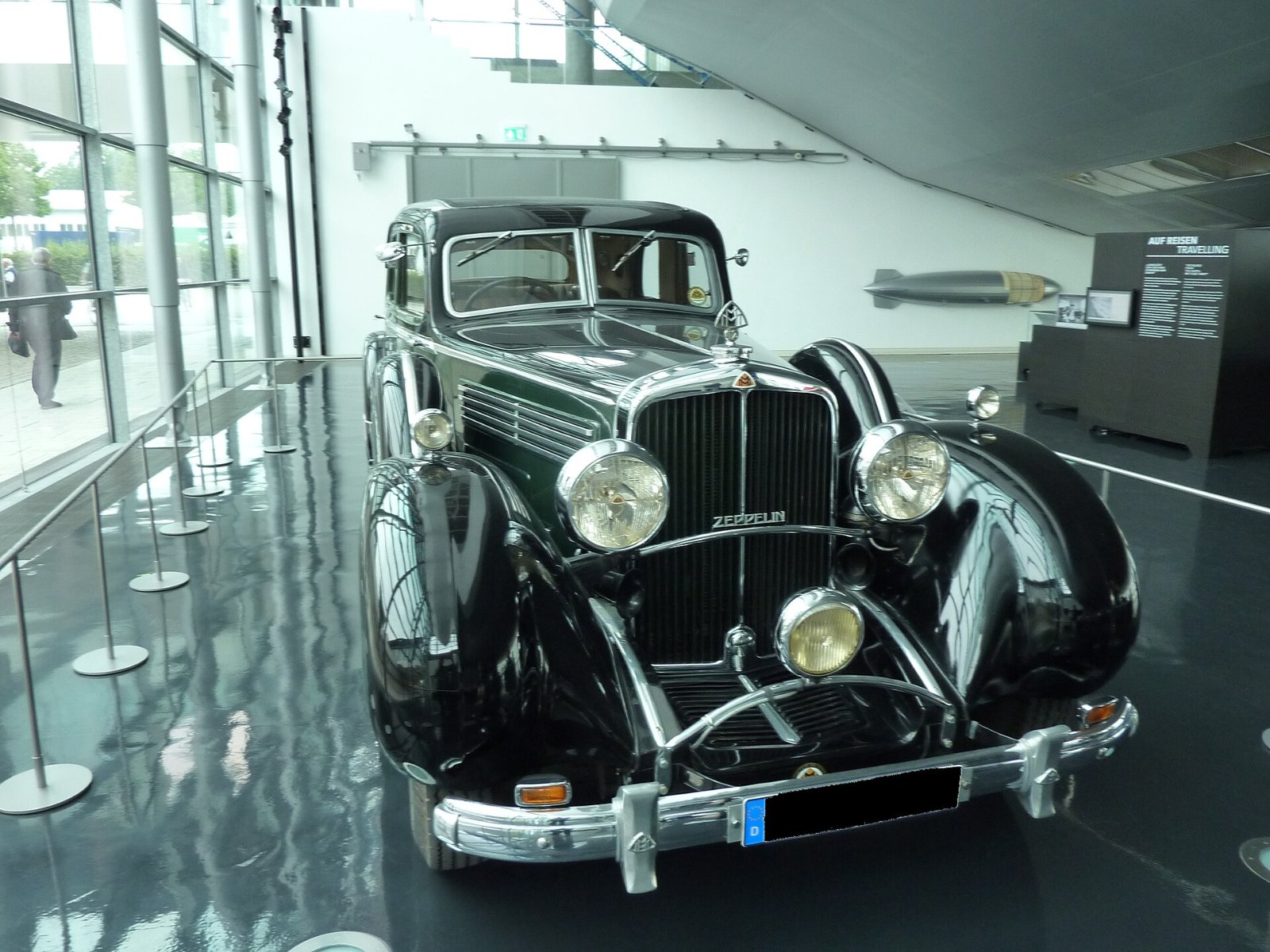
Maybach was never a car manufacturer. The company built between 1,700 and 2,400 cars in twenty years. It lived on airship engines, then on railcar engines, and finally on tank engines. By 1932 cars had fallen to roughly a tenth of turnover. And it came to car building because a Dutch customer went under and left a warehouse full of engines behind. That is not a footnote. It is the key to everything that makes these cars technically peculiar.
I worked through ninety-six sources for this article, among them three patents that appear in none of the usual Maybach accounts. They are the most interesting part. They set out how the famous preselector gearbox actually worked, and they name a man nobody else names. More on him later.
A note on units. Power figures follow the German convention, in PS, written here as hp. One PS is 0.986 British horsepower, so the difference hardly matters. Prices are in Reichsmark, the currency of the day. For scale, the average annual income in 1924 was 1,233 RM.
Three years in the wrong place, six years without its own name
The company legend begins at Friedrichshafen, and that is already the first mistake. The firm was founded on 23 March 1909 at Bissingen an der Enz near Stuttgart, as Luftfahrzeug-Motorenbau GmbH. The move to Lake Constance came only in the spring of 1912. Karl Maybach joined as technical director on 1 November 1909. That December he drew the type AZ: a straight six of 20.5 litres, 140 hp at 1,050 rpm.
At the time of the move the workforce was twenty workers and three clerks. From then on the company was called plainly Motorenbau GmbH. The name Maybach did not appear in it at all for six years. Only on 16 May 1918 did the shareholders resolve to rename it Maybach-Motorenbau GmbH, announced on 1 June, signed by Karl Maybach and Theodor Winz. The English-language Wikipedia dates that step to 1912. Six years out.
Between 1912 and 1918 the workforce grew from 23 people to 3,600. That is a factor of 157 in six years — and by the end the engine subsidiary employed more people than Luftschiffbau Zeppelin itself.
The man whose name stood over the gate was an employee
Karl Maybach owned twenty per cent of his own company. The majority shareholder was Luftschiffbau Zeppelin, so the man whose name stood over the gate held nothing but a blocking minority. Read this company history as the biography of an entrepreneur and you read it wrongly. The engineer ran the house technically. Others decided whether it survived: Alfred Colsman, and later Hugo Eckener, who ran the airship works. Maybach was an employee.
The father needs putting straight too, because Wilhelm Maybach, born in Heilbronn in 1846, had nothing to do with the firm at Friedrichshafen. At Daimler he had developed the spray-nozzle carburettor, the Phoenix engine and the honeycomb radiator. He left the Daimler-Motoren-Gesellschaft in 1907 after a quarrel over racing policy and the experimental shop, and died in Stuttgart on 29 December 1929. The honorific „king of designers“ sticks to him to this day; who coined it is unknown. I come back to that question at the end.
Three profitable years in the whole of the Weimar Republic
Here are the figures that turn up in no anniversary piece. Roman Köster went through the books of Maybach Motorenbau GmbH for a business-history conference paper. The result is sobering.
| Year | Turnover | Result |
|---|---|---|
| 1926 | 3,893,000 RM | −1,396,000 RM |
| 1927 | 4,571,000 RM | −1,398,000 RM |
| 1928 | 4,807,000 RM | +641,000 RM |
Between 1924 and 1927 the losses added up to some four million Reichsmark, and in 1925 the company needed a loan of two million. Hugo Eckener recorded in 1926 that the business had been running at a deficit for six to eight years. Across the whole Weimar Republic, Maybach made a profit in only three years. Anyone wondering why these cars exist in such small numbers will find the answer in that table. It was not a business.
A car maker by embarrassment
Going into cars was not a strategy but a way out of a corner. The Treaty of Versailles banned German aero-engine work in 1919. The company looked for new customers and supplied sixes to Trompenburg in Amsterdam, who built the Spyker marque. The Maybach Car Register still lists that delivery as a line of its own: „Spyker Type C4, 1920–1925: 150 units“. When Trompenburg filed for bankruptcy, Maybach was left sitting on a stock of engines — and built cars around them.
The first of those, the W 1 of 1919, still used a bought-in Daimler chassis and remained a one-off. The W 3 appeared at the Berlin motor show on 23 September 1921. The company advertised it on two points, neither of them about power: a gearbox without gearchanging and four-wheel brakes. Of the roughly 300 W 3 built, the company’s own source says not one survives today. Not one.
What such a car cost makes the small numbers easy to understand. The chassis alone was 24,000 Reichsmark, the body another 15,000 to 25,000. The average annual income that year was 1,233 Reichsmark. A W 3 therefore cost roughly nineteen times what an employee earned in a year — and that was for the bare chassis. The body came on top.
An engine test bed on a mountain top

Before the gearboxes, the engines that made the company deserve a look, because that is where its way of thinking began. The Mb IVa of 1916 was the world’s first production high-altitude engine, and it had no supercharger. It answered the loss of power at height with oversized cylinders and raised compression — 165 mm bore, 180 mm stroke, 23.096 litres, 6.08:1. The contemporary handbook carries the word in its title: überverdichtet, over-compressed. English renderings turn that into „supercharged“ with tiresome regularity. It means precisely the opposite.
An engine like that is too strong at sea level and has to be run throttled. So it had three carburettor settings, changed in flight: „La“ for ground level, „V“ up to 1,800 metres, „H“ above that. A mechanic worked at the carburettor inside the engine gondola while the ship climbed.
To test the engine at altitude at all, Maybach built a test bed on the Wendelstein in 1917, inside a plain timber shed at 1,840 metres. The heavy parts went up by rack railway, the engine delivered the expected 240 hp up there, and the military ordered it in quantity.
Three further habits of these engines belong here, because they show how people at Friedrichshafen thought. The twelve-cylinder VL I and VL II were reversible through engageable cams. They ran either way round, which gave the airship reverse thrust. The VL II could burn petrol or Blau gas — Blau gas has roughly the density of air, so burning it barely changed the ship’s buoyancy. And Karl Maybach laid his airship engines out to be repaired while running: in the gondola, in flight, over the sea. Repairability was a design goal here, not merely a question of how easy the thing was to service in a workshop.
Between 1928 and 1934 the Graf Zeppelin covered 1,008,000 kilometres on its original engines. The design brief said so explicitly: continuous running over long periods at the lowest possible consumption.
The Abweisklaue: a part that refuses the gearchange
People who write about Maybach write about twelve cylinders and prices. The part that everything turns on technically appears in almost no retelling. It is called the Abweisklaue, the deflecting dog, and it does exactly what the name says. It deflects the gearchange for as long as that change cannot be made cleanly.
The problem it solves is familiar to anyone who has changed gear without synchromesh. A dog clutch will only engage when the two halves are turning at nearly the same speed. Otherwise the dogs hammer against each other. Maybach’s answer was to put ramps on the tooth crowns. When tooth meets tooth, they slide down those ramps and push the two halves apart, instead of jamming into one another. Only once the speeds converge do the teeth drop into the gaps, and the gear is in.
So the driver chooses, and the geometry decides the moment. No synchroniser ring, no friction work inside the box, no clutch pedal — only a shape. It makes a botched change physically impossible. The first documented use is the Maybach W 5 SG of 1928, in the auxiliary overdrive box with its ratio of 0.63.
The workings are documented not just in a dictionary sense but in patent law. The Austrian patent AT 149232 B, filed by Maybach Motorenbau, records that the system works „particularly well with overrunning dog clutches, in which ramp faces prevent engagement until the speeds are equal“. That is the Abweisklaue, described in the firm’s own words.
It outlived the company by decades. The principle moved into the Mekydro gearboxes for rail vehicles and ran there as far as the German class 218 diesel, handling 2,000 kilowatts. A shift element from a 1928 luxury car was still moving locomotives in the nineteen-eighties.
What the patents say — and who wrote them
Three patents describe how the deflecting dog grew into a complete automatic shift. They are freely available, and apparently still barely read.
| Patent | Priority | Core claim |
|---|---|---|
| AT 149232 B | 8 August 1934 | Pressure is released to the shift cylinders as soon as the driver lifts off the throttle. A control valve works from throttle position, so the box can change up under acceleration and down on the overrun |
| DE 678713 C | 1 November 1936 | The shift cylinder. Inventor: Carl Boettner. The applicant’s successor in title today is Rolls-Royce Solutions GmbH |
| AT 159239 B | 31 October 1936 | The working medium is named explicitly as „vacuum or compressed air“. A shut-off valve is returned to the closed position by the flowing medium itself, through a branch line |

Three findings from them are worth spelling out.
First: preselection is meant literally. Selector members distribute the pressure, and preselecting the gear moves those members. The lever at the steering wheel therefore shifts no gears at all. It only sets the paths the pressure will take. The change itself happens later, at the moment the driver lifts off.
Second: there is an escape route for hill work. The same patent provides an auxiliary device that disengages the main clutch, so the dog clutch can be released at all on a steep climb. Dogs bind under load. The designers knew it, and they built the way out at the same time. That is exactly the difference between an idea and a production part.
Third: the valve ends its own shift. In the 1936 patent, the flowing medium returns the shut-off valve to the closed position through a branch line. A self-resetting shift, with no return spring and no electrical feedback, using the medium as its own timekeeper.
And then there is the name. DE 678713 C names Carl Boettner as the inventor, and the same man ran the company from 1949 alongside Karl Maybach and Jean Raebel. An engineer patents a shift cylinder in 1936 and thirteen years later runs the firm. He appears in no Maybach account I have found. That is the single find of this research that I set most store by.
Eight gears are four times two
The Doppelschnellgang, the twin overdrive, is the marque’s most misunderstood term. It does not mean a doubly high overdrive. It means a two-speed auxiliary box behind the main gearbox that doubles every ratio. Four gears in the main box times two gives the Zeppelin’s eight forward speeds; three times two gives the six of the W 6 DSG. The arithmetic comes out exactly. It also explains how Maybach reached gear counts nobody else had, without a single extra gear set in the main box.
How many gears the Zeppelin DS 8 actually had cannot be settled. Four statements sit side by side, and I put them here as they are.
- Eight forward gears, all in constant mesh, eighth an overdrive — „possibly the first car gearbox with eight forward speeds“, with that reservation stated
- Eight gears by way of the twin-overdrive unit
- Five to seven quiet ratios with semi-automatic preselection, designated DSG 80 or SRG
- From 1938, a ZF seven-speed as an option
Most likely various gearbox versions were offered across ten model years, and the sources describe different ones. But that is my guess, not a source. Nor can it be settled how the driver chose gears. One source names two levers on the steering column, a second a rotary knob on the wheel, a third a single lever. Here too: name all three, declare none.
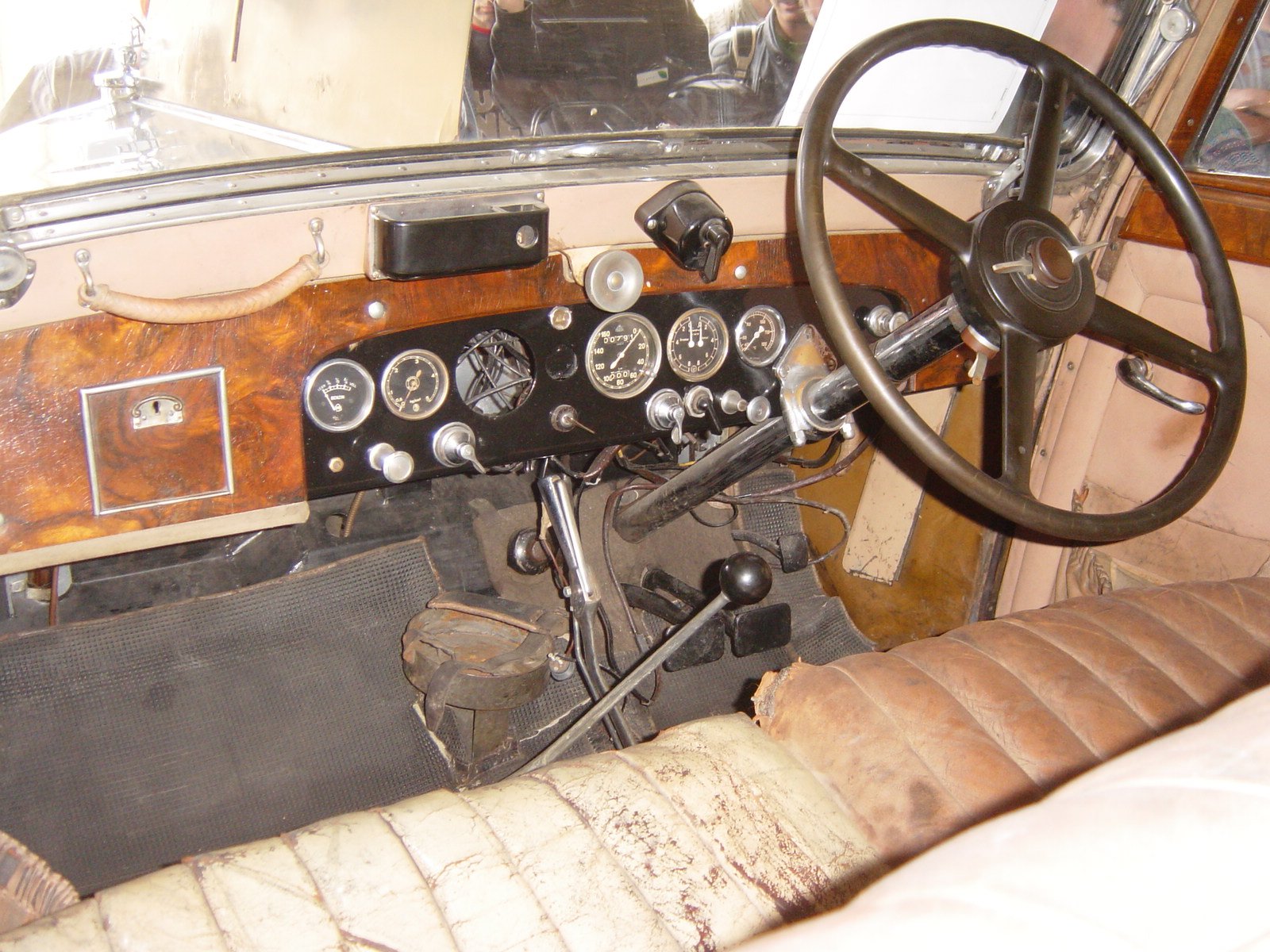
The sequence, on the other hand, is documented. Only first gear was engaged with the clutch and the left foot. Every other ratio was preselected, and lifting off the throttle let the next one drop in. The name of the system is documented too, but only by one original document. There exists a Bedienungsanleitung und Ersatzteileliste Maybach Variorex Typ 328145 — handbook and parts list — dated 8/1942, 72 pages. Its full title names three assemblies: the Variorex control, the multi-plate clutch, and the Beschleuniger, the accelerator. What that assembly did exactly, none of the sources I checked will say. By its name and by the patents, it actively matched shaft speeds so the dogs would take. Whoever gets hold of those 72 pages can finish this chapter. I could not.
The luxury car gearbox in a tank — and why it failed
In 1939 the Maybach preselector went into tank production almost unchanged, as the Variorex SRG 32 8 145 with ten forward gears and one reverse, fitted to the Panzer III in the Ausf. E, F and G. The driver preselected, and the change ran as soon as he pressed the clutch pedal. That is the same sequence as in the Zeppelin, with a different trigger.
It went wrong, and the reasons are recorded with remarkable precision. Frequent gearchanges produced excessive friction and clutch wear. To ease that, the rotating masses had to be kept small, which led to smaller gearboxes that were untried and insufficiently tested — and so to serious mechanical failures. An accelerator clutch was retrofitted, the trouble remained, and from the Ausf. H a simpler gearbox replaced the Variorex.
Here you can see what Maybach’s gearboxes really were: workshop constructions. As long as trained chauffeurs operated them and the service bay stood in Ravensburg or Friedrichshafen, they worked. Under field conditions, with hastily trained drivers and repairs in the mud, they failed.
That is also the honest answer to why nobody else built such a thing. Comparable systems certainly existed — the French Cotal preselector, for instance, often found in a Delahaye. The difference is licensing. Wilson, Cotal and de Normanville licensed their designs widely. Maybach sold its gearboxes to nobody. They went into the company’s own vehicles and nowhere else. So there were no volumes, no falling unit costs, and no pressure to simplify. That explains why the designs were allowed to be so elaborate — and why they disappeared with the firm.
How seriously the other side took the matter shows in a document from 1945. W. K. Temple wrote a thirty-page analysis for the School of Tank Technology at Chertsey, titled The Maybach-Variorex gearbox as fitted to Pz.Kpfw III. It sits in the Imperial War Museum today and, as far as I can see, has barely been read since.
Eight gears from three yes-or-no decisions
The development that followed is called Olvar OG 40 12 16, sits in the Tiger I from 1942, and is the most elegant piece of engineering in the whole series. The name runs together Öl and Variorex: the oil-pressure version. Eight gears forward, four back, ratios from 15.4:1 in first to 0.98:1 in eighth. Eighth is an overdrive again, exactly as in the Zeppelin.
The shift itself is the remarkable part. Three hydraulic cylinders, two positions each, controlled friction clutches on four shafts. The German description puts it plainly: „the combination of the three cylinders, effectively a 3-bit binary code, allowed eight different ratios“. Two to the power of three is eight. There is nothing more to it. This is a binary decoder built from hydraulic cylinders, made in 1942, worked by a ball valve and a lever that the driver pushed sideways into its gate.
One detail shows the scale of the thing. The oil pumps sat on an engine-driven shaft, and the gearbox shared its 32 litres of oil with the steering gear. The driveline was not reliable throughout — but it gave the vehicle a nimbleness remarkable for its weight.
The cars: three capacities, one power output

| Model | Built | Engine | Power | Number |
|---|---|---|---|---|
| W 1 | 1919 | Straight six on a Daimler chassis | 46 hp | 1 |
| W 3 | 1921–1928 | Straight six, 5.7 l | 70 hp | 300 to 305 |
| W 5 / W 5 SG | 1926–1929 | Straight six, 6.99 l, 94 × 168 mm | 120 hp | 248 to 300 |
| W 6 / W 6 DSG | 1931–1935 | Straight six, 6.99 l | 120 hp | 40 to 100 |
| DSH | 1930–1937 | Straight six, 5.2 l | 130 hp | 34 to 50 |
| Zeppelin DS 7 | 1929–1934 | V12, 6.96 l | 150 hp | 183 together |
| Zeppelin DS 8 | 1930–1939 | V12, 7.92 l, 7 camshaft bearings | 200 hp | |
| SW 35 | 1935–1941 | Straight six, 3.5 l | 140 hp | 707 together |
| SW 38 | 1936–1939 | Straight six, 3.8 l | 140 hp | |
| SW 42 | 1939–1941 | Straight six, 4.2 l, compression 6.6:1 | 140 hp |
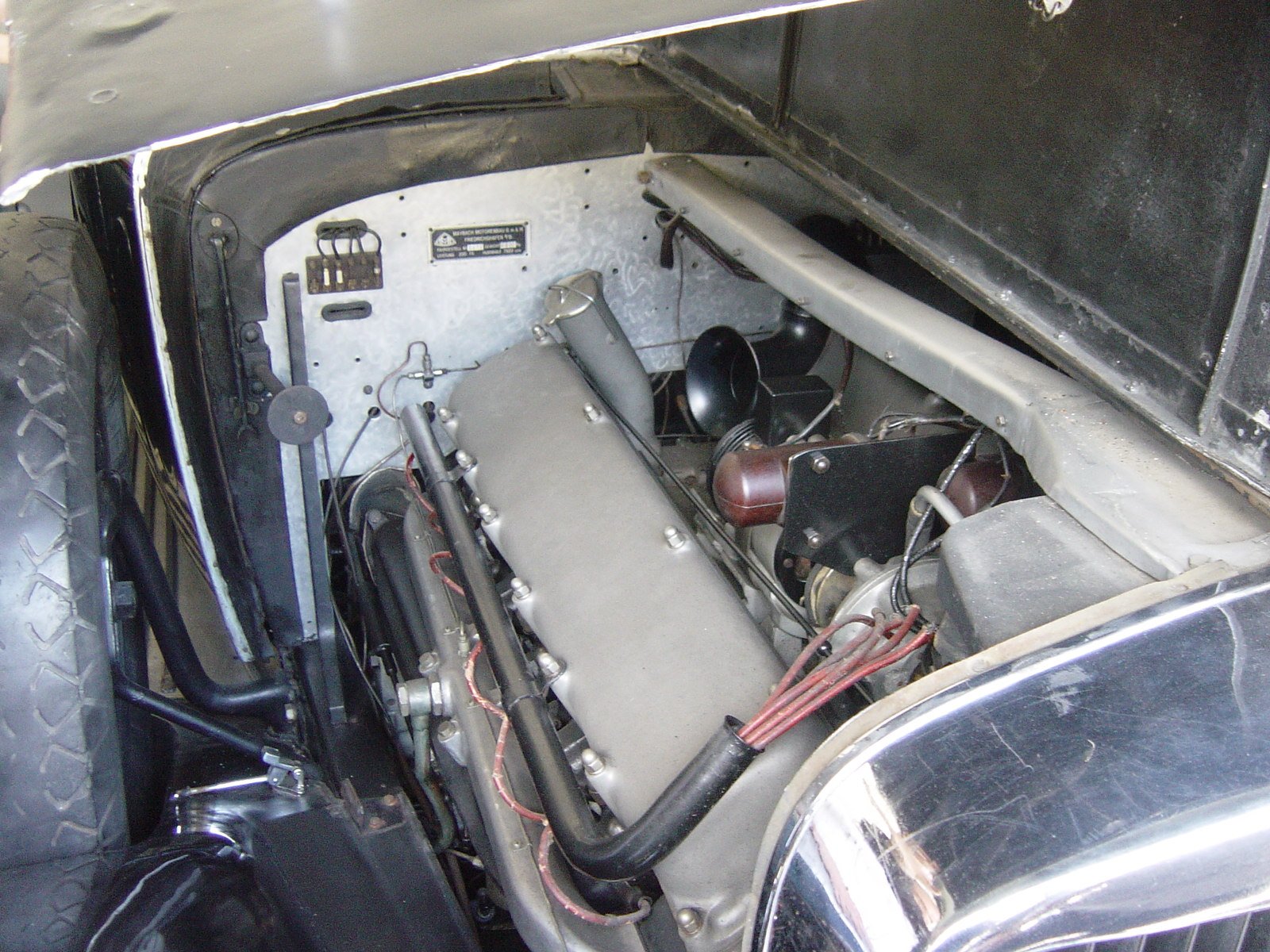
Three things stand out in that table. First, the SW series has three different capacities and always the same 140 hp. The extra capacity went into torque and smoothness, not peak power — a habit that comes straight out of airship engine work. Second, „SW“ is not a model number but a description of the layout. It stands for Schwingachswagen, swing-axle car, after the independent suspension front and rear. Third, the SW 42 had its compression lowered to 6.6:1, because of fuel quality. The war reached into the design before it stopped the production line.
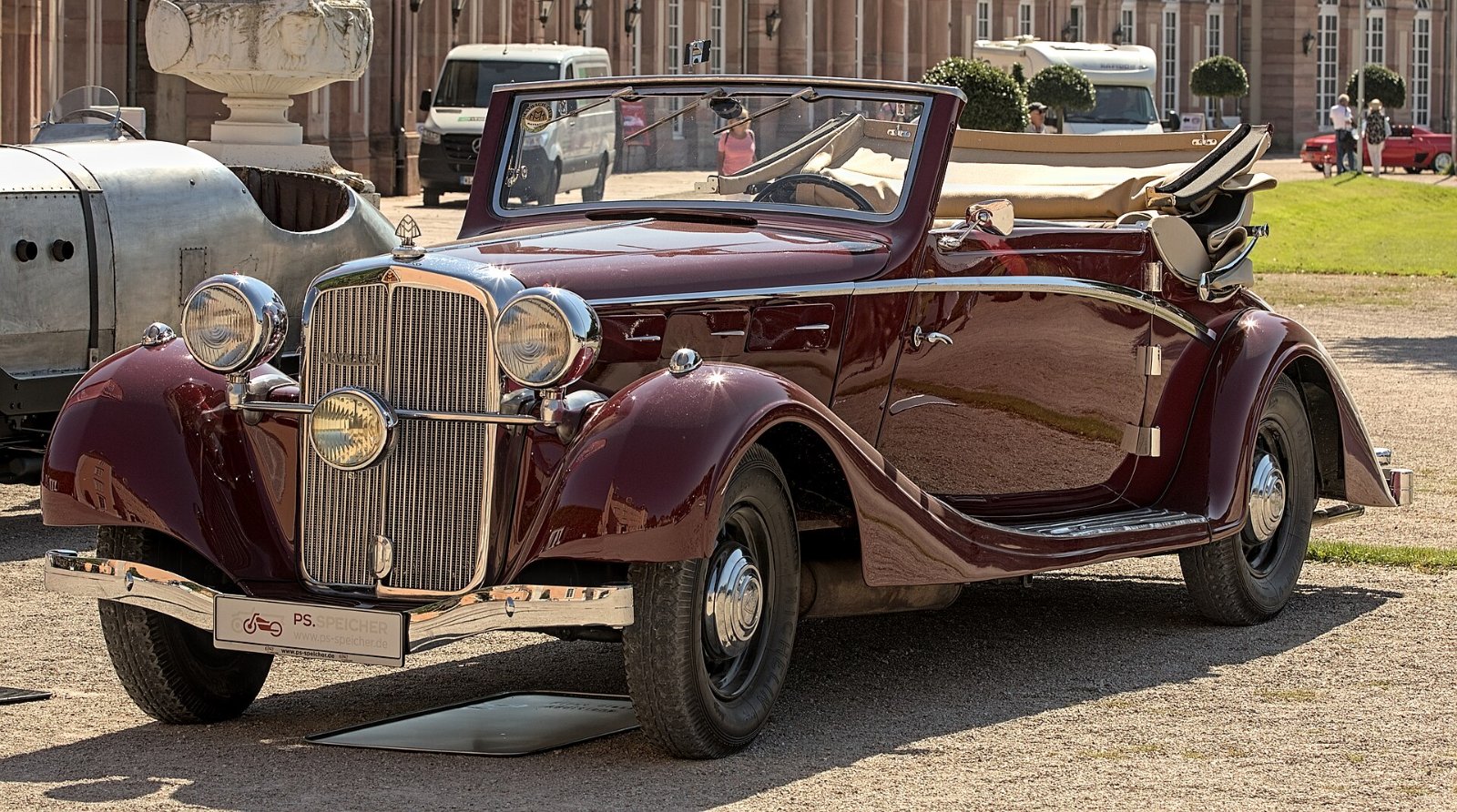
Maybach did not in fact build cars. It built chassis, and the bodies came from outside. The recommended coachbuilder was Hermann Spohn in Ravensburg, some nineteen kilometres from the works. The relationship was exclusive in neither direction: Maybach also worked with Erdmann & Rossi and Saoutchik, while Spohn bodied Hispano-Suizas and, after the war, built Veritas sports cars and plastic bodywork.
And since the question always comes: yes, there was a car with gold and rubies in it. In 1928 a Maybach saloon with such fittings is said to have been ordered for 186,000 Reichsmark, which came to 125 BMW Dixis. The sources for that are anniversary features without citations. The story stands here as an anecdote, not as evidence.
What saved the company was the railway
From 1933 and 1934 rail engines made up half of turnover, and by December 1934 Maybach led that market. Cars were down to roughly ten per cent by then. The best known vehicle is the Fliegender Hamburger, the Flying Hamburger, which on a trial run on 19 December 1932 covered 286 kilometres in 142 minutes. That is 120.8 km/h door to door, every slowing included, with a top speed on the day of 175 km/h.
Two Maybach twelve-cylinder GO 5 diesels of 410 hp each drove it. One widespread error is worth clearing up right here: the Flying Hamburger had no Maybach gearbox. It was diesel-electric, with dc generators and traction motors. Putting the preselector into that train confuses two quite different Maybach businesses.
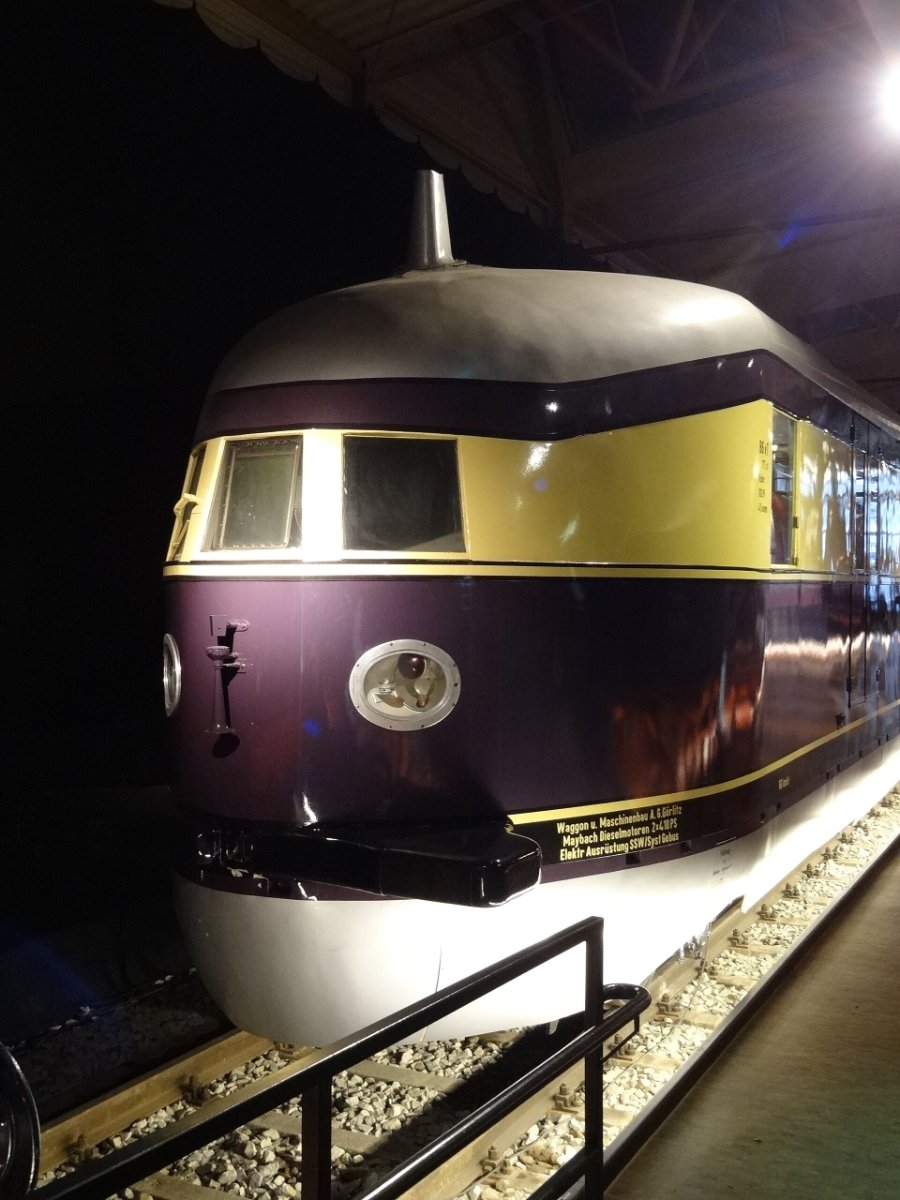
The GO 5 carries the most precise production figure in the whole dossier, and it is not a car: 146 engines by 1 January 1937. Its successor the GO 6 first managed 46,000 kilometres, later 150,000 with better maintenance. The post-war GTO 6 showed almost no wear after some 600,000.
Forced labour: what is documented, and what is passed on wrongly
This section belongs in the article, even though marque portraits usually leave it out. Maybach Motorenbau is one of the four Friedrichshafen firms that used forced labour. By June 1941 at the latest, some 14,000 forced labourers were working in the town. The two Maybach camps were called Seeblick I and Seeblick II and stood on the Hochstraße; research describes the conditions there as very poor. The cost of guarding the labourers was deducted from their wages, at least forty Reichspfennig a day — when a loaf of bread cost thirty-eight.
One distinction gets blurred almost everywhere, and it matters. On the current state of research, concentration camp prisoners were employed only by Luftschiffbau Zeppelin, not by Maybach. Statements to the contrary go back to an investigative error of 1973 that was later corrected. That exonerates nobody — forced labour remains forced labour — but it is a difference, and historical accuracy does not stop where it becomes uncomfortable.
Karl Maybach held the title Wehrwirtschaftsführer, a military-economy leader, and sat on the tank commission. After the war the workforce argued that they had „built no tanks, only the engines for them“; a French official noted in October 1947 that the works had been „proud of its tank engines“. Both statements are documented, and they stand here side by side, because together they show how the house saw itself. The standard work on the subject is Christa Tholander’s Fremdarbeiter 1939 bis 1945 of 2001. I have it in the bibliography but was unable to consult it.
Why 1941 was the end
From 1941 no car left the works at Friedrichshafen again. The reason is mundane and still rarely put this plainly: the capacity was needed elsewhere. By the end of the war Maybach had produced over 140,000 engines and 30,000 semi-automatic gearboxes. For comparison, twenty years of car building produced between 1,700 and 2,400 cars. The ratio is about one to sixty. Cars were never the business.

The company itself did not disappear. Karl Maybach ran it from 1949 with Jean Raebel and Carl Boettner, withdrew in 1952 and died at Friedrichshafen on 6 February 1960. Daimler-Benz took over in the same year. In 1966 came the merger into Maybach Mercedes-Benz Motorenbau GmbH, and in 1969 that became the Motoren- und Turbinen-Union, MTU for short. Since 26 August 2014 the house has belonged wholly to Rolls-Royce — which is why the patents of a Friedrichshafen gearbox engineer from 1936 today belong to a British group.
Five sentences you will read about Maybach and had better not repeat
„King of designers“. The honorific for Wilhelm Maybach has no documented origin. Three mutually exclusive datings are in circulation: France in the 1890s, the Nice week of 25 to 29 March 1901, and the Paris salon of 1903. One of the sources states outright that it cannot name the originator. What carries the phrase today is mainly the heritage communication of a large manufacturer.
„The world’s first production V12 for passenger cars“ — said of the Maybach Zeppelin. That is wrong. The Packard Twin Six was in production from 1915.
„The first car gearbox with eight forward speeds“. The English source puts „possibly“ in front of it. The reservation belongs in the quotation.
„The first car in Germany with four-wheel brakes“ — said of the W 3. The company source asserts it as fact; an independent source puts „reportedly“ in front. Mark it as a claim.
„The Mb IVa was built under licence at BMW as the BMW IVa“. A single claim from one encyclopaedia source, unconfirmed, and at odds with the usual account, in which the BMW IIIa and IV were Max Friz’s own designs. Anyone wanting to draw that line needs better evidence than I found.
One question remains, and I have no answer to it. The Abweisklaue is a part that makes misuse mechanically impossible, rather than catching it electronically. It worked for eighty years, from a luxury car of 1928 to a diesel locomotive of the eighties. Why it vanished from cars, while every shift decision there has since migrated into software, cannot be answered from the sources. Only the observation remains that Maybach never sold its gearboxes to anyone else.
Sources
All online sources retrieved on 10 September 2026. Source titles are left in their original language; translating them would misstate the reference. Where the text says „not found“, I looked and found nothing.
- DE 678713 C: Steuervorrichtung für das Druckmittel einer Schaltvorrichtung für Wechselgetriebe. Anmelder Maybach Motorenbau, Erfinder Carl Boettner, 1936/1939
- AT 149232 B: Steuervorrichtung für das Druckmittel einer Schaltvorrichtung für Wechselgetriebe. Maybach Motorenbau, Priorität 8. August 1934
- AT 159239 B: Steuervorrichtung für das Druckmittel einer Schaltvorrichtung für Wechselgetriebe. Maybach Motorenbau, Priorität 31. Oktober 1936
- Maybach Variorex Typ 328145. Bedienungsanleitung und Ersatzteileliste, Ausgabe 8/1942, 72 Seiten (Faksimile-Nachweis)
- W. K. Temple: The Maybach-Variorex gearbox as fitted to Pz.Kpfw III. School of Tank Technology, Chertsey 1945. Imperial War Museums
- Beschreibung, Betriebs- und Montage-Vorschriften zu dem Maybach-Flugmotor Bauart Mb IVa, 260 PS, überverdichtet
- Stefan Zima: Getriebe-Entwicklung. In: Technikpionier Karl Maybach, Springer Vieweg 2021, S. 425–443
- Stefan Zima: Luftschiff- und Flugzeugmotoren 1909 bis 1918. In: Technikpionier Karl Maybach, S. 305–325
- Eckermann / Treue / Zima (Hrsg.): Technikpionier Karl Maybach. Antriebssysteme, Autos, Unternehmen. 3. Auflage, Springer Vieweg 2021
- Roman Köster: Zeppelin. The airship and the need for diversification after WW I. EBHA-Konferenzbeitrag 2008 (PDF, enthält die Bilanzzahlen)
- Elmar L. Kuhn: Maybach Motorenbau GmbH. Aus: Luftschiffbaukonzern und Friedrichshafen in den 1920er Jahren
- Martin Ebner: Die Entnazifizierung von Zeppelin, Maybach, Dornier & Co.
- Christa Tholander: Fremdarbeiter 1939 bis 1945. Ausländische Arbeitskräfte in der Zeppelin-Stadt Friedrichshafen. Klartext 2001 (bibliografischer Nachweis)
- Denkstättenkuratorium NS-Dokumentation Oberschwaben: Gedenkorte Friedrichshafen
- Gedenkweg zur NS-Zwangsarbeit in Friedrichshafen. seemoz (nennt die Lager Seeblick I und II)
- Ausländische Arbeitskräfte im Zweiten Weltkrieg. Landesbildungsserver Baden-Württemberg
- Die Tochterfirmen und die Arbeiter in Friedrichshafen in der Zeppelinzeit. Landesbildungsserver Baden-Württemberg
- KZ-Außenlager Friedrichshafen. Wikipedia (enthält die Korrektur des Ermittlungsfehlers von 1973)
- Von der Luftfahrzeug-Motoren GmbH zur Maybach-Motorenbau GmbH. Wilhelm & Karl Maybach Foundation
- Karl Maybach — Ein Leben für den Motorenbau. Wilhelm & Karl Maybach Foundation
- Die Erprobung des Mb IVa in den Alpen auf 1.840 Meter Höhe. Wilhelm & Karl Maybach Foundation
- The Influence of Maybach in Yacht-Sport and Racing. Wilhelm & Karl Maybach Foundation
- Die Geschichte der Firma Maybach-Motorenbau GmbH in leichter Sprache. Wilhelm & Karl Maybach Foundation
- Maybach Car Register — Produktionszahlen je Typ
- An Unexpected Legend: Celebrating 100 Years Maybach W3
- Heike Weishaupt: 100 Jahre Maybach-Automobile. Zeppelin Museum Friedrichshafen, 23. September 2021
- Sammlungen. Zeppelin Museum Friedrichshafen
- Maybach SW 35 Schwingachswagen. Technik Museum Sinsheim
- Maybach-Ausstellung. Automuseum Maybach, Neumarkt
- Maybach. Deutsches Patent- und Markenamt, Reihe „Meilensteine“
- Maybach, Karl. Neue Deutsche Biographie / Deutsche Biographie
- Wilhelm Maybach: „König der Konstrukteure“. Initiative Kulturgut Mobilität
- Maybach gründet 1909 ein eigenes Unternehmen. Initiative Kulturgut Mobilität
- Maybach VL-2, V-12 Engine. National Air and Space Museum
- Maybach AZ, In-line 6 Engine. National Air and Space Museum
- Maybach-Abweisklaue. Wikipedia
- Vorwählgetriebe. Wikipedia (enthält die Beschreibung der 3-Bit-Hydraulikschaltung)
- Maybach W 5 SG. Wikipedia
- Maybach Zeppelin DS 8. Wikipedia
- Maybach Zeppelin DS 7. Wikipedia
- Maybach Zeppelin. Wikipedia (englisch)
- Maybach-Motorenbau. dewiki
- Maybach Mb.IVa. Wikipedia (englisch)
- Maybach VL II. Wikipedia (englisch)
- Maybach VL I. Wikipedia (englisch)
- List of WWII Maybach engines. Wikipedia (englisch)
- Panzerkampfwagen III. Wikipedia
- Maybach HL 230. Wikipedia
- DR 877 — Fliegender Hamburger. Wikipedia
- Maybach GO 5. Wikipedia
- Maybach GO 6. Wikipedia
- Maybach GTO 6. Wikipedia
- Hermann Spohn. Wikipedia
- Karl Maybach. Wikipedia
- Oheka II. Wikipedia (englisch)
- Alfred Colsman. Wikipedia
- MTU Friedrichshafen. Wikipedia (englisch)
- Luftangriffe auf Friedrichshafen. Wikipedia
Museum and auction photographs and company archive images were not used. Every photograph in this article comes from Wikimedia Commons and has been checked individually for author and licence. The schematic of the deflecting dog is my own drawing, made from the descriptions in the patents.
Bernd Mischke writes in Bernies Garage about car engineering, design and the people behind it. Tips, corrections and contradictions go to bernd [at] bernies-garage [dot] com.
Has anyone got the 72 pages?
Wanted: the handbook Maybach Variorex Typ 328145 of 1942, or anything that explains what the „Beschleuniger“ actually did. I found the name and nothing else.
Werkstattpost
A letter from the garage once a month: new articles, finds from the research, and now and then a question for you.