
A friend rang me a few weeks ago because he was about to buy an E39. „It’s a 528i with the M52 engine,“ he said, „but the seller keeps writing 286 S 1, and the registration document says something different again. So which is it?“ The answer is that all three are correct. They are simply three different things that look alike.
BMW developed one of the most logical engine naming systems in the industry – and then never published it in full. What circulates is a system reconstructed over decades by workshops, parts dealers and enthusiasts. It stands up remarkably well when you check it against real engines, but it has blank spots, and some stubborn errors travel with it.
This piece is an attempt to write the whole thing down properly for once: what the characters mean, old system and new, where the numbers sit on the engine, what of it ends up in the vehicle papers, and what defines each engine family. For every engine there is a note on what makes it technically interesting and on what tends to go wrong with age. And where the sources are thin, I say so rather than paper over it.
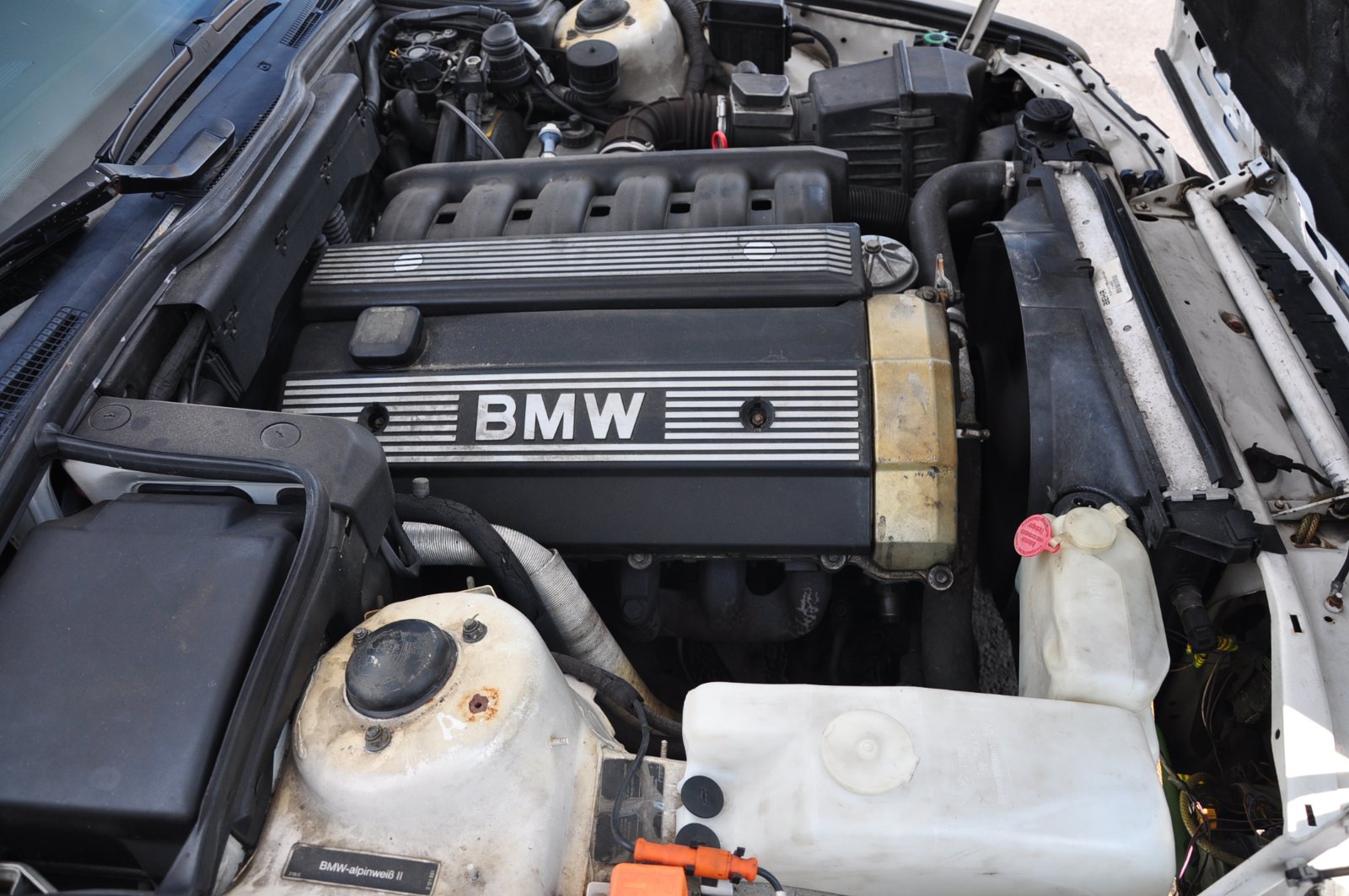
Four things that all get called „the engine number“
The commonest mistake happens before you even start: mixing up four different pieces of information that all relate to the engine and all consist of letters and digits.
| What | What it identifies | Example | Where it is |
|---|---|---|---|
| Engine designation (engine code) |
the series – the engine type, of which hundreds of thousands exist | M52B28, B58B30M0 | in the literature, in parts catalogues, in forums |
| Engine key (short designation) |
BMW’s internal short code for the same engine, written differently | 286S1, 256S5, 306D3 | stamped into the block, in parts catalogues, sometimes in the papers |
| Engine number | this one example – the serial number | eight digits, sequential | stamped into the block, directly below the engine key |
| VIN (FIN in German) | the vehicle, not the engine | 17 characters | registration document field E, body, windscreen |
The difference between the first three is the difference between „Golf“ (the series), „Golf GTI 16V“ (the version) and „the Golf standing in my garage“ (the individual car). The engine designation tells you which engine it is. The engine number tells you which one exactly. And the engine key is nothing but the same version written another way – which is why parts dealers and Wikipedia often show different codes for one and the same engine.
In practice: for parts you need the engine designation or the engine key. You will almost never need the engine number – except for insurance questions, for tracing a replacement engine, or when you want to prove that a supposedly original car still carries its original engine.
M52B28, character by character
Take the engine from that phone call. M52B28 breaks into four blocks:
| Position | Character | Meaning |
|---|---|---|
| 1 | M | engine family, or the department that developed it |
| 2–3 | 52 | series number – not the cylinder count |
| 4 | B | fuel: B = Benzin (petrol), D = diesel |
| 5–6 | 28 | displacement in tenths of a litre: 2.8 litres |
The same scheme on the S54B32 of the E46 M3: S = engine from the M GmbH, 54 = series, B = petrol, 32 = 3.2 litres. And on the M57D30: M = engine, 57 = series, D = diesel, 30 = 3.0 litres.
One detail trips a lot of people up: the displacement is rounded. The M52B28 measures exactly 2,793 cm³, the S54B32 3,246 cm³. If you find an odd figure under P.1 in the registration document and compare it with the code, do not let it throw you.
The first letter – and the biggest error of all
| Letter | Meaning | Period | Examples |
|---|---|---|---|
| M | simply Motor, the German word for engine – the conventional production engines | about mid-1960s to around 2001 | M10, M20, M30, M50, M54, M62 |
| N | New Generation – the production engines of the following generation | about 2001–2014 | N42, N52, N54, N63 |
| S | engines from BMW M GmbH for road cars | since 1984 | S14, S38, S54, S65, S85, S58 |
| P | pure racing engines from the M GmbH | – | P45, P60 |
| B | modular Baukasten, the building-block family | since about 2013/14 | B37, B38, B47, B48, B57, B58 |
| W | engines from outside manufacturers and suppliers | – | – |
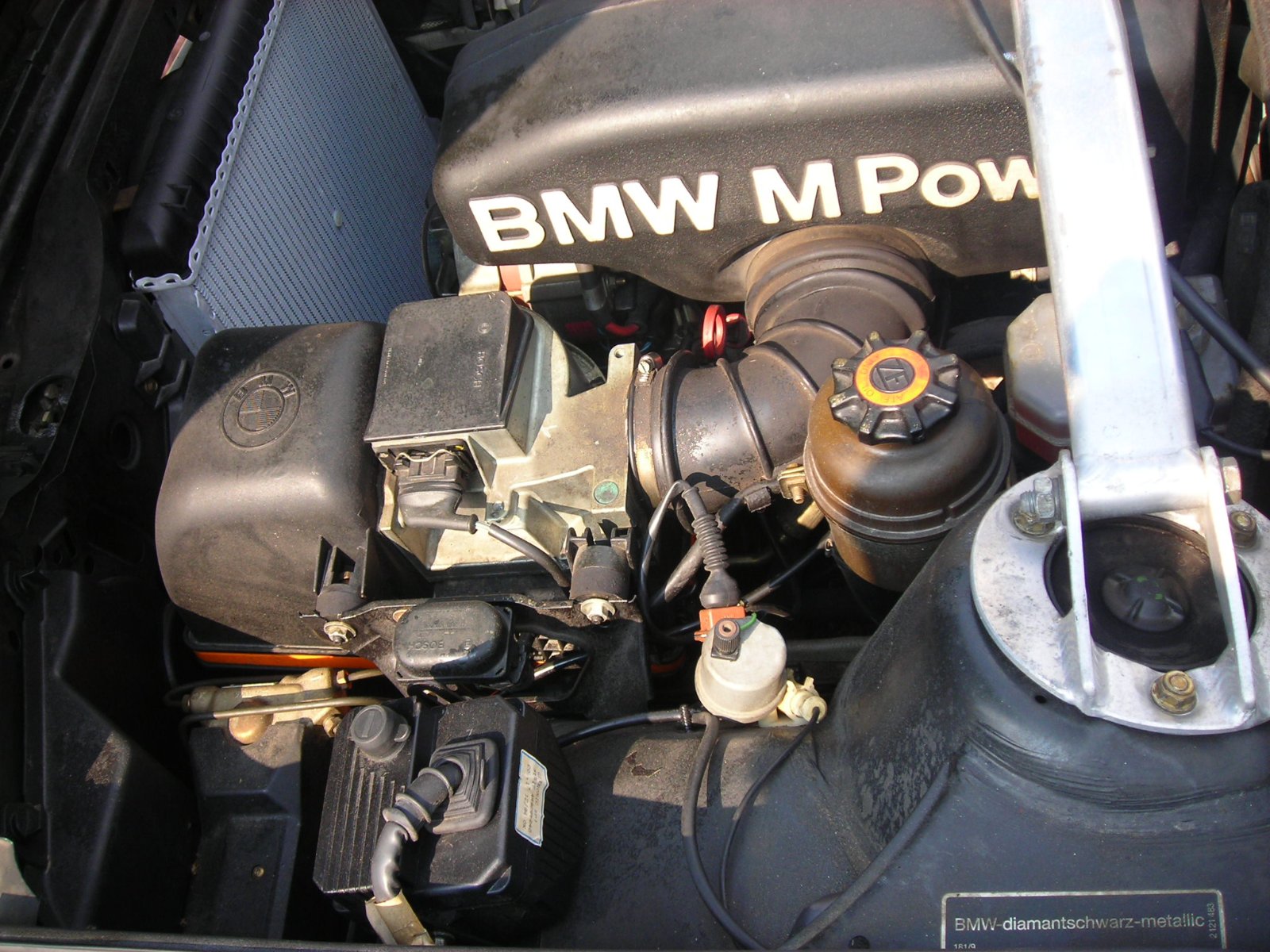
The M in M52 does not stand for Motorsport. It stands for Motor, the German word for engine. The M in „BMW M GmbH“ does stand for Motorsport – but the engines built by the M GmbH are precisely the ones that do not carry an M. They are called S.
The proof is the E46 M3. Its engine is the S54, not the M54. The M54 exists as well, but it sits in the 330i – a completely different engine of the same capacity, 228 hp instead of 333. Mix the two up and you buy the wrong parts.
How consistently BMW holds to this shows in the history: E30 M3 → S14. E36 M3 → S50 (Europe) or S52 (North America). E46 M3 → S54. E90/E92 M3 → S65. F80 M3 → S55. G80 M3 → S58. Six generations, six S engines, not one M.
The letter W is the rarest. It marks engines that do not come from BMW’s own house. The traffic runs the other way too: the N47 was taken over by Toyota for the European market and listed there under Toyota’s own nomenclature.
The number is the series – not the cylinder count
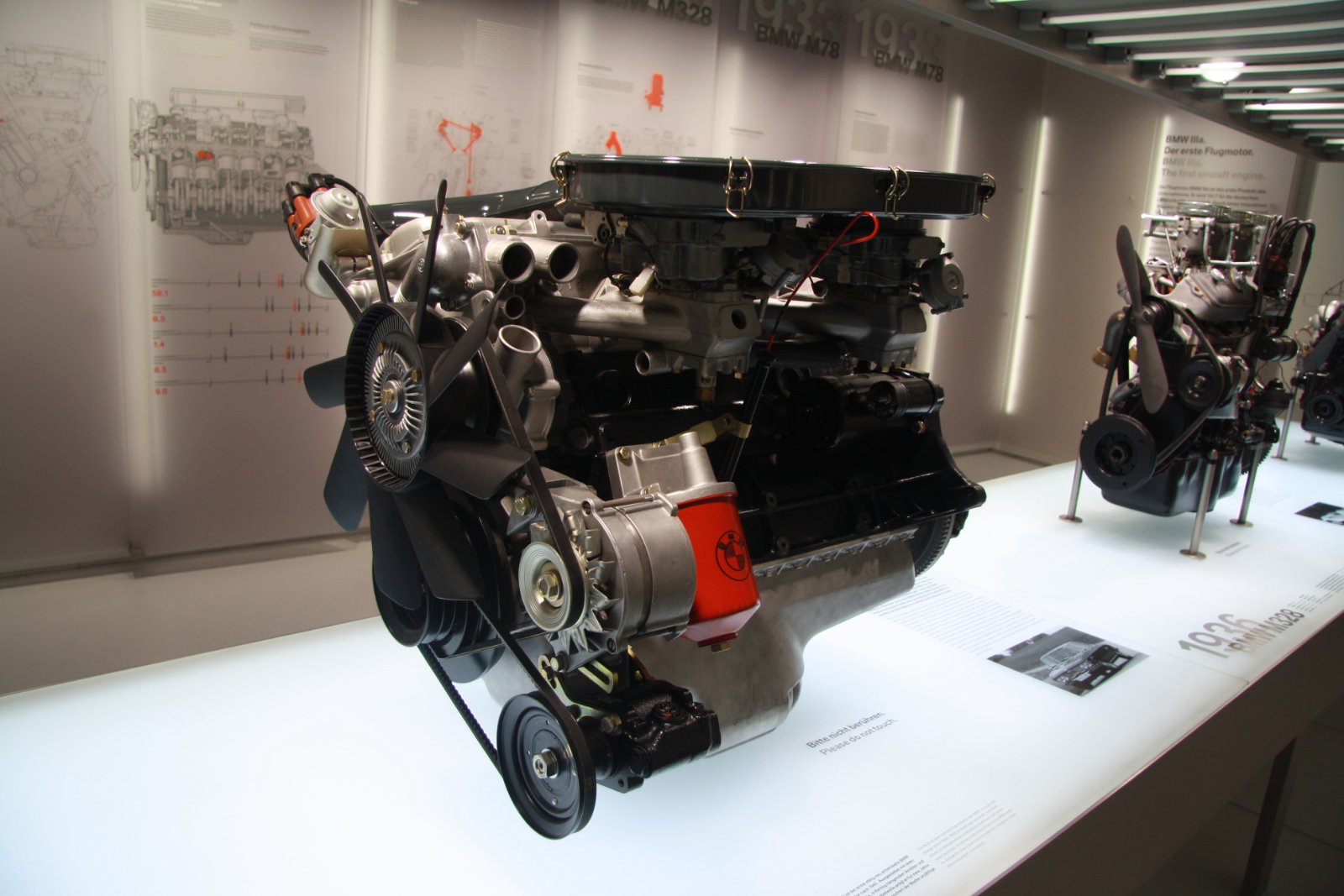
The second commonest error. The number in M50 says nothing about five cylinders, and it cannot: BMW has never built a five-cylinder passenger-car engine. The M50 is a straight-six.
That the number is a running development number shows in the fact that the same layout appears under several leading digits: the M10 is a four-cylinder, and so are the M40, M42, M43 and M44. The M20 is a six, so is the M30, and so are the M50, M52 and M54.
There is an order behind it all the same. From the eighties onward the leading digits group by layout, and that grouping holds to this day:
| Leading digit | Layout | Examples |
|---|---|---|
| 1x | inline four (M10 line) | M10, S14 |
| 2x | small straight-six, six-cylinder diesel | M20, M21 |
| 3x | large straight-six (M30 line) | M30, S38 |
| 3x (new) | inline three | B37, B38 |
| 4x | inline four | M40, M41, M42, M43, M44, M47, N42, N45, N46, N47, B47 |
| 5x | straight-six | M50, M51, M52, M54, M57, N52, N53, N54, N55, S50, S54, S55, S58, B57, B58 |
| 6x | V8 | M60, M62, M67, N62, N63, S62, S63, S65 |
| 7x | V12 | M70, M73, N73, N74 |
| 8x | V10 | S85 |
The 5 for a six-cylinder is where everybody stumbles. It is not an accident, though: it is held to throughout, from the M50 of 1990 to today’s B58.
The M engines make the point most elegantly that the number follows ancestry rather than cylinder count. The S14 of the E30 M3 is a four-cylinder, built from the M10 block with an S38 cylinder head shortened to four cylinders. Hence the 1: it comes out of the M10 line. The S38 in turn replaced the M88, which comes out of the M30 line – hence its 3. The number is a family tree, not a headcount.
TÜ, N and the other suffixes
TÜ stands for Technische Überarbeitung, technical revision. That much is certain, and it is one of the few abbreviations with a solid explanation behind it. English-speaking sources usually drop the umlaut and write „TU“.
A TÜ is not cosmetics. The important examples:
| Engine | From | What changed |
|---|---|---|
| M50TÜ | September 1992 | single VANOS on the intake camshaft – BMW’s first engine with variable valve timing of any kind |
| M52TÜ | 1998 | double VANOS, so on the exhaust side as well; more torque low down |
| M62TÜ | 1998 | VANOS on the intake camshafts, electronic throttle |
| M57TÜ, M57TÜ2 | – | two stages; from TÜ2 an aluminium block instead of cast iron |
| M47D20TÜ, M47TÜ2D20 | – | among other things swirl flaps in the intake ports (see weak points) |
Where exactly the TÜ sits in the code is inconsistent: you will find M50TÜB25 just as often as M50B25TÜ. They mean the same engine.
An N in the middle of the code – M57N, M57N2, N46N – is likewise a revision stage and entirely normal in BMW parts catalogues. Whether the N stands for „neu“, new, I could not document; what is documented is only that it is used that way.
HP turns up on the S54B32HP of the M3 CSL, which makes 360 hp instead of 333. The obvious reading, „High Performance“, is plausible but not officially documented.
And one abbreviation you will read in forums deserves to be ignored: „OL“ does not exist in BMW engine designations, as far as I could establish. It is probably a confusion with the output letter O of the new system.
The new system from 2013: eight positions instead of six
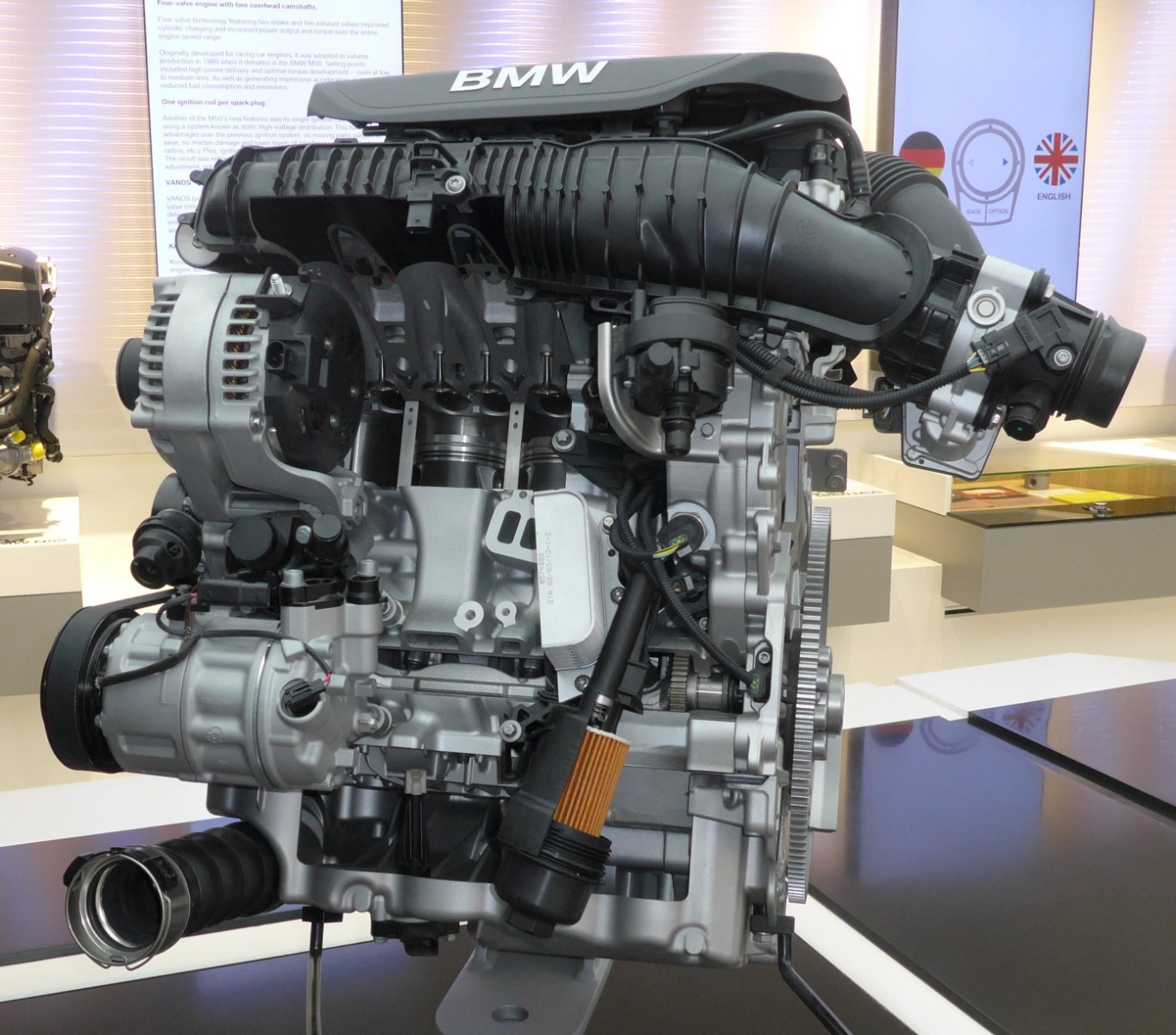
With the modular family the code grew longer and, in exchange, more precise. Six characters became eight, and every position has a job of its own. Take B58B30M0, the six-cylinder from the 340i and the Toyota Supra:
| Position | B58B30M0 | B48B20O1 | Meaning |
|---|---|---|---|
| 1 | B | B | engine family: B = modular, S = M GmbH |
| 2 | 5 | 4 | cylinder code (5 = straight-six!) |
| 3 | 8 | 8 | technology and fuel code |
| 4 | B | B | fuel and mounting orientation |
| 5–6 | 30 | 20 | displacement in tenths of a litre |
| 7 | M | O | output grade |
| 8 | 0 | 1 | generation / revision |
Position 2, the cylinder code, follows exactly the same logic as the leading digit of the older engines: 3 = three cylinders, 4 = four, 5 = straight-six, 6 = V8, 7 = V12, 8 = V10. Check it against the B38 (three cylinders), B48 (four) and B58 (six).
Position 3 is cleanly documented within the modular family: 7 means turbodiesel with direct injection (B37, B47, B57), 8 means the turbocharged petrol engine with Valvetronic and direct injection (B38, B48, B58), and 6 means the same technology in the stricter SULEV emissions variant. That is precisely why the cleaner version of the B48 is called B46. This reading cannot be projected back onto the older M and N engines, though – there the third digit is simply a variant number.
Position 4 is the most useful innovation in practice, because it carries two pieces of information at once:
| Letter | Fuel | Mounting | What that means in practice |
|---|---|---|---|
| A | petrol | transverse | front-drive platform: MINI, X1, 2 Series Active Tourer |
| B | petrol | longitudinal | classic BMW platform: 3, 4, 5 Series, Z4 |
| C | diesel | transverse | front drive |
| D | diesel | longitudinal | rear drive |
| E / G / H | electric / natural gas / hydrogen | ||
This can be confirmed independently: the B47 variants with D sit in rear-driven cars, the ones with C in front-driven ones. And the three-cylinder diesel in the MINI is called B37C15… – diesel, transverse. It fits.
Positions 5 and 6 are tenths of a litre again. The whole modular family rests on 500 cm³ per cylinder. That forces 1.5 litres for the three, 2.0 for the four and 3.0 for the six. Which is why the B38 and B37 are both „15“, the B48 and B47 both „20“, the B58 and B57 both „30“.
The output grade: K, U, M, O, T, S
The seventh position is the most interesting, because it gives away something you cannot otherwise see on the engine: where in its series’ output range it sits.
| Letter | Grade | Read as |
|---|---|---|
| K | 1 (lowest) | „Kleinste“, smallest |
| U | 2 | „Unterste“, bottom |
| M | 3 | „Mittel“, middle |
| O | 4 | „Obere“, upper |
| T | 5 | „Top“ |
| S | 6 (highest) | „Super“ |
I am careful with the word readings – they come essentially from a single publication, and German-language specialist forums support the direction („u0 = bottom, o0 = top end, t0 = top“) but not the exact wording. The ranking, by contrast, is very well documented, and against real output figures from two entirely different engine families:
| Engine code | Grade | Output |
|---|---|---|
| B37C15K0 | K | 70 kW / 94 hp |
| B37C15U0 | U | 85 kW / 114 hp |
| B57D30O0 | O | 195 kW / 261 hp |
| B57D30T0 | T | 235 kW / 315 hp |
| B57D30S0 | S | 294 kW / 394 hp |
Throughout this article the horsepower figures are metric horsepower (PS), the unit used in the German data. One PS is 0.986 bhp, so the difference against imperial horsepower is under one and a half per cent.
Two series, the same strictly ascending order. The same picture on the petrol side: N63B44O0 makes 402 hp, N63B44T3 523 hp. And with the current M six-cylinder, S58B30O0 with 473 hp stands next to S58B30T0 with 530 hp.
Position 8, finally, is a plain counter for major revisions: 0 for the first version, 1 for the first revision and so on. B58B30M0 is the original of 2015, B58B30O1 the revised one with up to 324 kW. It is the same idea as the old TÜ – only as a digit.
B58B30M0 read in full: modular engine – straight-six – turbocharged petrol with Valvetronic and direct injection – petrol, mounted longitudinally – 3.0 litres – middle output grade – first generation.
The engine key: 286S1 and 306D3
If you go looking for the stamped characters on an M52, you will not find „M52B28“ there. You will find 28 6 S 1. That is the engine key, BMW’s internal short designation, and it is built differently from the engine designation:
| Block | Meaning | 286S1 | 306D3 |
|---|---|---|---|
| 1–2 | displacement in tenths of a litre | 2.8 litres | 3.0 litres |
| 3 | cylinder count – here it really is a count | 6 | 6 |
| 4 | fuel: S = petrol, D = diesel | petrol | diesel |
| 5 | version or specification number | 1 | 3 |
So here, in the engine key of all places, the middle digit really is the number of cylinders – unlike in the engine designation. Confuse the two systems and you will inevitably reach the wrong conclusion.
Forums carry a stubborn debate about whether 306D3 is „the engine code“ or not. Both sides are right: it is a short identifier for this engine, but it is not its development designation. That is M57TÜ2D30. Which is exactly why parts dealers, vehicle papers and reference works often show three different codes for one and the same engine. It is not a contradiction, it is different languages for the same thing.
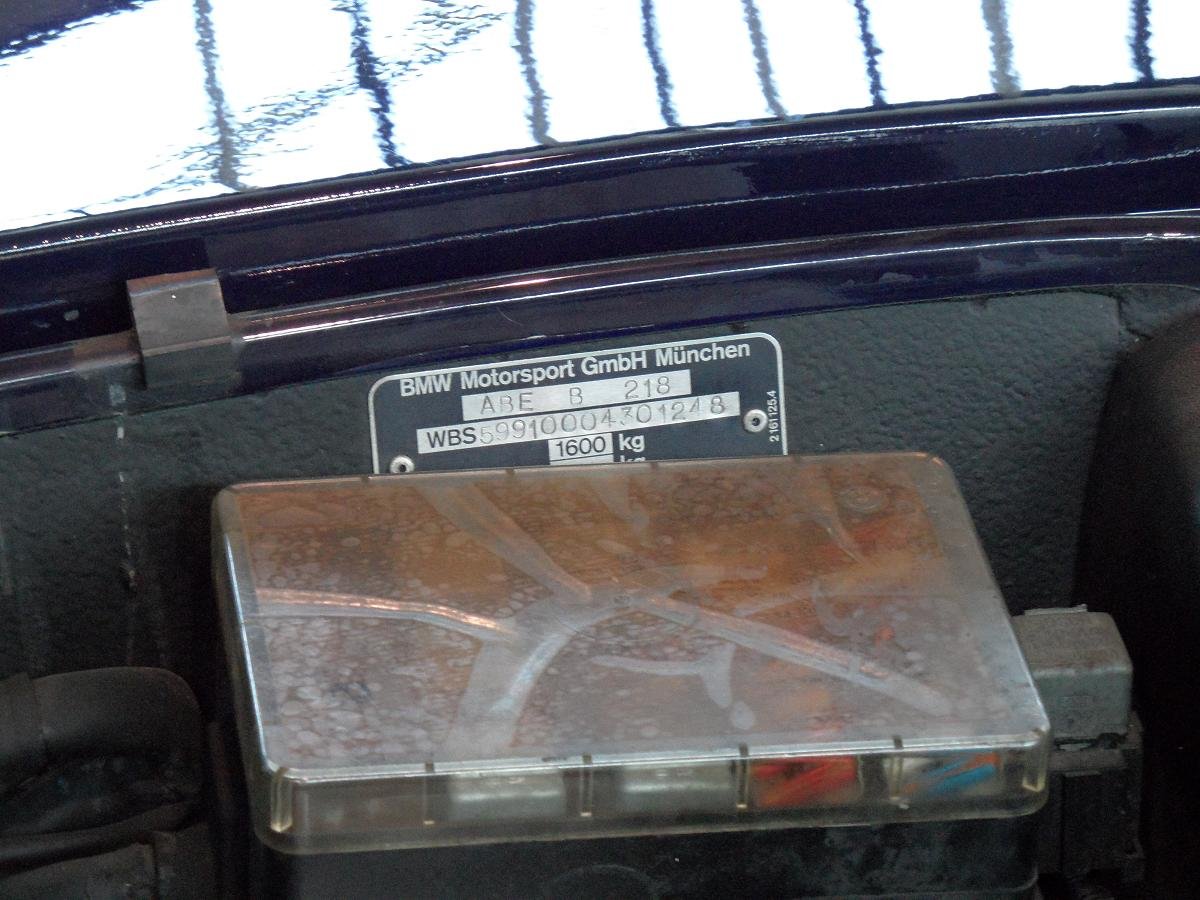
Where the number sits on the engine
Here I have to be honest: there is no publicly available overview of the stamping locations broken down by engine family. The reliable source is BMW’s workshop documentation (TIS or ISTA, the „engine identification“ document). What can be documented from public sources is this – with varying degrees of confidence:
| Engine | Location | Confidence |
|---|---|---|
| M50 / M52 / M54 | intake-manifold side, between oil filter and throttle body, low down where the block meets the sump, on a small raised pad. Two entries sit there one above the other: the engine key on top („28 6 S1“), the eight-digit engine number below it | forum and workshop practice, but very specific and consistent across several accounts |
| N52, N54, N55 | stamped on a marked pad on the cylinder block | only described in general terms |
| B37, B38A, B47, B48A (transverse) | in the sump area | only described in general terms |
| B38B, B48B (longitudinal) | different from the A variants, not specified further | uncertain |
| M20, M30 | no solid source. Practical accounts name the side of the block near the starter or the sump; the eight-digit number often shown on the M20 under the cover of the oil-pump drive shaft is a casting number, not the engine number | uncertain – do not rely on it |
| M47, M57, N47, N57, B57 | each has its own marked stamping pad on the block | documented only in general terms |
Two rules hold whatever the engine. First: the number is always stamped into the metal block, never printed on the plastic cover. Second: it almost always sits on a small machined flat – which stands out once you know what you are looking for.
In practice that means: clean the block, take a good lamp, and work along the lower edge of the block on the intake side. Four decades of oil and road grime turn stamped digits into a puzzle; a rag with brake cleaner and light held at a shallow angle does more than any torch pointed straight at it.
And the more honest advice: if all you want to know is which engine should be fitted, going via the VIN is more reliable than searching the block. BMW internally assigns the factory-fitted unit to every VIN – that is what every online parts catalogue rests on. You only need to look at the block when you want to check whether the original engine is still in there.
There is no formula linking engine number and VIN. You cannot derive one from the other. What exists is BMW’s internal assignment – and that is only accessible through the parts catalogues.
What of it appears in the vehicle papers
Considerably less than most people assume. The German registration document, the Zulassungsbescheinigung Teil I, uses the EU-harmonised field codes, so the same letters apply on a British V5C or an Austrian Zulassungsschein. In it you will find:
| Field | Content |
|---|---|
| E | VIN, 17 characters |
| D.1 / D.2 / D.3 | make / type-variant-version / commercial description |
| P.1 | displacement in cm³ |
| P.2 | rated output in kW |
| P.3 | fuel type – not the engine code, and certainly not the engine number |
| P.4 | rated engine speed |
| 2.1 / 2.2 | German manufacturer key (HSN) and type key (TSN) |
| 10 | fuel code of the German federal motor authority: 0001 petrol, 0002 diesel, 0004 electric, 0008 petrol hybrid, 0025 petrol plug-in hybrid |
Two corrections to widespread assumptions. P.3 holds the fuel type, not the engine code. And field 6 holds the date of the EC type approval, not the engine key.
Where the engine code turns up is inconsistent. In newer papers you occasionally find it around field 2.2 – one real example is the entry B47 D20 A. That collides with the standard use of 2.2 for the type key, and practice differs by registration office and model year. In papers issued before 2005 the code often sat under „Motorkennbuchstabe“, engine letter code.
What is certain is the statement in the other direction: the individual engine number practically never appears in the vehicle papers today. If you need it, you have to go to the engine.
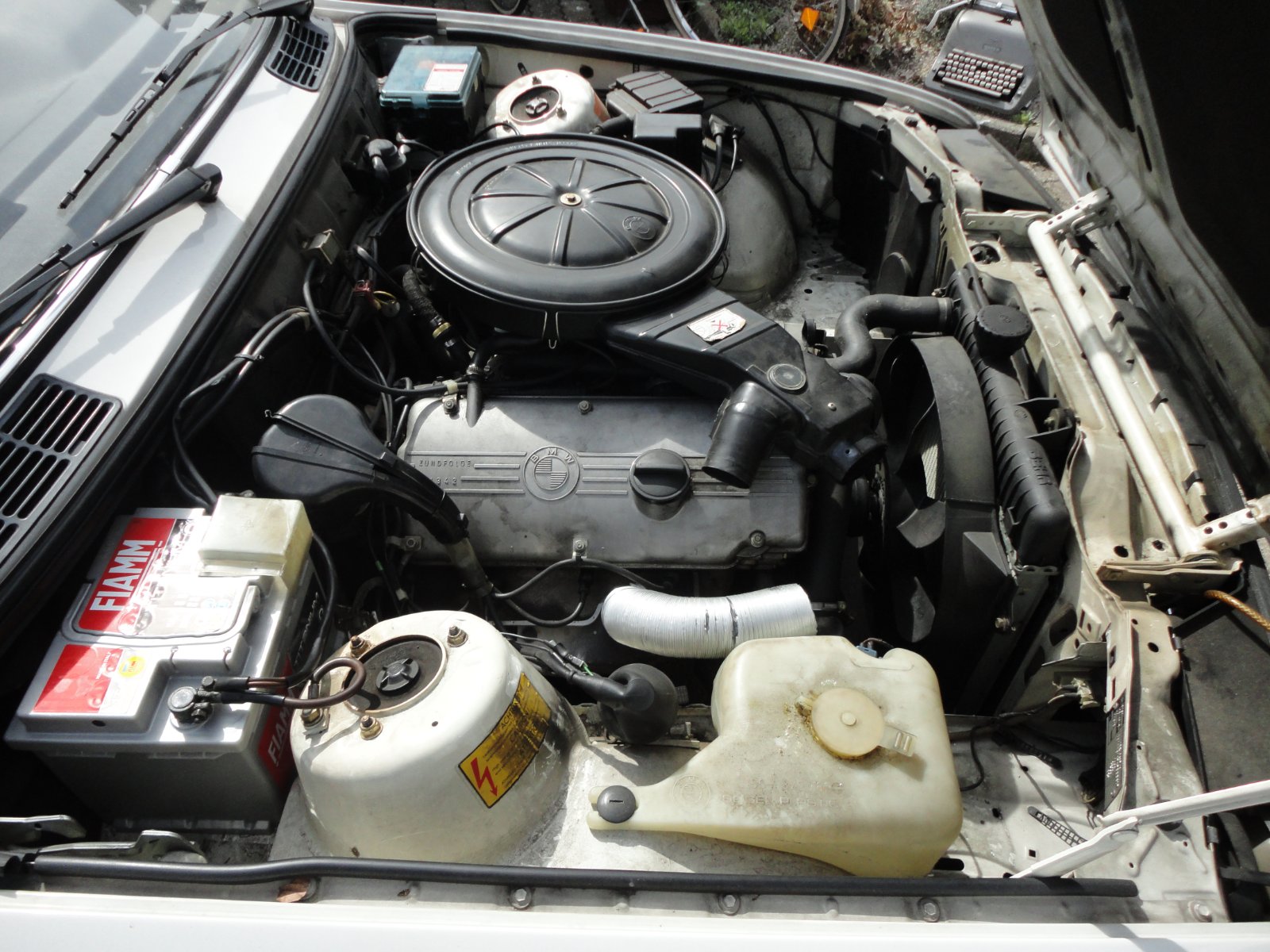
The petrol engines: from M10 to B58
M10 (1962–1988) – the ancestor
Inline four, single overhead camshaft, two valves per cylinder, timing chain, hemispherical combustion chambers, forged crankshaft in five main bearings. 1.5 to 2.0 litres, 55 to 125 kW. More than 3.5 million units in 26 years – it carried the Neue Klasse, the 02 series, the E12, E21, E28 and E30. Mixture preparation ran from Solex carburettors through K-Jetronic to L-Jetronic.
The finest footnote: the M12 motorsport derivative made up to 1,400 hp from 1.5 litres in Formula 1 qualifying. Out of the same block that ticked over quietly in a 1502.
M20 (1977–1993) – the small six
Straight-six, single overhead camshaft, two valves, rocker arms – and a toothed belt, not a chain. 2.0 / 2.3 / 2.5 / 2.7 litres, 90 to 126 kW. Mixture preparation from the Solex carburettor through K- and LE-Jetronic to Motronic 1.1 and 1.3. Cars: E21, E28, E30, E34, Z1.
The 2.7-litre „eta“ version is the odd one out: deliberately laid out for torque at low revs, 240 Nm at 3,250 rpm, and in exchange hardly keen to rev. Economical, but distinctly untypical by BMW standards.
M30 (1968–1995) – the „Big Six“
Straight-six, single overhead camshaft, two valves, timing chain, rocker arms, cast-iron block with aluminium head. 2,494 to 3,430 cm³, 110 to 160 kW. 27 years in production – BMW’s longest-lived engine series. It sat in the 2500, the 3.0 CS, the E12, E23, E24, E28, E32 and E34. Ward’s lists it among the best engines of the twentieth century.
M40 (1987–1994) and M43 (1991–2002)
M40: four cylinders, one camshaft, eight valves, toothed belt, hydraulic lifters. 1.6 litres with 73–75 kW, 1.8 litres with 83–85 kW. Motronic 1.3 in the E30, 1.7 in the E36. Cars: 316i and 318i in E30 and E36, 518i in the E34.
M43: the successor, technically the same layout but with a timing chain instead of a belt and roller finger followers. 1.6 / 1.8 / 1.9 litres, 101 to 117 hp. New were the DISA variable intake manifold, a camshaft sensor and a knock sensor.
M42 (1989–1996) and M44 (1996–2000)
M42: BMW’s first volume four-cylinder with twin overhead camshafts and 16 valves. Timing chain with hydraulic tensioner, forged crankshaft, cast-iron block, 1,796 cm³, 100 kW (136 hp), 172 Nm at 4,600 rpm, compression 10.0:1. Cars: E30 318is, E36. The S42 racing derivative made up to 320 hp from 1,999 cm³ in Super Touring.
M44: 1,895 cm³, 103 kW (138 hp), 180 Nm. Roller finger followers cut valvetrain friction by around 70 per cent; a hot-film air mass meter came with it. The crankshaft, however, was cast rather than forged. Built in Steyr.
M50 (1990–1996) – the turning point
Straight-six with twin overhead camshafts and four valves per cylinder, timing chain. 1,991 / 2,394 / 2,494 cm³. From September 1992 as the M50TÜ with single VANOS – the first BMW engine with variable valve timing of any kind. Cars: E34 520i and 525i, E36 320i and 325i.
M52 (1994–2000)
The M50 in aluminium: the block got a Nikasil coating – except for the USA and Canada, where the M50’s cast-iron block ran on until 1999. 1,991 to 3,152 cm³, 148 to 190 hp. Early engines with single VANOS, from 1998 the M52TÜ with double VANOS. Cars: E36, E39, E38, Z3 – and, in South Africa, even the Land Rover Defender.
M54 (2000–2006)
Straight-six, aluminium block with cast-iron liners – which settled the Nikasil question. Double VANOS, DISA two-stage intake manifold, electronic throttle with no mechanical fallback, Siemens MS43. Rev limit 6,500 rpm.
| Version | Displacement | Output | Torque |
|---|---|---|---|
| M54B22 | 2.2 l | 125 kW / 168 hp at 6,100 | 210 Nm at 3,500 |
| M54B25 | 2.5 l | 141 kW / 189 hp at 6,000 | 245 Nm at 3,500 |
| M54B30 | 3.0 l | 170 kW / 228 hp at 5,900 | 300 Nm at 3,500 |
| M54B30 ZHP | 3.0 l | 175 kW / 235 hp | – |
Three years running among Ward’s ten best engines. Cars: E46 330i, E39 525i and 530i, E53 X5, E60, Z4.
M60 (1992–1996) and M62 (1995–2005) – the V8 returns
M60: 90-degree V8, four valves per cylinder, duplex timing chain with self-adjusting tensioner. BMW’s first V8 in more than 25 years. M60B30: 2,997 cm³, 160 kW (218 hp). M60B40: 3,982 cm³, 210 kW (286 hp). Cars: E32 740i, E34 540i, E38 740i, E31 840i.
M62: aluminium block, now a single-row timing chain. 4.4 / 4.6 / 4.8 litres. From 1998 as the M62TÜ with VANOS on the intake camshafts and drive-by-wire. Mostly Alusil; only the very earliest examples were still Nikasil. Cars: E39 535i and 540i, E38 735i and 740i, E53 X5 – plus the Range Rover L322 and the Morgan Aero 8.
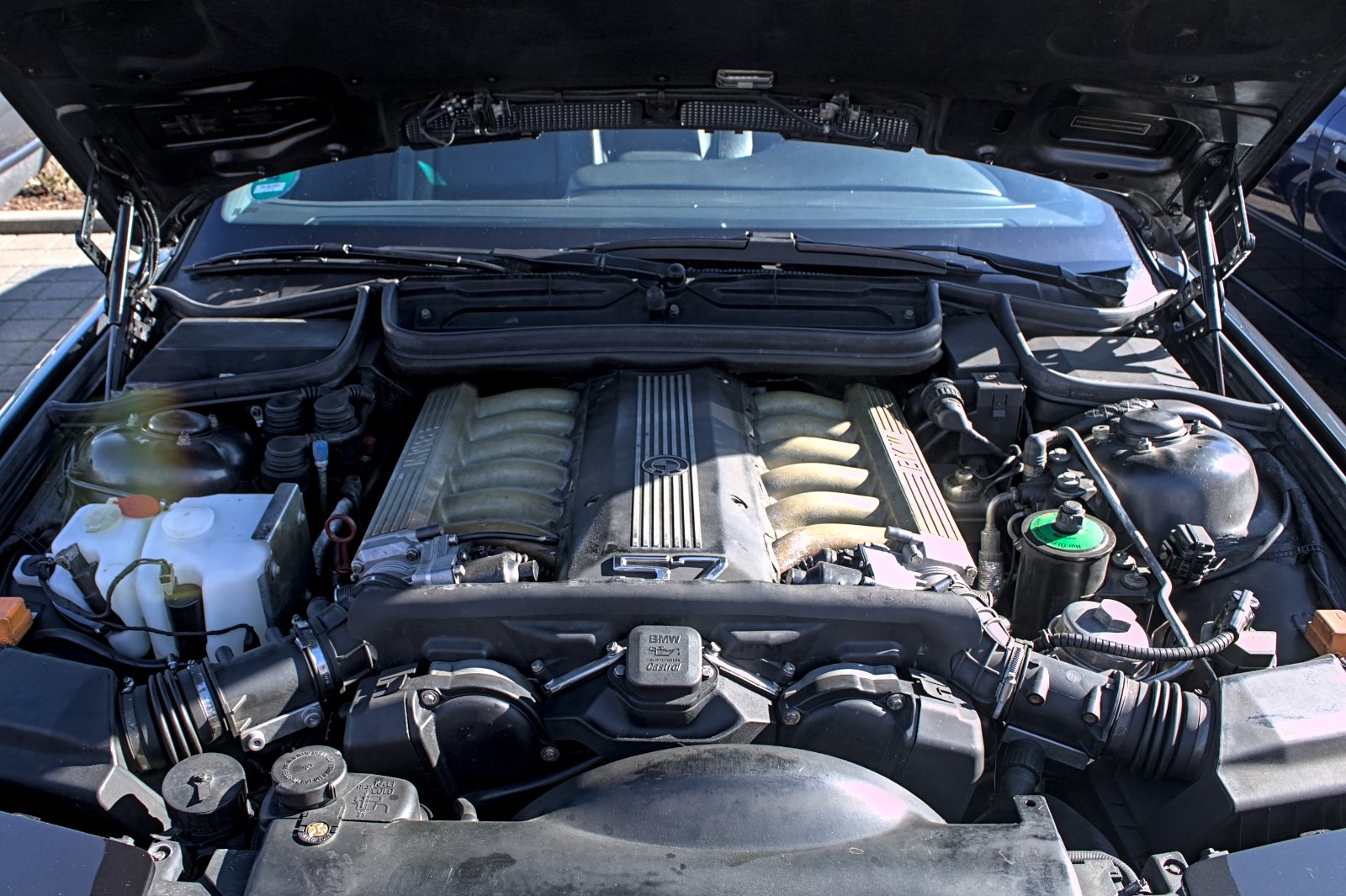
M70 (1987–1996) and M73 (1993–2002) – the twelve-cylinders
M70: BMW’s first production V12 and the first post-war German twelve-cylinder in a passenger car – ahead of Mercedes, ahead of VW. 5.0 litres, one camshaft per bank, only two valves per cylinder, 296 hp at 5,200 rpm, 450 Nm. The architecture is essentially two 2.5-litre M20s at 60 degrees.
What stands out is the thoroughgoing redundancy: two Motronic control units, two fuel pumps, two fuel rails, duplicated sensors, in some cases two alternators. In an emergency the engine runs on six cylinders. Cars: E32 750i, E31 850i, Alpina B12.
M73: 5.4 litres, 326 hp at 5,000 rpm, International Engine of the Year over 4 litres in 1999. Cars: E38 750i, E31, Rolls-Royce Silver Seraph. A four-valve prototype, the M72 with 355 hp, never reached production.
N42, N45, N46 – the Valvetronic fours
The N42 (2001–2004) was BMW’s first engine with Valvetronic, the fully variable valve lift that largely makes the throttle butterfly redundant. Aluminium block, two balancer shafts. N42B18: 1,796 cm³, 105 kW. N42B20: 1,995 cm³, 110 kW. Cars: E46 316i through 318Ci.
The N45 is the variant without Valvetronic, the N46 (2004–2015) the revised version with it. 1.8 and 2.0 litres, 85 to 127 kW. It simply carried on after the N43 arrived, because the N43 could not be used in countries with high-sulphur fuel. On the N40 the sources contradict each other: some describe it as an N42 without Valvetronic, others as an N42 without balancer shafts.
N52 (2004–2015) – the last naturally aspirated six
Technically the most elaborate engine in this list. The world’s first water-cooled production engine with a magnesium-aluminium composite crankcase: a magnesium jacket around an aluminium core. Valvetronic and double VANOS, an electric water pump instead of a belt drive, a volume-controlled oil pump and a rev limit raised from 6,500 to 7,000 rpm. Compression 10.7:1, 100 RON recommended. 130 to 200 kW.
Twice among Ward’s ten best engines – and BMW’s last straight-six without forced induction. After it came the turbocharged fours.
N53 (2006–2013) – the lean-burn six
Straight-six with direct injection, piezo injectors and stratified charge, double VANOS, magnesium block – but no Valvetronic, for which there was no room. Europe and selected markets only: for North America, Canada, Australia and Malaysia it was considered unsuitable, because the sulphur content of the fuel there would have damaged the direct injection. 140 to 200 kW.
N54 (2006–2016) – the first volume turbo
BMW’s first turbocharged petrol engine in volume production. 3.0 litres, two turbochargers, direct injection, double VANOS, aluminium block – expressly without Valvetronic. 225 to 250 kW. Its reputation rests on throttle response: contemporary tests said it could pass for a naturally aspirated engine.
N55 (2009–2019)
The successor and in many ways the better engine: BMW’s first straight-six with a twin-scroll turbocharger – one charger instead of two. Now with Valvetronic, which improved response, low-end torque, emissions and consumption. Instead of the N54’s expensive piezo injectors it used solenoid injectors. 225 to 272 kW, 400 to 500 Nm. Three years running among Ward’s ten best.
N20 (2011–2017) and N13
N20: four cylinders, 1.6 and 2.0 litres turbocharged, twin-scroll charger, double VANOS, Valvetronic, direct injection. It took the place of the naturally aspirated N52 and N53 sixes – at comparable output, with more torque low down and less consumption. For many people this was the moment BMW stopped being BMW.
N13: 1,598 cm³ turbo out of the Prince family, the joint development between BMW and PSA. 136 or 170 hp. Cars: F20 1 Series, F30 316i and 320i ED. Its successor was the three-cylinder B38.
N62, N63, N74 – the big ones
N62 (2001–2010): naturally aspirated V8, the first BMW V8 with Valvetronic and the world’s first engine with continuously variable intake runner length. 3.6 to 4.8 litres, from 270 hp. Worth noting: there was never an M version of it.
N63 (since 2008): V8 in „hot-V“ layout – the exhaust manifolds and turbochargers sit inside the vee, the intake is on the outside. That shortens the exhaust path and makes the engine narrower. N63B44O0: 402 hp. N63B44T3 from 2018: 523 hp.
N74 (since 2008): BMW’s first turbocharged V12, 6,592 or 6,749 cm³, 407 to 625 hp. Direct injection, double VANOS, no Valvetronic. Cars: F01 760i, G12 M760Li – and the Rolls-Royce Phantom VIII, Ghost and Cullinan.
B38, B48, B58 – the modular family
All three follow the same layout: 500 cm³ per cylinder, direct injection, Valvetronic, double VANOS, turbocharger.
B38 (since 2013): three cylinders, 1.2 and 1.5 litres, compression 11:1, single-scroll charger with an aluminium turbine housing. 55 kW up to 141 hp. Cars: i8, 1 Series, 2 Series, 3 Series, X1, X2, every MINI.
B48 (since 2014): four cylinders, 1,998 cm³, twin-scroll charger. Roughly 170 to 312 hp. The B48TÜ from 2018 brought a one-piece timing chain, separate cooling circuits and forged components. SULEV variant: B46. Cars: 1 Series to 7 Series, X1 to X4, Z4 – plus the Toyota Supra and the Morgan Plus Four.
B58 (since 2015): straight-six, 2,998 cm³, closed-deck aluminium block, compression 11.0:1, twin-scroll charger with a water-cooled charge air cooler, forged steel crankshaft and forged rods. 213 to 324 kW. Five times among Ward’s ten best engines. Cars: 3 Series to 7 Series, X3 to X7, Z4, Toyota GR Supra, Morgan Plus Six, Ineos Grenadier.
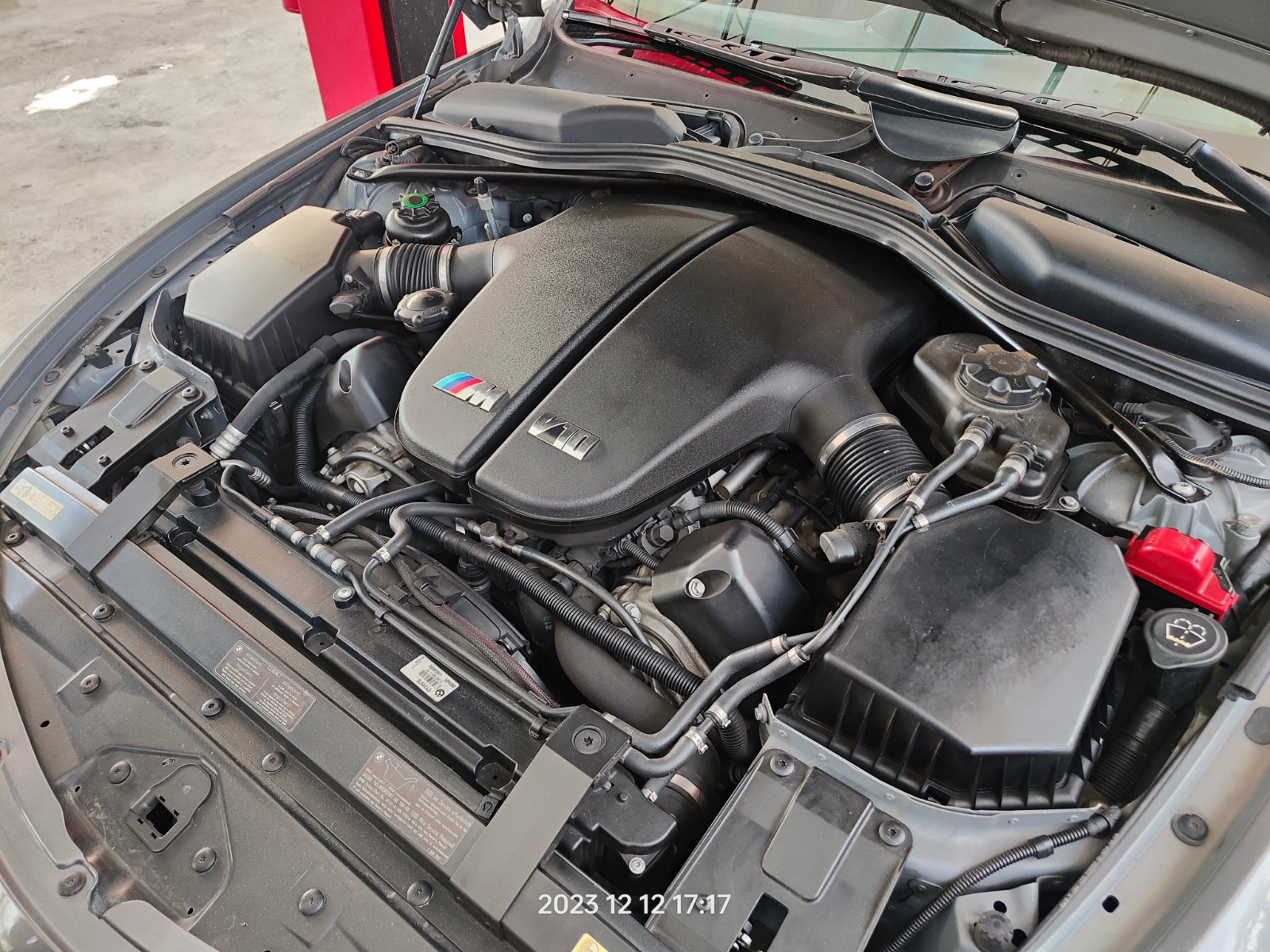
The M engines: S14 to S58
The S series is the part of the programme BMW is famous for – and the part where the naming system confirms itself most elegantly. Every S engine carries the leading digit of the series it came from.
| Engine | Built | Layout | Output | Notable | Cars |
|---|---|---|---|---|---|
| S14 | 1986–1991 | I4, 2.0–2.5 l | 143–175 kW 192–235 hp |
M10 block with a shortened S38 head, two throttle bodies with two butterflies each | E30 M3 |
| S38 | 1984–1995 | I6, 3.45–3.8 l | 255–335 hp | six individual throttle bodies with intake trumpets in an aluminium plenum; replaced the M88 | E28 M5, E34 M5, M6 |
| S50 / S52 | from 1992 / 1996–1999 | I6, 3.0–3.2 l | S52: 240 hp | S50B32 with double VANOS; S52 North America only | E36 M3 |
| S54 | 2001–2008 | I6, 3,246 cm³ | 333 hp at 7,900, CSL 360 hp |
cast-iron block, compression 11.5:1, individual throttle bodies, 8,000 rpm | E46 M3, M3 CSL, Z3 M, Z4 M |
| S62 | from 1998 | V8, 5.0 l | 294 kW / 400 hp | double VANOS on intake and exhaust, 7,000 rpm | E39 M5, Z8 |
| S65 | 2007–2013 | V8, 4.0/4.4 l | 420–450 hp at 8,300 | compression 12.0:1, 8,400 rpm, eight individual throttle bodies; derived from the S85 | E9x M3, M3 GTS, M3 CRT |
| S85 | 2005–2010 | V10, 5.0 l | 378 kW / 507 hp | BMW’s only production V10, 8,250 rpm, about 100 hp per litre, ten electrically actuated individual throttle bodies | E60 M5, E63 M6 |
| S63 | from 2010 | V8 turbo, 4.4 l | up to 591 hp | hot-V like the N63 | X5 M, X6 M, M5, M8 |
| S55 | from 2013 | I6 turbo, 3.0 l | up to 493 hp | closed-deck block, compression 10.2:1, two mono-scroll chargers (one per bank of three cylinders) | F80 M3, F82 M4, F87 M2 |
| S58 | from 2019 | I6 turbo, 3.0 l | 473 hp (O0), 530 hp (T0) |
closed-deck cast-iron block, double VANOS and Valvetronic; derived from the B58 | G80 M3, G82 M4, X3 M, M4 CSL |
The S85 deserves a remark of its own. A ten-cylinder in a saloon, 507 hp from five litres without forced induction, 8,250 rpm, ten individual electrically actuated throttle bodies – and International Engine of the Year four years running. It has not happened again, and it will not. The S65 of the E92 M3 is essentially the same engine with two cylinders fewer: identical bore and identical stroke, 92 × 75.2 mm.
The diesels: from M21 to B57
| Engine | Built | Layout | Output | Injection | Cars and notable points |
|---|---|---|---|---|---|
| M21 | 1983–1991 | I6, 2,443 cm³ | 63–85 kW 84–114 hp |
swirl chamber, Garrett turbo | E28 524td – in 1983 the fastest production diesel car in the world; E30 324d/324td |
| M51 | 1991–2000 | I6, 2,497 cm³ | 85–105 kW 114–141 hp |
swirl chamber, Bosch VP37 | E34, E36, E38 – plus the Range Rover P38A and the Opel Omega B |
| M41 | 1994–2000 | I4, 1,665 cm³ | 66 kW / 89 hp | indirect injection, turbo | E36 318tds. BMW’s first four-cylinder diesel, derived from the M51 – 86 % shared parts |
| M47 | 1998–2007 | I4, about 2.0 l | 85–120 kW 114–161 hp |
increasingly common rail | E46 320d, E39; as the M47R, mounted transversely, also in the Rover 75 and Land Rover Freelander |
| M57 | 1998–2013 | I6, 2.5–3.0 l | 110–210 kW 148–282 hp |
common rail, 1,350 → 1,600 bar | E39 525d, E46 330d, E60 530d, Range Rover L322. TÜ and TÜ2; aluminium block from TÜ2. Built in Steyr |
| M67 | 1998–2009 | V8, 3.9/4.4 l | 190–243 kW 255–326 hp |
common rail, bi-turbo | E38 740d, E65 740d. The first bi-turbo diesel V8 in a luxury car, up to 750 Nm; twice International Engine of the Year. No direct successor |
| N47 | 2007–2014 | I4, 1.6/2.0 l | 70–160 kW 94–215 hp |
common rail | 1 Series to 5 Series, X1, X3, MINI – and Toyota in Europe. See weak points |
| N57 | since 2008 | I6, aluminium | 150–230 kW 201–308 hp |
common rail 1,800 bar; bi-turbo 2,000 bar; N57S as a tri-turbo | 3 Series to 7 Series, X3 to X6. Replaced the M57 and the M67 at once |
| B37 | since 2012 | I3, 1,496 cm³ | 70–85 kW 94–114 hp |
common rail, variable-geometry turbo | 116d, 2 Series Active Tourer, X1, MINI Cooper D |
| B47 | since 2014 | I4, 2.0 l | 85–170 kW 114–228 hp |
common rail, compression 16.5:1 | from the B47TÜ1 (November 2017) with AdBlue. B47D longitudinal, B47C transverse |
| B57 | since 2015 | I6, 3.0 l | 195–294 kW 261–394 hp |
common rail, up to four turbochargers in a double sequential arrangement | debut in the G11 7 Series; 3 Series to 8 Series, X3 to X7, Ineos Grenadier |
Two engines on this list wrote motoring history. The M21 in the 524td was the fastest production diesel car in the world in 1983 – at a time when diesel meant taxis and tractors. And the M67 was the first diesel V8 with two turbochargers in a luxury car; 750 Nm from a compression-ignition engine was a statement in 1998. It never got a successor: the 740d passed to the N57, a six.
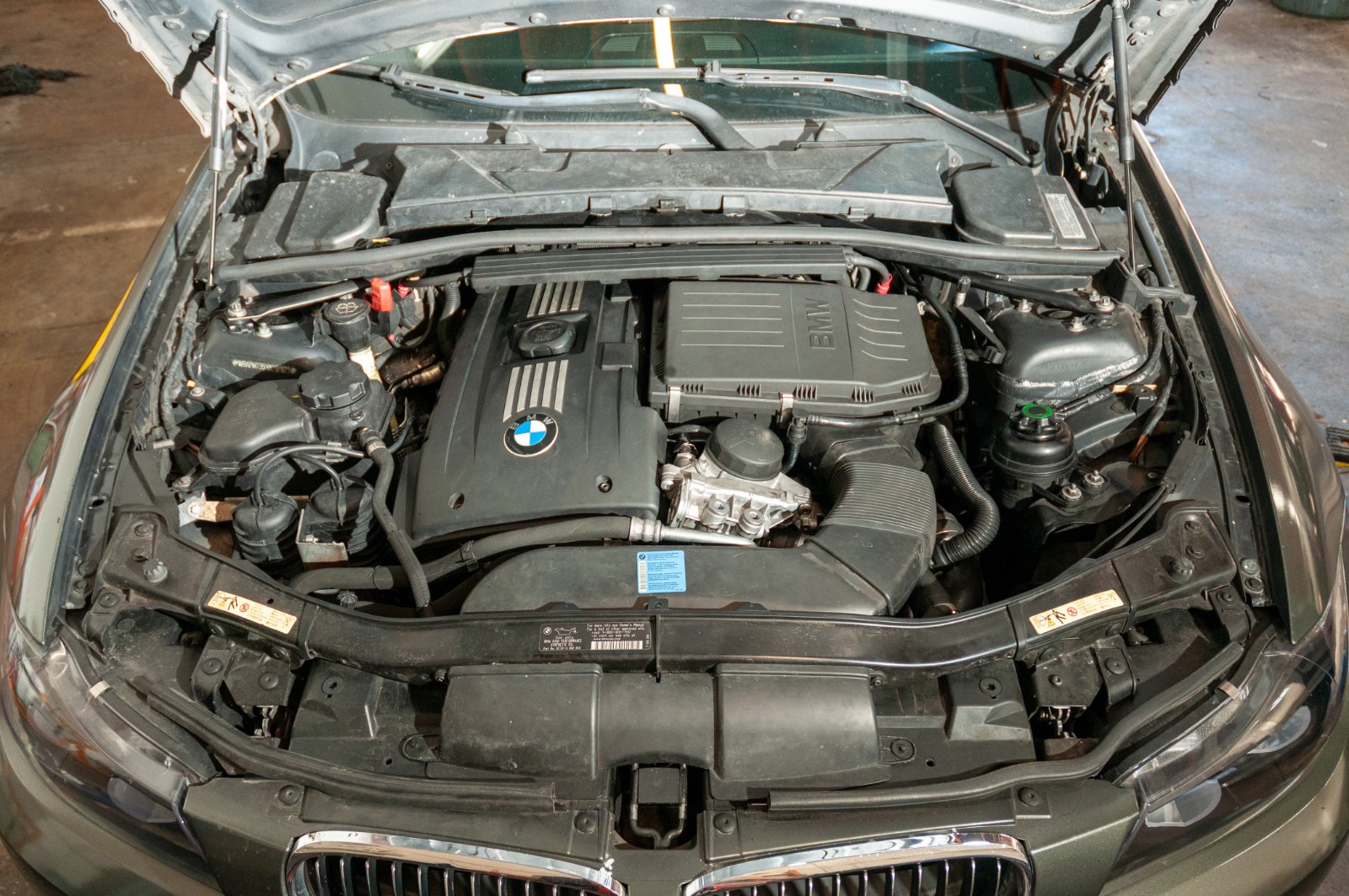
Weak points, engine by engine
One word first: I list here only what can be documented, and I say so when a widespread claim could not be. That matters more with engine faults than elsewhere, because half-knowledge is particularly persistent in forums – and because an undeserved bad reputation can make a good engine unsellable.
N47 – the timing chain at the back
The best-known BMW engine failure of this century. Premature timing chain wear, worst on engines built between 1 March 2007 and 5 January 2009; failures also occurred on engines built up to 2015. The real problem is the position: the chain sits at the back of the engine, near the flywheel – to change it the gearbox has to come out. The symptom is rattling; in bad cases the engine shuts down while driving. BMW paid limited goodwill but refused compensation.
Less well known but equally documented: broken wastegate springs, which cause boost loss and 30 to 50 per cent higher fuel consumption, and porous vacuum hoses at the EGR cooler – which led to a recall of around 1.6 million vehicles in 2018.
M60, early M52 and M62 – Nikasil
The sulphur content of the fuels sold in the early nineties in the USA, Britain and South America attacked the Nikasil bore coating. The result was loss of compression. BMW replaced engines under warranty and switched to Alusil; on the M52 it became cast-iron liners. On the M62 only early examples were affected.
On the M60 you can tell from the casting number, on the right-hand side of the block level with the third cylinder, above the coolant drain:
| Casting number | Specification |
|---|---|
| 1 725 970 / 1 741 212 | Nikasil, M60B30 |
| 1 725 963 / 1 742 998 | Nikasil, M60B40 |
| 1 745 871 | Alusil, M60B30 |
| 1 745 872 | Alusil, M60B40 |
This list does not come from BMW but from the scene – it is internally consistent and has been in use for years, but it is not a manufacturer document. And the practical reading: with today’s fuel quality, a Nikasil block that passes a clean compression test can last a very long time yet. The panic of 1997 is no longer a panic in 2026.
N54 – the high-pressure fuel pump
The most serious N54 problem: if the high-pressure pump fails, the engine shuts down. A 2010 recall covered more than 130,000 vehicles, around 40,000 of which had the pump replaced; BMW extended the warranty to ten years or 120,000 miles. Also documented: injector failures with the same warranty extension, and wastegate rattle from bushing wear. All of these extensions applied to the USA only – German-market cars got none of them.
S54, S65, S85 – the rod bearings
The classic among M engine failures. On the S85, rod bearing wear is documented from as little as 80,000 km in some cases; on the S54 it mainly affects the 2001 to 2003 model years, with the potential to destroy the whole crank assembly.
The causes are well researched and lie in several factors working together. BMW systematically reduced bearing areas across the generations to save friction – so the same combustion forces act on smaller surfaces. Add inertial forces that rise with the square of engine speed, full load at low revs (a thin oil film), mixed friction at cold start, and oil change intervals that are too long. The S54 is considered the most exposed: the smallest bearing area at 779 mm², plus an oil pressure control valve that tends to stick.
A second specialist source adds the bearing clearance being too tight – around 0.001 inch as standard against an industry guide value of 0.0025 inch – and, on the S54, a design assuming oils with a high ZDDP content, which modern oils no longer provide for emissions reasons.
The recommendations diverge depending on the source, and it is worth knowing that before you spend money. One advises an annual oil change, or every 10,000 km, with a high-grade fully synthetic oil, and avoiding long warm-up phases and full load at low revs. The other recommends changing the bearing shells on the S65 and S85 preventively about every 96,000 km, using coated bearings.
For a sense of the cost: shell replacement including diagnosis 2,000 to 3,000 euros, extended crankshaft work 5,000 to 10,000 euros, a full rebuild after a catastrophic failure 15,000 to 25,000 euros.
M52TÜ and M54 – the crankcase ventilation
Every part of the crankcase ventilation system ages together. Typical signs: markedly rising oil consumption, brittle and cracking vacuum hoses (classically the hose from cylinder 1 to cylinder 6), a torn diaphragm in the ventilation valve with a trumpet-like noise when you open the oil filler cap, and a dipstick tube blocked with an oil-water emulsion.
The test costs nothing: with the engine running, lay a plastic bag over the open oil filler neck. If it is sucked firmly in, the valve has failed. Left alone, this leads to heavy oil loss, poor running and, in the extreme, internal damage.
N42 and N46 – Valvetronic and timing chain
The Valvetronic here often fails through worn eccentric shafts or dead actuator motors; the typical symptom is a badly fluctuating idle. More serious is timing chain stretch, which can end in engine failure, encouraged by failed chain tensioners and neglected oil changes. The warning sign is rattling at cold start or on gear changes. Add oil leaks at the valve cover, valve stem seals and vacuum pump, plus ageing VANOS solenoids.
So for these engines the buying rule is: a complete service history and documented timing chain replacement – or walk away.
N20 – the timing chain guide
Early N20s had timing chain guides made from faulty polycarbonate that broke down prematurely. If the guide fails, the chain jumps teeth, pistons and valves collide – catastrophic engine failure. A class action followed in the USA in 2017; BMW’s motion to dismiss failed, and a federal judge ruled that the company could not escape the claim entirely.
N63 – oil consumption and what follows
The N63 counts as the most troublesome modern BMW V8: timing chain stretch, failed injectors, damaged valve stem seals and excessive oil consumption. An investigation by the US authority NHTSA looked at the sheer number of problems in 2019 but never ordered a mass recall.
Instead there was the „N63 Customer Care Package“ – expressly not called a recall by BMW, but effectively one. It covered free inspection and, where needed, replacement of injectors, battery, low-pressure fuel sensor, vacuum pump, ventilation lines and air mass meters. On top of that the service interval was shortened from two years to twelve months. Affected model years: 2008 to 2014.
M47 and M57 – the swirl flaps
The M47D20TÜ introduced swirl flaps in every intake port, held by two small screws on an actuating rod. Vibration can work these screws loose – the flaps then reach the cylinder and destroy pistons, cylinder head and turbocharger. BMW strengthened the design in 2006. The same principle exists on the M57, and removing or replacing the flaps preventively is common practice there – although the failure mechanism can only be documented for the M47.
M42 – the profile gasket
Early M42s suffered wear in the timing chain components. More serious is the profile gasket that seals the lower chain case against the underside of the cylinder head: if it fails, coolant reaches the engine oil, which can take the bearings with it. BMW improved the gasket material and repaired the cars under warranty.
M20 – toothed belt and head cracks
The M20 is an interference engine: if the belt breaks, the pistons destroy the valves. With neglected servicing it breaks soon enough. On top of that the cylinder head tends to crack at the camshaft bearing between the fifth and sixth cylinders when it warms up unevenly, and the crack can run on around the intake valve of the fifth cylinder into the water jacket.
S54, S55, S58 – the finer points
S54: breaking tabs on the exhaust camshaft hub, VANOS solenoid failure from vibration and heat, disintegrating seals on the sealing plate – and an exhaust-side timing chain rail that can wear from as little as 48,000 km (30,000 miles) if the improved parts were never fitted.
S55: the crankshaft hub (rare but expensive), carbon build-up as a consequence of direct injection, oil leaks at ageing seals. S58: wastegate rattle, a leaking oil cooler, valve coking, occasional wear on the crankshaft trigger wheel. Both lists come from dealer and blog sources; they say nothing about how often any of it happens.
N57 – the fires in British police cars
An unusual case. In January 2022 BMW acknowledged a technical problem connected with vehicle fires in British police cars. It occurred after long periods of idling followed by fast driving – precisely the duty cycle of a patrol car. British police forces withdrew or restricted N57 vehicles; in January 2023 BMW stopped supplying British police forces altogether.
What I could not document
These four count as settled fact in forums but could not be supported by solid sources. I list them as experience, not as fact:
- M30, head gasket. There are forum discussions about cracked heads on six-cylinders, but no solid source identifying this as a typical M30 weak point.
- M40, worn camshafts. Here there are a great many forum threads with photographic evidence – but no specialist source. The experience is so unanimous that I would take it into account when buying; that still does not make it documented.
- N52, valve stem seals and the electric water pump. Likewise only experience.
- M50 and M52, cooling system. The familiar rule – water pump with a plastic impeller, thermostat, expansion tank and radiator as a wear set roughly every 100,000 km – could not be supported by a specialist source with figures. There are plenty of forum threads about coolant loss and overheating on these engines, and I consider the rule sensible. I cannot pass it off as documented.
Common errors
„The M3 has an M3 engine.“
There are no M3 engines. The six generations ran with the S14, S50 or S52, S54, S65, S55 and S58 – all S engines.
„The number in M50 is the cylinder count.“
The M50 is a six. On the old M engines the number is a series number; in the new scheme the first digit is a cylinder code in which, of all things, 5 stands for the straight-six. BMW has never built a five-cylinder passenger-car engine.
„S stands for Sport.“
Not documented. What is documented is the function: S marks engines from BMW M GmbH for road cars, P the pure racing engines. What the letter itself is meant to stand for, BMW has never written down.
„M stands for Motorsport.“
In the engine designation, M simply stands for Motor, engine. If M meant Motorsport, the E46 M3 engine would have to be called M54 – and that engine exists, in the 330i.
„The engine code is in the registration document under P.3.“
P.3 holds the fuel type. The individual engine number practically never appears in the registration document today.
„306D3 is the engine code.“
It is the engine key, a short identifier for the same engine. The development designation is M57TÜ2D30. Both are correct; they simply belong to different systems.
How to use the code in practice
Buying parts. Do not rely on the model name. Depending on the year, a 325i can have an M20, M50, M52, M54 or N52 – five fundamentally different engines under the same boot lid. Search by VIN or by engine code, never by „E36 325i“.
Buying used. The code tells you what to look at. An N47 from 2008 means: have the timing chain checked, before you buy. An M54 means: crankcase ventilation and oil consumption. An S54 means: rod bearings, service history, oil change intervals. An M60 from the early nineties means: read the casting number and run a compression test.
Selling. Put the full engine code in the advertisement and you will sell faster. „E92 M3, S65B40, rod bearings renewed at 96,000 km“ answers three questions before anyone asks them.
Placing the output. On the newer engines the seventh position tells you where your example sits in the range. A B58B30M0 is the entry grade, a B58B30O1 the revised upper one. That matters as much for remapping as for the question of why two supposedly identical 340i pull differently.
And the most important sentence at the end: what counts is always what is written on your engine. Not the model year, not the badge on the boot lid, not the entry in the online advertisement. The block does not lie.
Further reading
These pieces are currently published in German only; the titles are given as they appear on the site.
The counterpart for the other group: Motorkennbuchstaben bei Audi und VW, including the EA numbers and a search across 296 engine letter codes. On the cars these engines sit in: Kaufberatung BMW E32 (M30, M60, M70), Kaufberatung BMW E24 and Kaufberatung BMW E30. How an engine is properly rebuilt: Generalüberholung Schritt für Schritt. And on the question of who decides what BMWs look like: siebzig Jahre BMW-Design.
Further reading: The BMW kidney: ninety years of a radiator grille — the component that sits in front of every one of these engines, and the one question BMW has never answered.
Sources
- BimmerLife: BMW Engine Designations Explained – meaning of the leading letters M, N, S, P, B, W; structure of the eight-character codes; output grades K/U/M/O/T/S.
- Esse Werks: BMW Engine Codes Explained – cylinder code, fuel and mounting letters, displacement in tenths of a litre.
- BimmerWorld: BMW Chassis and Engine Codes – S against P, and the leading digits mapped to engine layout.
- BMW-Syndikat: Bedeutung der Motorenkennzeichnung – German-language mapping of the output grades (u = bottom, o = top end, t = top).
- BMW-Syndikat: Motornummer am M52 – stamping location, engine key „28 6 S1“ and the eight-digit engine number.
- Motorenlager: Motorcode im Fahrzeugschein finden – engine code against engine number, and where each appears in the papers.
- checkdenwagen: Felder der Zulassungsbescheinigung and evbnummer: Fahrzeugschein – what fields E, D, P.1 to P.4, 2.1 and 2.2 contain.
- Wikipedia: Kraftstoffcode – the German federal motor authority codes in field 10.
- Wikipedia on the petrol engines: M10, M20, M30, M40, M42, M50, M52, M54, M60, M62, M70, N42, N52, N53, N54, N55, N20, N62, N74, B38, B48, B58.
- Wikipedia on the M engines: S14, S38, S63 and N63, S65, S85.
- Wikipedia on the diesels: M21, M41, M51, M47, M57, M67, N47, N57, B37, B47, B57.
- FCP Euro: Guide to the BMW S54 – displacement 3,246 cm³, CSL with 360 hp, rod bearing failures of the 2001 to 2003 model years, VANOS and chain rail problems.
- VOSS Competition: Pleuellagerschaden von S14 bis S85 – shrinking bearing areas, 779 mm² on the S54, maintenance advice and cost ranges.
- Sprint Motorsports: BMW Rod Bearing Issue Explained – bearing clearance 0.001 against 0.0025 inch, the ZDDP question, replacement intervals for the S65 and S85.
- Probsten-Tech: Kurbelgehäuseentlüftung am M52TÜ – symptoms, the plastic bag test, consequential damage.
- Gebrauchtwagenberater: BMW N42 Probleme – Valvetronic actuator, eccentric shaft, timing chain stretch, VANOS solenoids.
- CarComplaints: N63 Customer Care Package – scope of the measure, shortened service interval, affected model years.
- Garagistic: Picking the right M60 engine – casting numbers separating Nikasil from Alusil.
- PM-Tec: BMW M20 – the eta layout, the toothed belt in an interference engine, cracking at the camshaft bearing.
- Bimmer-Service: BMW Engine Number Identification – structure of the engine number, stamping locations on the newer series.
- MT Auto Parts: BMW Engine Code Location – the basic rule of metal block rather than plastic cover, identification via the VIN.
On how well this is documented: BMW has never published the engine naming system in full. What stands here is a reconstruction from specialist publications, cross-checked against real engine codes and real output figures – the output grades, for instance, can be confirmed against two independent engine families. For the stamping locations of the engine number, and for some of the word readings, the sources are thin; that is said explicitly at the relevant places. The reliable source for stamping locations remains BMW’s own workshop documentation. Source titles are left in the language they were published in.

About the author
Bernd Mischke, born 1975. Trained mechanic, today a simultaneous interpreter for English and a trainer on automotive subjects – on the shop floor and worldwide. Writes here about what sits between the brochure text and the pub argument. More about me
Questions, corrections or a suggestion for a topic? Straight to me: bernie[at]bernies-garage.com
Werkstattpost
A letter from the garage once a month: new articles, finds from the research, and now and then a question for you. The letter itself is written in German.
A confirmation email follows – the sign-up is complete only once you click the link inside it. Unsubscribe any time with one click, and nothing is passed on to third parties.
What should we write about?
Which model, which piece of engineering, which story is still missing here? Write it down – a lot of the subjects on this site came about exactly that way.


The suggestion goes straight to Bernd. The email address is optional and is used only for the reply.